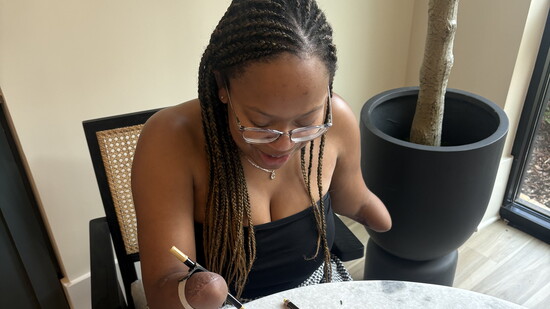
Imagine waking up from a routine surgery to find out your health took a major turn for the worse. This was the reality for twenty-four year old Celeste Bradley when she was rushed back to the hospital shortly after a deviated septum surgery only to be diagnosed with sepsis. Celeste fought for her life, and the cost was the unthinkable. She had her whole life ahead of her but would now have to face a reality with no hands or feet.
"I found out about my hands and feet about a month apart," Celeste recalls. "The hands came first. At the time I knew it was necessary because I couldn’t move my fingers. They were extremely cold," she continues. The memories of the nurses bringing heating pads to put on her hands are engrained in her mind, but more so the fact that nothing could touch the cold sensation. "I knew it was necessary. I was almost relieved," says Celeste. After surgery, she even managed to joke with her brother about potential Halloween costumes. Despite the enormity of what she was facing, she found a way to laugh.
The news about her feet was different. She had been reassured over and over that they could likely be revascularized, and she held onto that hope tightly. A woman of deep faith, she prayed relentlessly, leaned on her pastor’s visits, and believed wholeheartedly in the possibility of a miracle. “I’ve seen God work in the lives of my family and community,” she says. “I truly believed He could save my feet.” In the end, the miracle looked different than she had imagined. Her feet were not healing. Keeping them meant risking her life, and choosing survival meant losing all four limbs.
“Living without hands was one thing,” she admits. “But living without all of my limbs felt like a nightmare. In the beginning, I couldn’t see how I could ever be independent or happy again.” But even in that moment, one of the darkest of her life, she made a decision that would shape her healing. “I knew my attitude had to change,” she says. "I was devastated but determined to get back to the life that I was living before I got sick. I’ve continued to be hopeful, even on the hard days, that I will be able to do all of the things that I want to do, including living independently again." she explains.
The road from the hospital bed to rebuilding her daily life has been anything but linear. “Slow,” she says with a laugh. “Very, very slow. And I’m not a patient person.” Insurance approvals, outside funding, fabrication of prosthetics, learning to use her body in new ways...each step required weeks or months of waiting. But the journey also opened her eyes to an entirely new world.
“Before this, I didn’t know anything about prosthetics,” she says. “Now I’m amazed. It’s incredible what these devices can do.” She uses her prosthetic legs every day, while her upper-limb devices are still in development. As she waits, she leans on others for help, which has been a humbling, vulnerable experience that has taught her that strength isn’t only physical. “Strength is asking for help,” she says. “It’s grieving and still celebrating what you’ve gained. It’s moving forward even on the days that feel impossible.”
Celeste is honest about the emotional toll this has taken. “It’s impossible to avoid sadness,” she says. “Every day, I remember how easy life used to be.” To manage the mental hurdles, she builds structure into her days: prayer, meditation, staying busy, being intentional about redirecting negative thoughts. Her dad’s words echo in her mind: “An idle mind is the devil’s playground.”
Her favorite distraction and source of joy is her dog, Duke. She smiles, “Playing with him, training him, just being around him… it brings me so much happiness.” She also works closely with mental-health professionals, reminding herself that trauma changes the brain and that needing help is not weakness. “There is absolutely no shame in getting help,” she says. “We aren’t meant to do this alone.”
Small victories have become major milestones. Walking again. Laughing again. And even picking up new hobbies, like pickleball. Her brother had played for years, and she always intended to join him but could never fit it into her packed schedule. “I regret not playing with him before I got sick,” she says. “But now I’ve played several times, and it feels incredible. I was once worried I’d never walk again. Playing a sport feels like a gift.”
She’s also slowly returning to her favorite pre-illness passion: baking. Adaptive equipment has helped, but it’s still a work in progress. “I’m not fully independent with it yet,” she says. “But one day I will be. I believe that.”
If there’s one thing Celeste is adamant about, it’s that she hasn’t walked this road alone. Her support system has wrapped around her from the moment she fell ill: family, friends, coworkers, church members, hospital staff, therapists, parents of her former patients, and countless people from the community. “I am incredibly blessed,” she says. “Not everyone has what I have. My support system has carried me.”
At twenty-four years old, this is not the life that Celeste saw herself living, but after what she's been through, she remains grateful for another chance at life and the lessons she is learning from her new normal. This has been a process of waiting, and healing, and learning. But since her illness, she has discovered a strength she never knew she had. “I used to think strength was physical,” she says. “Now I know it’s a mindset. It’s choosing to keep going, even when it feels like you can't.”
The greatest lesson she wants to share with anyone facing unimaginable hardship? “Don’t compare your progress to anyone else’s. Everyone’s journey is different. The only comparison that matters is whether you’re doing better than you were yesterday, nd whether you’re doing your best. That’s what counts.”
@celestescourage