Think about everything in your home that runs on electricity, water, or gas today compared to when Highlands Ranch and Lone Tree were built. Now consider how much has changed in a century. From smart circuit panels and electric vehicle chargers to high-efficiency heat pumps, the modern Colorado home is more like a mini power grid than a simple shelter.
Navigating that technological leap over the last century is how Bell Plumbing, Heating, Cooling & Electrical built a 100-year history. How did this legacy business last for a century, while once-iconic brands like Blockbuster or Polaroid eventually withered?
According to Tom Teynor, Bell’s CEO and Highlands Ranch resident, a century of responding to consumer expectations, adapting from primitive mechanical systems to smart-home sanctuaries, has kept this Centennial state business thriving. "We've had such an opportunity over the years to adapt, flex and change, and respond to what our customers really want."
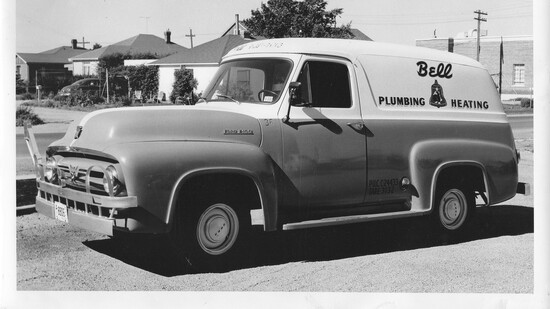
In the early 19th century, founder Denny A. Bell set out as a dryland farmer in eastern Colorado, but the Dust Bowl quickly proved that endeavor ill-timed. As a plumber's son, he returned to the trade he grew up around. Because his father, George, already operated a plumbing company under the family name, Denny launched his own one-person, one-truck operation in 1926 as University Park Plumbing & Heating Co.
Denny earned his Master Plumber designation in 1933 and assumed the Bell Plumbing and Heating name when his father retired. From the beginning, Denny sought a personal connection with each of his customers.
Imagine what a day in the life of a plumber looked like in the 1930s. After sitting at a kitchen table listening to homeowners' concerns, Denny would open his toolkit, heavy with 50 pounds of cast-iron wrenches, lead solder and a blowtorch. Typical work included fixing burst pipes, repairing coal-fired furnaces and installing galvanized steel pipe for a family’s first indoor bathroom. Without thermal imaging cameras to find leaks, he tested pressure by hand and relied on his senses to guide him.
As demand grew beyond single-truck repairs, he expanded the business into an incorporated residential contractor with a dedicated office and parts showroom. As Teynor notes, “Denny added a parts counter because he wanted one-on-one connections with people...so that customers could come to him to get advice.”
The post-war housing and remodeling boom, from the mid-1940s through the 1950s, ushered in the company’s second era as Denny was joined by his son, Douglas Bell. Together, they oversaw extensive suburban growth, expanding beyond basic utility work to include residential kitchen and bath remodels alongside custom cabinetry. At the same time, they transformed the company into a commercial enterprise capable of installing commercial-scale piping, central boiler systems, and municipal utility tie-ins.
In 1955, under Denny and Doug’s joint leadership, they built their landmark 235,000 sq. ft. headquarters on East Evans Avenue, complete with an expanded retail parts showroom and an on-site millwork shop. Bell grew into one of the largest contractors west of the Mississippi, dispatching 40 trucks daily and serving over 10,000 accounts.
Picture the daily operations. By 8 a.m., the retail parts counter was busy with the clatter of plumbing fixtures for handy homeowners from suburban neighborhoods. Behind the counter, staff members sketched pipe schematics to guide in-home fixes. In the dispatch room, operators directed service trucks toward the city's growing communities, servicing everything from plumbing leaks to civic construction projects like the USAFA, Bears Stadium, DU Ice Rink, and the 1956 J.C. Penney flagship downtown. Notably, Bell donated Denver’s first kitchen sink garbage disposal to the Governor’s Mansion to dispel fears that disposals would ruin municipal sewers.
By the 1970s, the mantle passed to the family’s third generation: Doug’s sons, Larry and Gary Bell. This era saw the massive build-out of South Metro Denver, including Highlands Ranch and Lone Tree. As rural areas south of County Line Road grew into master-planned communities, the company shifted away from commercial work to serving residential homes.
The showroom evolved as the suburbs expanded. Homeowners from South Metro Denver and northern Douglas County explored full-scale kitchen displays, designer fixtures, and custom cabinetry in a premium retail setting. By 2014, the company officially rebranded as Bell Home Solutions to reflect its growth from mechanical services into a full retail and residential design-build service.
During this time, home mechanics underwent other significant changes. Cast-iron stacks and galvanized lines gave way to flexible PEX tubing, high-efficiency heat pumps, and smart leak detectors.
Teynor notes, "Think about the advancements and the number of things that were not electrified 20 years ago. Original electrical panels cannot handle things like high-efficiency heat pump systems, rooftop solar integration, and indoor air filtration. And so, we have future-minded smart panels.”
In 2018, after nearly a century of family leadership, the third generation transitioned executive leadership and rebranded in 2019 as Bell Plumbing, Heating, Cooling & Electrical. With Teynor at the helm, the firm restored its iconic 1955 retro logo while modernizing its operations, reclaiming its roots in residential plumbing, HVAC, electrical, and sewer installations, closing its retail showroom, and moving all consultation services back into its customers’ homes, much like Denny did at the beginning.
"Bell grew up with Denver. As new neighborhoods were built across the city, we were right there helping put in the infrastructure,” Teynor says. “For a full century, our priority has remained exactly where it started: answering directly to our customers, not to private equity, investors, or a national franchise. That independence is something we hold with immense pride.”
Today, technicians employ a tablet, a serial-number scanner, and an infrared thermal camera alongside a traditional toolkit. Before touching a single fitting, they run digital tests to ensure accurate diagnostics and efficient service.
Looking ahead, the trade will continue to evolve rapidly. Modern residential infrastructure is moving toward integrated systems, incorporating bidirectional Vehicle-to-Home battery systems, digital load-management electrical panels, cold-climate heat pumps, among many other advancements. As a result, home maintenance is shifting from reactive emergency repairs to automated monitoring and preventive services.
Teynor carries forward the legacy of the Bell family into the 21st century: “Change has always been a part of Bell’s story. It’s about listening to our customers and adjusting to how modern homes actually work.”
While Denny Bell probably wouldn't recognize today's tools, the connections he built over kitchen tables and the parts counter remain the same. In Teynor’s words: "We're in business to solve problems for people." A hundred years after Denny loaded his first truck, that commitment keeps the business thriving across generations.
"Change has always been a part of Bell’s story. It’s about listening to our customers and adjusting to how modern homes actually work." Tom Teynor