his month, Scotch Plains–Fanwood joins communities across the United States in celebrating America’s 250th anniversary. Our towns hold some of the richest Revolutionary-era history in Union County — but how many of us truly know the stories behind it?
Personally, I didn’t fully appreciate our community’s role in securing America’s independence until my high school son came home from a volunteer event with the SPFHS History Club. Inspired by what he learned, I began exploring the remarkable history right here in our own backyard.
So, in honor of Revolution 250, I offer this abbreviated look at some of Scotch Plains–Fanwood’s historic highlights — and invite you to explore on your own from here.
Scotch Plains’ history dates back more than 300 years to its settlement in 1684. Long before European settlers arrived, the area was inhabited by the Raritan tribe of the Lenni Lenape. European exploration began with Giovanni da Verrazzano in 1524, followed by Dutch settlers in 1609. By the 1680s, Scottish immigrants led by George Scot established settlements here, giving rise to the name “Scot’s Plains.”
In those early years, Scot’s Plains was part of West Fields (later Westfield). In 1877, the community separated and became Fanwood Township. Then, in 1895, a one-mile section in the center incorporated separately as Fanwood Borough.
Scotch Plains also served as an important backdrop during the American Revolution — most notably during the Battle of Short Hills on June 26, 1777. Despite its name, the battle did not occur in present-day Short Hills, but was named for the area’s rolling terrain. General George Washington positioned his troops strategically in the Watchung Mountains, where they could monitor British troop movements. The battle ultimately contributed to the withdrawal of British forces, leaving New Jersey free of a major British occupying force for the first time since 1776.
Today, the Battle of Short Hills Monument stands at the entrance to Ash Brook Golf Course. Erected in 1977 by the Scotch Plains American Revolution Bicentennial Committee, the monument features a replica Revolutionary War cannon atop a stone tower.
Some of Our Most Notable Historic Sites
The Frazee House
Perhaps the town’s most famous historic landmark, this 18th-century farmhouse is closely tied to both the Revolutionary War and the Battle of Short Hills. According to local legend, Lord Charles Cornwallis and his men stopped at the Betsy Frazee House on Raritan Road after smelling freshly baked bread. When Betsy reportedly told Cornwallis, “I give you this bread in fear, not in love,” he left empty-handed.
The home nearly fell into ruin around 2000 before an extensive restoration effort led by the Fanwood-Scotch Plains Rotary Club and local preservation groups saved it. Today, it is listed on both the New Jersey and National Registers of Historic Places.
Osborn Cannonball House
Built in the early 1700s, this colonial home earned its nickname after being struck by a stray cannonball as Washington’s troops retreated from British forces following the Battle of Short Hills.
Today, the home operates as a museum managed by the Historical Society of Scotch Plains and Fanwood. It features period furnishings, colonial construction details, formal gardens, and rotating exhibits on local history. It is considered one of Union County’s best-preserved colonial homes.
Shady Rest Country Club
In 1921, Scotch Plains gained national recognition with the establishment of Shady Rest, believed to be the first Black-owned country club in the United States. Originally built as the Ephraim Tucker farmhouse in the 18th century, the property later became a nationally significant African American cultural and social center.
Shady Rest welcomed legendary performers including Count Basie, Duke Ellington, Ella Fitzgerald, Cab Calloway, and Sarah Vaughan. Today, the site is listed on the National Register of Historic Places.
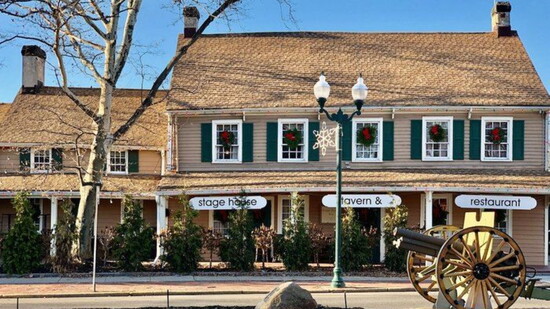
Stage House Tavern
Originally erected in 1737 by John Sutton as the Stage House Inn, this building later became both a tavern and the home of Captain Recompense Stanberry. It also served as a stop along the Swift and Sure Stage Line, which connected Philadelphia and New York.
When the stagecoach arrived carrying mail, a miniature cannon would be fired to alert townspeople to collect their letters. During the Revolutionary War, colonial leaders Lord Stirling and General Lafayette reportedly discussed battle plans here. Later, during the Civil War, the tavern became a rallying point for Union recruits.
At the time, travel was largely conducted on horseback along Native American trails, which eventually evolved into wagon roads traveled by stagecoaches and horse-drawn buggies. Those same routes became many of today’s major roadways, including Front Street, Park Avenue, Martine Avenue, Raritan Road, and Westfield Road.
Fanwood’s Railroad Roots
Fanwood was officially founded in 1895 around the Central Railroad of New Jersey, which passed through the area during the 1800s. The original train station, built in 1874, still stands today as the oldest surviving train station in Union County and remains the symbolic center of downtown Fanwood.
Now home to the Fanwood Museum and a gathering place for community groups, the station was built in Victorian Carpenter Gothic and Queen Anne style. With its steep gables, decorative trim, Gothic windows, and full-width porch, it remains a classic example of Victorian-era railroad suburb architecture. Preservation efforts funded by the State of New Jersey have helped maintain the historic structure.
It is widely believed that Fanwood was named after journalist Fanny Wood, who wrote glowing accounts of the area’s scenic beauty for leading New York publications, helping attract new residents and investors to the community.
Over 250 years later our Scotch Plains Fanwood community has grown to the vibrant, beautiful place we call home today.