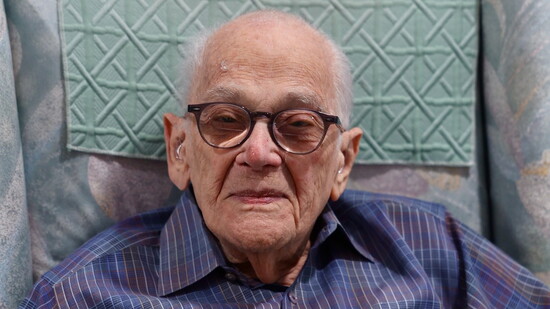
At 104 years old, Walter J. Levy has witnessed more than a century of change. But one friendship still holds a special place in his heart: his relationship with Thelma and Phil Vogel. As Vogel celebrates its 40th anniversary, Levy, an original board member of the Dallas Jewish Coalition for the Homeless, offers a rare firsthand look at the people behind what has become avital resource for Dallas children and families experiencing homelessness. "When Thelma called, you didn’t say no," Levy recalled with a smile.
Levy met the Vogels through the Jewish Federation, where the couple volunteered and where he served in executive leadership after a career in social work. When Levy's wife came home from surgery, Thelma and Phil arrived dressed as a waiter and waitress, bringing dinner and serving the family themselves. Their shared belief that communities must care for their most vulnerable members would lay the groundwork for Vogel.
Among Levy's most vivid memories is a bus trip Thelma organized to show community leaders conditions too often overlooked. "What we saw was not to the credit of this community," Levy recalled. He remembered children living in unhealthy conditions, widespread illness, and families in urgent need.
Working alongside Doris Budner and others, Thelma inspired a movement to help. In 1987, 23Jewish organizations came together to form the Dallas Jewish Coalition for the Homeless. Their first project, known as "The Alcove," began serving 10 children in an alcove at the downtown family shelter. Levy served on the coalition's board. After the coalition eventually disbanded, Vogel Alcove, Inc. was established with its own separate board. Vogel's leaders soon realized that serving children meant helping their families, too. "Their parents have problems, and they need help," Levy said.
That understanding drives Vogel's Bridge to Hope initiative today, which helps families build long-term stability through housing, childcare, mental health, financial literacy, and education. When President and CEO Karen Hughes described the program, Levy saw the organization's earliest principles at work. "What you say in itself is progress," he observed.
Levy's affection for the Vogels is unmistakable. He recalled the final dinner he and his wife shared with the couple shortly before the plane crash that took their lives. Asked what Thelma would think of Vogel today, Levy imagined her still involved, identifying needs and recruiting leaders. "She would see what the needs are," he said. He also credited Phil's financial expertise.
As Vogel marks its 40th anniversary alongside its 35th Annual Arts Performance Event, Levy remembers attending the very first one, which featured violinist Itzhak Perlman. Despite the progress, he knows the need remains. "The problem of homeless children has not evaporated," he said. The proof of Vogel's impact, he believes, is in the children themselves: "When you see a girl or a boy, how they came to Vogel, and what they are like a year later, it's an eye-opener.
"A father, grandfather, and great-grandfather, Levy still supports Vogel and encourages younger generations to find their own ways to serve. "I take great pleasure in seeing to it that this organization, which started with practically nothing, has flourished," he said. "And the flourishment is not over.
"Asked what he would tell Thelma and Phil today, he answered simply, "I would tell them that I love them, and that what was done in the creation of Vogel is something unique, and the progress that has been made in the 40 years is absolutely outstanding. "Learn more by visiting VogelAlcove.org
“When you see a girl or a boy, how they came to Vogel, and what they are like a year later, it’s an eye-opener.”
—Walter J. Levy