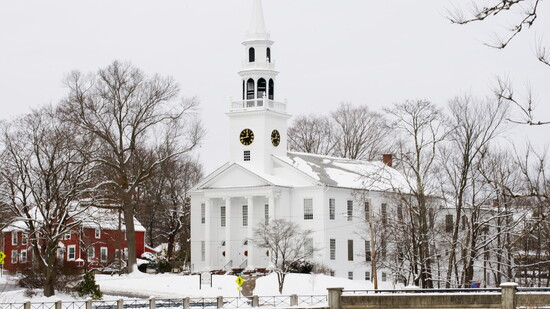
Standing proudly at the heart of Milford's historic downtown, the white steeple of First United Church of Christ Congregational has watched over the community for two centuries. The landmark building is a living chronicle of Milford's evolution, a structure that has adapted alongside the community it serves while maintaining its role as a gathering place for citizens in times of celebration, crisis, and everything in between.
The story begins in 1640, when the founders of Milford—having purchased land from the Wepawaug Native Americans—built their first meeting house roughly 100 feet from the current site. "The folks who started the church were the ones who settled Milford," explains Reverend Adam Eckhart, who has served the congregation for 24 years. That original structure was smaller, designed for a fledgling settlement that hadn't yet mastered winter heating. Congregants were content sitting close together, sharing warmth as they worshipped.
By the 1720s, the growing community needed more space. The second meeting house rose on the current location, lasting a full century despite its reputation for being somewhat precarious. "There are legends that when guest preachers would come and the wind started to blow, it would creak and shift," Eckhart shares. "They would leave as soon as the service was over because they were afraid it was going to fall on them." That building featured two balconies and stood even taller than today's sanctuary—an impressive if slightly terrifying feat of colonial engineering.
The structure's instability proved prophetic. The steeple fell once, was rebuilt, then succumbed to a major hurricane around 1817. Combined with the building's general rickety condition, this prompted the congregation to start fresh. Between 1823 and 1824, they constructed the current building.
A Space That Shaped Community Life
The first two meeting houses, pre-dating the separation of church and state in Connecticut, served as the literal center of municipal decision-making, where Milford residents gathered to debate and vote on town matters. Though the current building wasn't technically a meeting house in the governmental sense, it maintained the congregational tradition of serving as a community gathering place. Over the decades, it has hosted everything from Boy Scout courts of honor to mayoral debates. Until recently, the Plymouth Men's Club held candidate forums in the sanctuary – a small echo of the building's original civic purpose.
The structure has witnessed and marked significant moments in American history. In 1849, the church installed a clock in the steeple—not merely for timekeeping, but as a genuine community asset. "People were just starting to figure out how important it was to synchronize time because of trains," Eckhart notes. In an era before personal watches were common, that clock helped the neighborhood stay coordinated.
During the 1920s, the church added a gymnasium to serve Milford's young people. Central High School didn't yet have its own gym, so the church provided space for basketball and volleyball during New England's harsh winters. When the high school finally built its own gymnasium in 1948, the church converted the space to offices and a fellowship hall. "Part of what's amazing about churches is when we try to provide something that is an asset for not just the church itself, but for the community around it," Eckhart reflects.
Maintaining History in a Modern Age
Last summer, the church completed a major renovation of its most recognizable feature: the steeple. The project addressed damage that accumulates from a uniquely challenging combination—New England winters meeting salt air from Long Island Sound. "The southern side, which takes the salt air coming in, really does a number on wood," Eckhart explains. The congregation kicked off fundraising during their bicentennial celebration two years ago.
The work required careful balance. Milford's historic commission mandates using original materials wherever humanly possible, meaning wood must be replaced with wood despite its vulnerability to the elements. "We have to maintain a very old, very expensive historic building," Eckhart acknowledges. "But it's part of our responsibility and joy because it certainly makes people notice this church."
The renovation brought unexpected benefits beyond the restored appearance. A new digital system eliminated the need for someone to climb the steeple every five or six days to manually wind the clock. The bells can now be rung remotely via smartphone app—a technological upgrade Eckhart jokes about keeping away from his children.
A Living Building for a Living Community
Today, the building serves multiple purposes throughout each week. The sanctuary hosts Sunday services and welcomes various community groups including Boy Scout Troop One. The Plymouth building—constructed in 1951 with leftover bricks from the high school—houses a food pantry open every Tuesday, along with various 12-step recovery groups that meet throughout the week.
The basement, which overflowed with Sunday school children during the baby boom, still houses kids for their Sunday morning sessions, and now hosts a weekly grief support group, knitting circles, and coffee hour after services. In the parking lot, two sheds house the Medical Equipment Ministry, providing wheelchairs, walkers, and other essential items free to community members transitioning from convalescent homes.
Throughout its 202 years, this building has functioned as a gymnasium, a town hall, a community timekeeper, and a refuge. The numbered pews still bear marks from an earlier fundraising era when families rented their seats—a physical reminder baked into the architecture of how community institutions evolve.
"This is a central piece of Milford's history," Eckhart says simply. Walking through the space, you can trace American history through its features: the transition from tax-funded religion to voluntary giving, the baby boom's impact on Sunday school wings, the slow march toward modern conveniences like electricity and digital clocks. The building stands as evidence that the best architecture doesn't just house a community, but grows alongside it.
"We have to maintain a very old, very expensive historic building...but it's part of our responsibility and joy."
"Part of what's amazing about churches is when we try to provide something that is an asset for not just the church itself, but for the community around it."