By honoring the land, preserving family history, and building with intention, one Harrisonville home proves that progress doesn’t have to erase the past.
Some homes begin with a blueprint. Others begin with a memory.
For Sherri Moreland Peters, building a new home with builder, Michael Burns (Jameson Homes) on her family’s farm wasn’t about creating something flashy or trend-driven; it was about coming full circle. After her husband retired in 2021, the couple made the decision to return to Harrisonville, where Sherri’s roots run deep. What followed was a thoughtful, deeply personal journey that honored generations past while creating a lasting place for generations to come.
The land itself tells a story. In 2024, Sherri and her husband Jim purchased 20 acres of the farm where her grandparents once lived between 1936 and 1944. It was here that Sherri’s father spent his childhood years, growing up in a modest farmhouse surrounded by barns that still stand today. Though the home had never been owned by the family, her grandparents were renters during the Depression, and it remained an important chapter in their story.
“It felt like a full-circle moment,” Sherri says. “This was the site of my father’s childhood home. Building our last house here just felt right.”
Rather than removing the original farmhouse to make way for new construction, the family chose preservation. The century-old home was carefully lifted and moved down the road to Red Barn Ranch. The decision ensured the house would remain part of the family legacy—just with a new purpose.
Watching the home move was unforgettable.
“It sat in the backyard of the new house for nine months,” Sherri recalls. “When it finally went down the road, it was a big day.” Coordinating the move required multiple utility companies and a team of specialists, but it also brought together family and neighbors to witness a rare moment in time. Sherri made sure her great-nieces and nephews understood the significance. “I wanted them to know this was history, and that someday, they’ll be the ones telling the story of how Grandpa Charles’ house moved down the road.”
Today, the farmhouse rests on its new foundation at Red Barn Ranch, awaiting renovation. Once complete, it will become part of the pumpkin patch experience, an extension of the land’s legacy of family and farming.
While the old house moved on, the new one took shape with equal intention just a few miles down the road.
Sherri wanted a modern home that respected its rural surroundings without leaning heavily into farmhouse clichés. Instead, the design strikes a classic balance, one that feels grounded, functional, and timeless. Exterior colors were carefully chosen to complement the surrounding barns and landscape, and the home was positioned to preserve as many mature trees as possible, including a massive maple that stood on the property when Sherri’s grandparents lived there.
Inside, the most meaningful design elements come from a single tree.
A hundred-plus-year-old American Elm once stood in the front yard of Sherri’s childhood home. The tree with the tire swing, the climbing branches, and the shade where homemade ice cream was enjoyed on summer days. When the elm had to be cut down six years ago, the family salvaged the wood, having it milled into mantles and tabletops so each sibling could keep a piece of it.
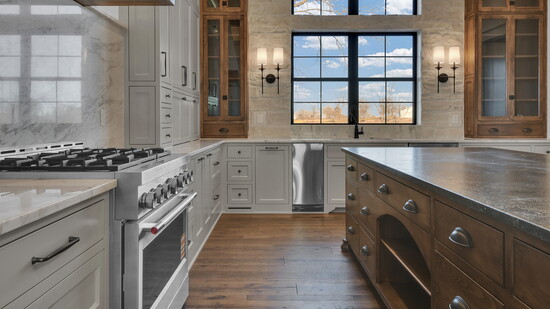
“That mantle was the very first element we had for the new house,” Sherri says. Today, it anchors the home in the living room, along with a custom hood in the kitchen crafted from the same wood. Wormholes and imperfections remain proudly visible, a non-negotiable detail for Sherri. “The character makes it even more special.”
The elm’s story continues in smaller ways, too. Charcuterie boards made from the same tree were gifted to family members, each one a tangible reminder of summers spent playing outside at Grandma Marilyn’s house, a tradition that spanned generations, centered around the pool and the farmyard rather than vacations away.
While the old farmhouse represented a simpler time with only four rooms and no indoor plumbing, the new home reflects a different season of life. Designed with “age-in-place” features, the layout prioritizes comfort, longevity, and real farm functionality. A dedicated mudroom and bathroom allow Sherri’s husband to come straight in from the fields without tracking dirt through the house, while thoughtful adjacencies make daily routines seamless.
“It was a privilege to help create their new family home, honoring the history and planning for the future,” says designer Brooke Cover. “Working alongside Sherri and Jim and listening to the stories woven through their family history often felt like paging through a cherished photo album. The memories came vividly to life.”
Surrounding the home, the family has continued restoring the historic barns, preserving their presence and purpose. The old milk barn now serves as Sherri’s workshop for furniture projects, further blending past and present.
Living next to Red Barn Ranch brings daily joy. Sherri often sees preschoolers caring for animals and exploring the outdoors, greeting her with waves and smiles. “They call us Aunt Sherri and Uncle Jim,” she says. “It’s incredibly heartwarming.”
Though their children are grown and live out of state, the home represents permanence, something Sherri long hoped to give them after years of corporate relocations.
“This is our last house,” she says. “This is where we’ll make memories with our kids and grandkids. No matter where life takes them, we want them to feel connected to this land.”
In the end, the story of this home isn’t about what was built—it’s about what was kept. Memory. Legacy. And the quiet understanding that honoring the past can be the strongest foundation of all.
This was the site of my father’s childhood home. Building our last house here just felt right.”