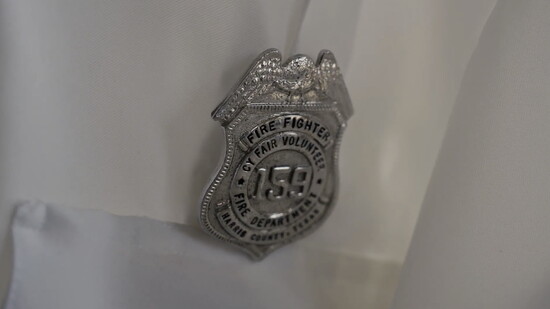
For Alan Miller, the Cy-Fair Fire Department has always been part of his story. He just never imagined that decades after serving his community as one of the department’s early EMTs, the department would be called upon to save his life.
On March 25, 2025, Miller’s morning began like any other. He took his granddaughter to an allergist appointment, returned home and mowed the yard. Afterward, something didn’t feel right. He called his wife, took a shower and briefly spoke with a neighbor. Then his condition quickly worsened.
What happened next is largely missing from Miller’s memory. Somehow, instinct—or perhaps training that had been ingrained decades earlier—took over. He put his dog safely in the bedroom, unlocked the front door and called 911. “I think I’m having a heart attack. I’m getting dizzy,” Miller told the dispatcher.
Those actions proved critical.
Cy-Fair Fire Department EMS arrived as Miller went into cardiac arrest. The crew immediately began CPR and lifesaving treatment, giving him a chance to make it to the hospital and allowing his medical team to continue the fight.
The odds were daunting. Miller later learned he had roughly a 12 percent chance of survival and an even smaller chance of avoiding serious neurological or kidney complications. Yet he survived—and returned home to the family that means everything to him.
For Miller, the people wearing Cy-Fair uniforms that day represented more than an emergency response team. They represented a department he knew firsthand.
From 1978 to 1987, Miller served with the Cy-Fair Fire Department and was a member of its first EMT class. At a time when the department and emergency medical services looked very different than they do today, he was among those who answered calls and helped care for neighbors in their most vulnerable moments.
More than three decades later, the roles were unexpectedly reversed.
That history made Miller’s eventual reunion with the Cy-Fair paramedics who helped save him especially meaningful.
“Cardiac arrest survivor reunions are rare. Survivors who leave the hospital neurologically intact are rarer still,” says Justin Reed, Assistant Chief of EMS for the Cy-Fair Fire Department. For Miller, his family, the first responders and his medical team, the opportunity to come together was one worth celebrating.
The reunion also gave Miller the opportunity to tell the first responders what their actions truly meant to him.
“It wasn’t just me that y’all saved, it was my whole entire family,” Miller said.
His words captured the reach of a single emergency response. Miller was able to return home not only as a survivor, but as a husband, father, grandfather and an important part of the lives of the people who love him.
His grandchildren perhaps expressed it most simply. One grandson created a drawing for the responders with a message that needed no further explanation: “Thank you for saving my Papa.”
Miller’s survival is also a powerful reminder of the chain of people behind a successful emergency response—from the family member who recognizes something is wrong and the dispatcher on the other end of a 911 call to the EMTs and paramedics providing immediate care and the hospital team waiting to take over.
In Miller’s case, timing mattered tremendously. His medical team credited Cy-Fair EMS with arriving at precisely the critical moment and immediately beginning CPR and lifesaving therapies that helped make his recovery possible.
For Miller, the experience has brought his connection to the Cy-Fair Fire Department full circle. Nearly 50 years after he first trained to help others as a member of the department’s first EMT class, another generation of Cy-Fair first responders was there when he needed them most.
It’s a connection that now spans generations—from Miller’s early years of service to the team that helped give him more years with his family. And for Miller, it’s a reminder of just how much the work of first responders can mean to the people and families on the other end of the call.