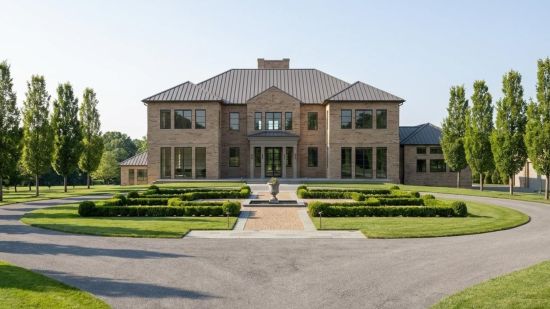
Most houses are expected to stay put. Homeowners tend to insist on it.
Yet while designing a residence on a bluff overlooking the Hudson River, I have found myself thinking about ships.
A ship needs a port—a place to rest, replenish and prepare for another voyage. A house offers its own kind of anchorage. What interests me here is the possibility of being firmly at home while contemplating the adventure of setting out.
It is, in a sense, a vessel that never leaves port.
Approaching from the land, the house presents a composed, traditional face. Masonry walls, familiar proportions and a formal entrance suggest permanence. It appears perfectly content with its place in the world.
But the house has a secret, and I see no reason to reveal it from the driveway.
Architecture, like good theater, should know when to make an entrance.
Arrival begins through a relatively compressed vestibule, leading into a tall foyer organized around a stair. There is a sense of space opening, but the house has not yet shown its hand.
Passing through an opening in a massive wall, the room beyond expands both vertically and horizontally, taking on the scale of the landscape. An immense expanse of glass opens the interior toward a view extending for miles.
And suddenly, there is the Hudson River.
The great room and imagined river outlook. Interior concept.
It is a theatrical moment, although I would hope nobody feels obliged to applaud.
The sequence gives arrival a human rhythm: enclosure, anticipation, discovery. There is somewhere to pause, put down the burdens of the day, and then look up.
That great wall of glass interests me particularly. I think of it less as a window than as the wide aperture of a camera lens.
A picture window presents a view. A lens invites us to explore one.
Move through the room and the composition changes. The river unfolds toward the north, then the south. A boat enters the picture, the opposite shoreline shifts in perspective, an unexpected reflection catches the eye.
Architecture can be remarkably effective at teaching us how to look.
The Hudson is an accommodating subject, although not always a cooperative one. Across that broad reach of water, wind and weather arrive with few introductions.
Here in the Hudson Valley, the relationship evolves through four seasons. Spring rain, summer sun, autumn winds and winter snow ask different things of a waterfront house—and offer different pleasures to those within it.
Beneath its familiar architectural dress, the residence must perform with considerable technical sophistication. Structure, glazing, insulation and carefully resolved connections work quietly together to provide shelter. Like a ship, the house depends upon technology that its passengers need not spend much time thinking about.
That protection makes an intimate encounter with nature possible. From a comfortable chair, a winter storm becomes something to watch with fascination. One can appreciate the river’s more powerful moods without having to dress for them.
Ground-floor presentation study. Arrival below; river-facing terrace above.
But what sort of life might such a house encourage?
Consider a quiet afternoon with a book, interrupted by a passing boat. A family gathering that drifts toward the windows as the evening light changes. Or a child watching the river and wondering where it leads.
Ordinary moments, certainly. Architecture doesn’t invent them. But it can encourage them, lending unexpected richness to everyday life.
A generous gathering room needs the companionship of quieter places. A terrace extends life outdoors when the weather invites it; a sheltered interior makes staying in equally appealing. The house accommodates company and solitude, changing seasons and changing moods.
Our aspirations, after all, are more complicated than our room lists.
We want to belong somewhere without feeling confined by it. We seek familiarity, but also discovery. We want the comfort of knowing where we are and, occasionally, the excitement of imagining where we might go.
The house, terrace and river. Conceptual visualization.
This residence remains an architectural study. Its eventual inhabitants will bring their own histories, preferences and hopes to it. For now, it explores desires that many of us recognize.
This is part of what I mean by Architecture of Identity.
Identity includes who we hope to become and the life we wish to create around us. Nor does it prescribe an architectural style. The house’s traditional landward face and open river-facing character serve different, compatible desires: reassurance and possibility.
A well-made home, like a well-tailored suit, should provide both composure and freedom.
Which brings me back to the ship.
A vessel at anchor is not necessarily at the end of its journey. It has simply found somewhere worth staying. The river below, meanwhile, continues toward the Atlantic and the larger world beyond.
The house remains firmly on its bluff, an anchor to the familiar world and a gateway to the imagination.
The imagination, fortunately, has no such obligation.
Harris Le Roy Architecture PC | HarrisLeRoyArchitecture.com