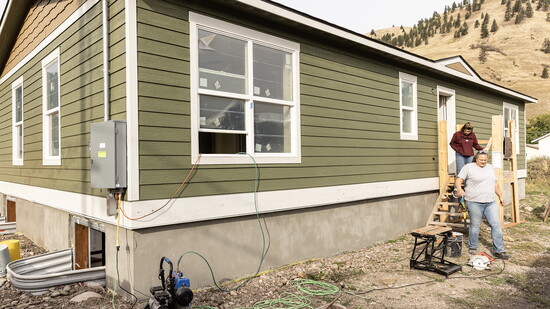
The word “home” is many-layered and deep in its connotations; “home” doesn’t necessarily mean “a house.” But it’s also hard to imagine feeling at home, or feeling grounded and centered, if you don’t have a secure roof over your head.
Habitat for Humanity began humbly in the late 1960s by husband-and-wife duo Linda and Miller Fuller, on a communal farm in Georgia (USA), to address this very issue. Through the 70s they expanded to Africa, and officially established Habitat for Humanity International in 1976.
Needless to say, they’ve had a massive footprint, impacting untold numbers of families worldwide who have needed a place to call home.
Closer to Missoula, we’ve all heard the news stories (even as recently as September 3, 2026, in the New York Times) about the crisis of affordability and availability of housing in Montana. And we feel it acutely here in the Missoula Valley, one of countless desirable locales in the Treasure State to see booming real estate prices in the past half-decade.
Where does that leave your average Missoulian with a family, and with fewer and fewer options for housing?
“I don't know that it's necessarily a ‘solve,’ but for all of their existence one of Habitat's missions is that everybody deserves a place to call home,” says Karla Nichwander, native Missoulian, local real estate agent, and Habitat for Humanity of Missoula board director since January 2026.
“And that home can vary in degrees,” she continues. “It doesn't necessarily have to be this extravagant mansion or this little shack, but it's a place that you have security, and you have hope, and you have a future. And stability—that’s what I think that Habitat really wants to provide. It may just be that one family, but that one family, we believe, has kind of a ripple effect.”
Habitat for Humanity of Missoula, much like the organization around the world and across time, are not simply providing housing free-and-clear of obligation or effort. It’s a collaboration, Karla says, a group effort, that involves Habitat, the prospective homeowners, and a host of volunteers.
“It's kind of a community uplift, or hand-up, and less of a handout, less of a subsidizing, less of a doing,” she says. “The community wants you to be a part of it. So, let's build it together. Our families are asked to contribute labor hours, ‘sweat equity.’ And there are so many volunteers that help us out.”
“I've got a fellow board member who calls it a ‘barn raising,’ she continues, “where the entire community comes together to lift up this individual family, a lot of everybody pitching in to lift them up, which is really a warm feeling. And we call it a mission. I think it's very much our North Star—that sometimes just helping each other out a little bit does good for all of our souls, right?”
There’s another ingredient here—along with the multitude of community members and Habitat for Humanity employees and board members who come together for these barn raisings—that makes Habitat’s mission possible.
In addition to the ever-increasing cost of housing is the upstream costs of building materials and land to build on. And this is where Habitat for Humanity’s donors enter the picture. Their generosity is as integral to this work as the hands that carry the boards or nail the shingles.
“One of the biggest struggles I think that we're hitting right now is just the price of land, which is the same as anybody else that’s going to build a house,” Karla says. “So we look to a lot of our donors, our sponsors, our legacy people. There's just some people that just have had little plots of land here and there, and they’ll deed it over to Habitat for Humanity, so then we can keep going with it, which is really wonderful.”
“Pay it forward” seems to be a guiding principle for all of what surrounds Habitat for Humanity. It probably helps the organization succeed in such a community-centric place as Missoula, where folks seem to look out for each other like it’s a reflex. If one neighbor has plenty, they will often share what they have, and, like Karla says above, it can create a ripple effect.
“One of our core elements is we have the Habitat ReStore that's out in East Missoula. It’s similar to here in town, where we have Home Resource,” Karla says. “It's a similar thing. You can donate excess material, products that you don't need anymore, and we sell that. That money then funnels back into the organization, so that helps build tomorrow’s house.”
“A lot of times the materials themselves will go to tomorrow's house,” she says. “Say I'm a builder in town, and I have extra roofing shingles. I can donate them, and they're going to then go onto another house for us.”
Habitat for Humanity of Missoula is also paying it forward in their approach to building, in which they focus on sustainable models for their new-home builds, such as using reused materials, or durable materials that require little maintenance across their lifespan and thus reduce disposability and the need for replacement, and incorporating green elements like solar panels.
Karla talks about Habitat’s current project in the center of Missoula Valley and the confluence of some of the aforementioned graces at work.
“We are just in the process of completing a build over off of Burlington Avenue, kind of in the middle of Missoula,” she says, “and we are in partnership with Front Step, which is a land trust. That whole lot was donated from a family. There's a teeny, tiny little house on the front of it that was renovated and cleaned up; the back half of the lot, we have built a triplex, or three-unit town home.”
“All of that production in there has been energy efficient; you’re looking at materials that basically require no maintenance, theoretically, for the rest of their lives. There are solar panels on it that we have worked with NorthWestern Energy to acquire as a donation. You basically have the ability for the families to have minimal costs and very minimal maintenance.”
“We like that model, the three townhomes, because for Missoula—and I would say almost the whole county—we have barriers. We have rivers and mountains, and we can only go so wide and so far. We know that infill is going to be a good way for us to build more. And I think as people's wants and needs change, maybe you don't need a 2,000-square-foot house, you know? So how do you accommodate the need for more housing, whether it's growing up or growing wide or whatever it is. ”
“One of the biggest struggles I think that we're hitting right now is just the price of land...so we look to a lot of our donors, our sponsors, our legacy people." - Karla Nichwander
Habitat for Humanity of Missoula survives on grants, sponsorships, and donors. While scheduled fundraisers throughout the year raise funds to help accrue the money it takes to buy and build, it is still an uphill battle with land being scarce and expensive. Any given house for a family will cost $275-300,000 so the need for funding is at an all-time high. HabitatMissoula.org.