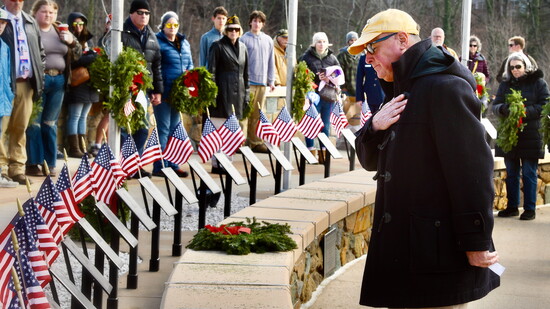
As the Vietnam War brought loss to the Charlottesville area, locals took up the cause of honoring those who served with the Dogwood Vietnam Memorial, which still stands today. Jim Carpenter, a 20-year veteran of the U.S. Army Reserve, Charlottesville native, and board member of the Dogwood Vietnam Memorial Foundation, shares the history of this enduring tribute, the first of its kind in the United States.
In November 1965, the Vietnam War reached close to home when Earlysville’s SPC Champ Lawson became the area’s first casualty. Lawson lost his life in a helicopter crash in Southeast Asia on November 4.
The idea of honoring Lawson emerged during a conversation among three local veterans, Ken Staples, Bill Gentry, and Jim Shisler, at a barbershop. All three were members of the Dogwood Festival, and they presented the proposal at the next board meeting, where it was approved. Shisler then brought the idea to City Manager Jim Bowen, who supported it provided the memorial occupied a highly visible location and required no city funding.
Before the project was finished, Charlottesville recorded another casualty, PFC Grandville Jones Jr., a Lane High School graduate and University of Virginia alumnus.
In early January 1966, the project was completed. It was then formally dedicated during the annual Dogwood Festival on April 20. SGT Barry Sadler, a Green Beret known for “The Ballad of the Green Berets,” was a special guest.
As opposition to the war grew across the country, including demonstrations at the University of Virginia, local losses continued. For many who returned from Vietnam, there was no formal welcome home. In a divided nation, some encountered hostility or silence rather than gratitude, while many returned with physical and emotional wounds or later experienced the effects of Agent Orange.
Over time, public understanding changed, and the Dogwood Vietnam Memorial became a place where veterans could gather, remember, and share experiences once difficult to discuss. Some Vietnam veterans who visit have called it the “hill that heals.”
The site continues to prompt quieter moments of remembrance. It has also served as a place for younger generations to learn. For several consecutive years, Charlottesville High School students who had read Tim O’Brien’s “The Things They Carried” walked to the site to meet Vietnam veterans, hear their experiences, and ask questions about the war.
In 2015, the memorial was redesigned during construction of the John Warner Parkway. Much of the original material was incorporated, including cobblestones, the American flagpole, and the engraved granite stone bearing the names of local service members who were lost in the war in Vietnam. Its new level concrete base also improved accessibility. A year later, stainless-steel plaques featuring photographs and brief accounts of the fallen were added.
The memorial is as meaningful to family members as it is to veterans. At the 50th rededication, one of the first plaques unveiled honored SPC Richard Carter, who lost his life in Vietnam in 1970. His mother, Beulah, attended despite having pneumonia but had to leave early. She returned weeks later, raised her hand to her lips, and touched it to the steel.
The memorial continued to grow in 2025 with a new plaza honoring 26 University of Virginia students lost in Vietnam. The approximately $240,000 addition was completed debt-free through private donations and a Foundation brick campaign honoring U.S. veterans.
Today, the memorial honors 56 young men who gave their lives in service to their country. It is the oldest civic memorial in the country dedicated to all who served in Vietnam, predating the Vietnam Veterans Memorial in Washington, D.C., by approximately 16 years.
Six decades after Staples, Gentry, and Shisler first envisioned a local place of remembrance, the DVM Foundation continues its work. Shisler guided the memorial from its creation until his death in 2022, and veteran Bruce Eades now serves as Foundation president.
Plans are also being developed to improve access for visitors with mobility challenges, including parking and a pedestrian bridge connecting the eastern side of John Warner Parkway with McIntire Park. Supported throughout its history by the community it serves, the memorial continues to provide a place to remember those who did not return home, recognize those who served, and preserve their stories for generations to come.