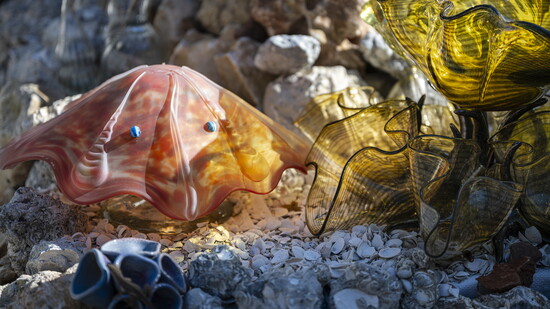
Alan Keck, master potter and ceramics teacher at the Venice Art Center, has conjured up a fantastical underwater scene from millions of years ago with blown glass, clay, porcelain, shells, fossilized rocks from the cretaceous period, and more. A variety of vivid creatures and delicate details bring the reef to life. Blue and teal tube worms with flowing tentacles emerge from the ocean floor; yellow, green, and amber-tinted clams sporting rattlesnake tails mingle with sprawling octopi; and a sleek, mottled orange stingray rests among the rocks. Alan named his creation From an Ancient Seabed, after the tallest portion of the installation from which a burgundy clam emerges, surrounded by colorful barnacles and twisted seagrass. This area also contains the earliest pieces Alan crafted in 1992 in Emporia, Kansas where he taught ceramics and glassblowing at the local high school.
Already a master potter, Alan was hired in 1988 to teach 100 ceramics students. He also, however, was tasked with teaching 15-20 glassblowing students. Emporia High School had one of the earliest in-house glassblowing facilities in the nation as of the early 1970s, and Alan would be the first educator to make use of it. There was just one problem: he had never blown glass.
“I wanted to be the best teacher I could be,” said Alan, so he invested his free time in learning the intricacies of glassblowing from the ground up. Each evening, Alan would visit longtime friend Hal Berger of Dodge City, Kansas, who had become a professional glassblower, to observe his process. “I’d sit down and watch him from the very first steps,” Alan explained. From there, he would go to the high school at night and practice what he’d learned before teaching it to his students the following day. “Every day I’d go back and watch him do the next little step, and it took me a long time to get good at it,” Alan said.
In the end, the long nights of study and practice paid off. Many of Alan’s students went on to become professional glassblowers themselves as a direct result of his commitment. In 2010, a group of Alan’s former students joined him in building a chandelier as a gift to the school. Inspired by the complex glass-blown chandeliers of artist Dale Chihuly, the project became so extensive that the high school presented the group with their own room to finish the fixture in its final year of construction. After five years of hard work, the 10-foot, ornate crystal chandelier was hung in the school’s library for all to admire.
“Art in all levels of school is so important,” said Alan, who discovered his passion for ceramics when he himself was a high school student. Although he experienced success and recognition as a star athlete, nothing compared to the sense of accomplishment his artwork provided. “The Scholastic Art and Writing Awards was instrumental in my life,” he remembered, “when I was a junior, I won the first national Gold Key for ceramics that anyone in Kansas had ever won.” He had previously won regional awards and would go on to win another Gold Key in his senior year, and Alan credits the program with leading him on his “artistic journey.”
Even as a child, Alan was mesmerized by The Undersea World of Jacques Cousteau and Walt Disney’s Wonderful World of Color. Far from the ocean in Dodge City, Kansas and new to the experience of color television, he spent his Sunday nights in the 1960s immersed in new worlds filled with strange, beautiful ocean creatures and vivid, imaginative characters. “I was influenced by these two geniuses,” said Alan of Jacques Cousteau and Walt Disney. The combination of ocean life and fantasy would inspire many of his later creations, including From an Ancient Seabed. Alan’s lifetime pursuit of ceramics and glassblowing has allowed him to construct a scene that evokes in others the same sense of wonder he felt gazing into the depths of the sea and watching fantasies unfold in radiant color.
The installation was first built at the Emporia Arts Center in 2004; around the time Alan received his initial lung cancer diagnosis. “There’s nothing that’ll light a fire under you and motivate you to try to finish things up like some doctor telling you you’ve got lung cancer,” remembered Alan, “something like that has a big influence on your life.” Alan continued teaching and making art until he retired in 2014. Shortly thereafter, he moved to Florida to be near his daughter and son-in-law. Having put all his creative energy into teaching, Alan then took a three-year break from art. Another diagnosis, however, led him to start creating again. “I’d gone 13 years with no cancer and then it came back on me, and that really inspired me to get busy again,” Alan said. He considers the years that have followed to be the most productive time of his life.
In December 2025, more than 20 years after it was built for the first time, Alan reassembled From an Ancient Seabed. He is immensely grateful to the Venice Art Center and its CEO Mary Moscatelli for allowing him to teach and construct his installation again, which is meant to be seen and enjoyed by the public.
“I really want it to be public art, that was my intent,” said Alan of his creation, “intent is important when you’re an artist.” Alan noted that photography is one means of allowing more people to see a work of art “than can ever see it in real life.” He wants his work to be experienced, felt, and shared both in print and in person.
Alan hopes From an Ancient Seabed will find a permanent home in a communal setting such as an aquarium or hospital where many people can enjoy the peace, tranquility, and contemplation it encourages. He finds that allowing the mind to embrace fantasy is one of the best investments one can make with their time. “Let your mind wander, it’s beneficial,” said Alan, “I think if everybody would take ten minutes every morning when they got up and just … daydream, dream, that they would spend a much more productive day.” “Dream,” he says, “it’s so worth it.”
no sidebar