Twelve years ago, David Linares and Elizabeth Reviriego met in London. They were Spaniards working in other people's restaurants, far from home. They opened a place in Madrid. Then they came to California and built their own on Ramona Street.
David and Elizabeth had worked in hospitality since they were teenagers. He started at sixteen. She left home at nineteen. Both had spent their careers in Spanish restaurants in cities that were not Spain. London was where their lives crossed, both of them on the same side of the kitchen, both far from home.
They went back to Spain together. They opened a restaurant in Madrid, the first they owned. Before opening it they had also run a marketing company in Spain, but restaurants were where their hands had always gone, and where they returned. They began planning a second location. Before they could open it, an opportunity arrived to move to the United States, and the decision in front of them was whether they wanted to start a family before the next adventure, or after. They wanted to do one more thing before family. They sold what they owned in Spain, packed two lives into a flight to California, and started over.
That was seven years ago. For most of those years they lived on the peninsula and learned the Bay Area room by room. Good food was easy to find. The room they wanted to eat in was harder. Not a destination restaurant. Not a chef's table. A neighborhood Spanish dining room where the menu does not change much, where the meal slows down on purpose, and where the food gets better as the hours go on.
They began looking for the right space. They needed about 4,500 square feet, in a part of the peninsula where people would come for dinner. There were not many options. When the former Bird Dog space on Ramona Street became available, they recognized it. Another Spanish place a few blocks over, La Joya, had recently closed. Downtown Palo Alto was ready for a Spanish room and not getting one.
Macarena opened in March, named after the elegant Spanish grandmother who would sit at the head of a long family table and gather everyone around her. The restaurant David and Elizabeth had been carrying in their heads for years was finally a room with a door.
David is direct about why Palo Alto. The community here is well informed about Spanish food. There is a love for the cuisine in this part of the country that is harder to find in places where Spanish food is rarer. When customers walk in, they walk in already appreciative. They come back. They become regulars, and then they become friends.
For a Spaniard living abroad, Elizabeth says, that is the unexpected gift. Macarena is open every day, and every day the people walking through the door love the country David and Elizabeth come from. She calls it a dream come true.
The kitchen reads the same way. Macarena has four founders, not two. David and Elizabeth's chef co-founders are Toni Santanach and Sergio Box, longtime friends who had each owned a restaurant in Spain. Toni came out of the Hofmann School in Barcelona, the culinary institute whose own restaurant earned a Michelin star. Sergio came from Valencia, the region paella was born in. The four built the concept together. The four cook the dishes they grew up eating.
Macarena is not reinventing Spanish food. Macarena is serving it. The menu is the food the four founders ate at home, the dishes their families have been cooking the same way for as long as anyone can remember, authentic and recognizable to anyone who has eaten in Spain. David puts it as a matter of history. You can keep combining new ingredients, he says, but the flavor you are looking for is the one your kitchen has been cooking for a hundred years.
Three plates make the case for the kitchen. Cochinillo, a suckling pig roasted seven hours until the skin breaks under a spoon. Fideuà, a paella built on thin pasta instead of rice, a Mediterranean-coast dish you almost never see on a US menu. Canelones, Catalan pasta cylinders filled with oxtail and béchamel, a dish that is Spanish despite its Italian-sounding name. The octopus, the jamón, the beef, and the rice are imported from Spain. David and Elizabeth bring the ingredient list home with them every time they go.
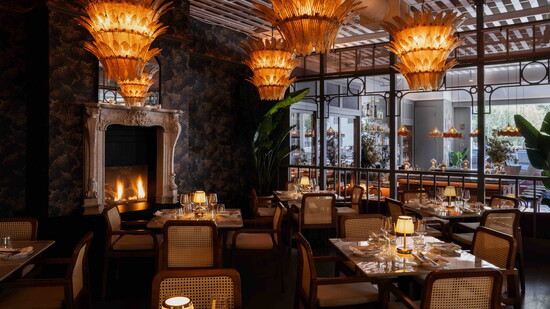
The room is the work of Alexa Nasifi of Adean Studios, who took the founders' idea for the room and built it as a physical space. She closed the floor plan down from the open layout Bird Dog had run before. The new plan creates warmth and a sense of discovery rather than the wide sightlines of an American restaurant. The bones of the redesign are wood partitions in the shape of the patio andaluz, the inner courtyard of an Andalusian house, a shape Spaniards grow up walking through and Americans rarely encounter.
The partitions divide the restaurant into three rooms. The main dining room is moody, elegant, and timeless. Behind the wood partitions sits El Salón de Macarena, a private room with a fireplace, a long farm-style table, chandeliers low over the wood, and vintage-patterned wallpaper. At the other end is the Lounge, which takes its cues from Madrid and reads more modern: red banquettes, pop art colors, and black and white photography. Outside, on a patio nicknamed "the train" for its narrow shape, the doors open onto Ramona Street.
Roman shades on the wood partitions can be raised or lowered, so the private room becomes part of the main room when the night calls for it. The restaurant changes shape with the size of the party, which is how rooms work in Spain.
In 2026, the LIV Hospitality Awards in Zurich named Macarena their winner in the casual restaurant architectural design category. David says they were shocked. The recognition arrived from a country none of the founders was born in, for a restaurant in a town none of them grew up in, on the second venture of a hospitality life that started for David and Elizabeth as teenagers.
What the award noticed is what a Saturday-night reservation will notice. A room that did not exist anywhere in downtown Palo Alto before the four founders opened it. A room they spent years planning, then built.
David and Elizabeth came to California seven years ago to do one more thing before family. Macarena is what they did. Toni and Sergio joined them in California for it.
"It was a restaurant that was being built for many years in our heads, until we finally made it happen."
— David Linares
"Gastronomy is our way of speaking. This is the way we communicate with the community."
— Elizabeth Reviriego