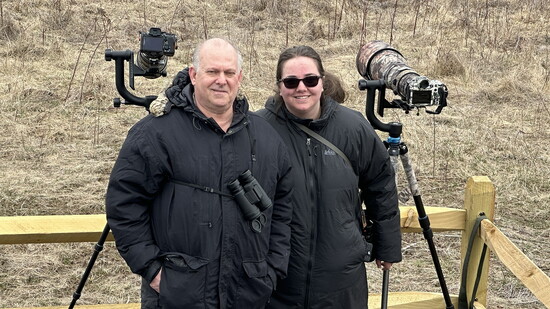
Spending a frigid winter day in the woods with your dad, hoping to encounter a bear, might not seem like a typical weekend activity for someone, but for Julianne Livni, there’s nowhere she’d rather be.
Julianne and her father, Michael, are a team of wildlife photographers who are investing their passion to help spread awareness about the beauty - and fragility - of our natural neighbors.
“People care the most about what they know,” Julianne shares. “I think it is extremely important to share these photographs so people understand why we must preserve land and not damage the environment. If people become passionate about the animals based on seeing photographs of them, they will protect them.”
Hopefully, it might even inspire some to invest more time and resources to care for the natural world around them.
“One huge way people can help is to stop using rat poison, and education about these poisons is extremely important. Rat poisons not only kill the rat, but also anything that will eat the free meal that comes from a rat dying. Foxes, birds of prey, and owls often become victims of rat poison. Live traps, spring traps, etc., are more humane options. When we have more wildlife reproduction success, those animals will take care of the rats for us. One owl can eat 1,000 to 3,000 rodents a year, which is a lot more than one box of rat poison would ever do.”
Their efforts are also shared with the scientific community. “I monitor an eagle nest with the volunteer program we have in NJ, where people volunteer to report their findings, and that data is used to give to the NJ Fish and Wildlife Department for how well the eagles are doing each year. This gives them information they can use to see if certain areas need more protection for the eagles to investigate why some eagles’ nests could fail.”
So if you see an eagle soaring above your NJ home, there’s a good chance that it’s been on the Livni’s radar.
Their daily jobs couldn’t be further afield from this calling that they share - Julianne’s a paralegal, Michael is in cybersecurity - yet they approach it with the fervor that belies the appearance that they’re not professionally-honed naturalists.
“The first thing I do when I am interested in photographing a subject is finding out everything I can about their behavior,” Julianne explains. “What time of day are they most active? What is their diet like? Once you can find out what their food and type of territory they like is, you can look for likely places they will be and at what time. Apps like iNaturalist, eBird, and Merlin give me a good place to start looking for where animals have been seen in the area. Then I often will set up trail cameras in those areas to see if any of the subjects I am looking for are passing by. I cannot be everywhere at once or all the time, but the trail cameras will capture movement for weeks at a time. Once I have all that information, I go to the spot at the time they are most active, usually dawn and dusk, and look for my subjects, looking for tracks, food left behind, and scat, often waiting hours in one place.”
“My dad and I have grown closer because it is something we are both extremely passionate about, helping the animals we can and providing insight and education to others on how they can help; and we get to do together. These are animals that most people never get to see, even though they may be living right around us. It's a really unique experience to share together that creates once-in-a-lifetime opportunities.”
These opportunities include a trip to Minnesota in winter to photograph Great Grey Owls (“It was negative 20 degrees - and we were loving it.”) and a limited-access excursion to Machias Seal Island, off the coast of Maine, that’s protected as a puffin breeding ground.
Julianne first became interested in photography at just eight years old, when Michael bought a DSLR camera. It inspired her to take photography classes at Wayne Hills High School, and she even began developing her own film prints in college. From the start, she had a passion for photographing flowers and wildlife.
Now, Julianne and Michael are sharing that artistic affinity as allies for a natural world that is often overlooked, yet hidden in plain sight - a wonderful world that’s radiant through their shared lens.
You can see more of Julianne’s work on Instagram, @JuliannePhotographs.
These are animals most of us never get to see.