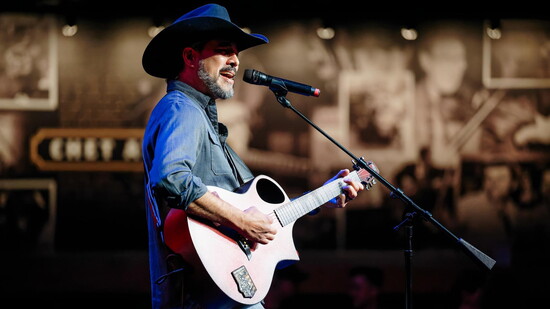
For Donovan Chapman, service has never been just a chapter of life. It's a calling that has followed him from battlefields overseas to stages in Nashville - and, ultimately, to a quiet corner of Mt. Juliet.
The former United States Air Force Pararescueman has spent much of his life answering calls for help. During over a decade of military service, he deployed around the world, including Kuwait and Afghanistan, serving in some of the most demanding environments imaginable. Today, his mission looks different, but the goal remains the same: helping others find their way through difficult moments.
"I traveled all over the world supporting combat deployments and military training," Chapman says. "When I was honorably discharged, I was offered a recording and publishing deal with Curb Records, which brought me to the Nashville area."
Long before the record deal, music had already become part of his story. Born and raised in North Louisiana, Chapman grew up surrounded by strong family values, faith, and a deep respect for service. His Hawaiian heritage introduced him to music at an early age through his mother, who shared the sounds and traditions of her native Hawaii. He eventually learned to play the ukulele and later turned to songwriting as a way to process his own experiences.
Military service was never a difficult decision. It was part of his family's legacy. His great-grandfather served in World War I. His grandfather served in World War II. His father was drafted into Vietnam. Both Donovan and his younger brother would later serve in Afghanistan.
"I felt the call to duty to serve the way all the men in my family did," Chapman says. "It seemed like the most honorable decision to make to honor our legacy."
That legacy eventually led him into one of the military's most elite career fields. After initially serving as a Security Policeman, Chapman cross-trained into Air Force Pararescue, a Special Operations career field responsible for combat search and rescue missions in some of the world's most dangerous conditions. The work demanded everything.
"You're flying missions to rescue men and women who have been injured in the worst circumstances," he says. "The connection, the bond, the love and respect we developed toward each other is known deepest in those environments. You become closer than blood kin."
Like many veterans, Chapman returned home carrying experiences that would take years to fully process. Multiple injuries, including spinal, nerve, and traumatic brain injuries, required extensive rehabilitation. At one point, he was told he would never sing again. Instead, he taught himself to play guitar during recovery.
That determination eventually led to a successful country music career, including charting singles and record deals with Curb Records and Category 5 Records. Yet even as his music career grew, Chapman found himself drawn toward a greater purpose.
He discovered that outlet through Freedom Sings USA, where he founded the organization's Special Operations Veterans Class. The nonprofit pairs professional songwriters with veterans, active-duty military members, and their families, helping them share their experiences through song. For Chapman, the work represented a powerful intersection of service, storytelling, and healing.
"When a veteran hears their story in a song for the first time, they become the observer of themselves," he explains. "For once, it's not just memories and emotions inside their head. They can step back and see it. That's where healing begins."
And that work became part of his own healing journey as well.
"Maybe one day someone will sit with me and help me with my song," he says.
Today, Mt. Juliet serves as home base for both his music and his mission. Drawn to the area's strong sense of community, he says he appreciates the people who have become like family and the hometown feel that still exists despite the city's growth.
"I appreciate the beautiful Tennessee hillside country and the feeling that there still is some Tennessee in Mt. Juliet," he says. "I appreciate that the Police and Sheriff's Department are relentless about keeping this community safe."
As America marks its 250th anniversary this year, Chapman hopes the celebration encourages younger generations to better understand the sacrifices made by those who came before them. And his perspective on patriotism has evolved since his years in uniform.
"The reason I served was to give everyone that freedom of choice," he says. "Our flag is a symbol of that freedom. It's not political. It's a symbol of the freedoms our forefathers and foremothers dreamed of us having."
It's a message rooted in experience, but also in hope. After years of service, injuries, recovery, and reinvention, Chapman has learned that resilience often begins with compassion - for others and for ourselves.
"Everyone's pain is as real as another's," he says. "Smile, laugh, cry - it's all part of the plan."
For a man who once rescued people in combat zones, helping others find healing through music may seem like a different mission. But to Chapman, it's simply another form of rescue.
Sometimes we all just need to see and hear our story in a song.
The reason I served was to give everyone the freedom to choose their own path in life. Our flag isn't political - it's a symbol of the freedoms generations fought to protect.