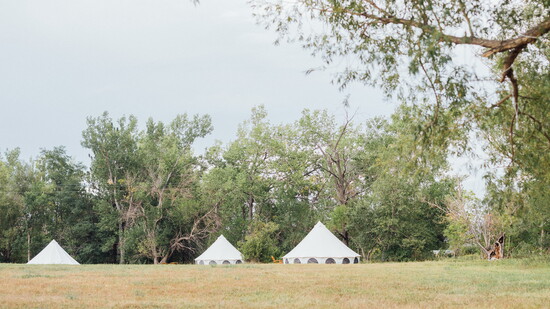
There is a certain feeling that comes over you at Yellow Barn Farm. Maybe it's the cows mooing and pigs oinking in the background, the rhythm of people gathering around a long table, or the way a simple meal stretches into an evening you don't want to end. Maybe it's the sense that food, land, and community are all part of the same living story.
For Azuraye Wycoff, Head Ecopreneur at Yellow Barn, that feeling is intentional.
What began as a piece of land has evolved into a community hub, business incubator, and living experiment in regenerative living, a place where farmers and entrepreneurs, artists and wellness practitioners, families and educators share the same soil and discover what becomes possible when those worlds are no longer kept separate.
"Yellow Barn is a living social ecology," Wycoff says. "It is a demonstration hub for all things regenerative and a petri dish for testing all kinds of theories and experiments on how to integrate these divergent and often contradictory lines of work, living, and play."
In a world increasingly divided into categories and silos, Yellow Barn is blurring the lines, and perhaps that is its greatest experiment.
Planting Seeds & Growing People
The phrase "Planting Seeds & Growing People" has become central to Yellow Barn's identity, and it is less a slogan than a philosophy. "We might be doing agriculture," Wycoff says, "but what we're really up to is helping humanity step into a new iteration of self."
The land becomes a teacher. Farming requires patience, collaboration, adaptability, and the ability to notice when something isn't working and change course. It requires learning to work within limitations rather than constantly trying to overcome them. Those lessons apply to people too.
At Yellow Barn, growth happens both above and below the soil. Seeds become plants. Ideas become businesses. Strangers become neighbors. Conversations become collaborations. And like any healthy ecosystem, none of it exists entirely on its own.
Regeneration Starts in the Soil
At the heart of Yellow Barn is regenerative agriculture, a practice rooted in the idea that farming should leave land healthier rather than depleted. Instead of treating soil as an endless resource, this approach considers the long-term relationship between soil, water, plants, animals, and people through composting, cover cropping, integrating animals, reducing tillage, and increasing biodiversity.
Wycoff describes it as a positive feedback loop: what's put into the land today should compound over time, ultimately giving back more than it takes.
That philosophy carries particular weight in Colorado, where water is scarce, climate conditions are increasingly unpredictable, and agricultural land faces pressure from development and rising costs. For Wycoff, regenerative agriculture offers a path toward resilience. Healthy soil retains moisture. Diverse ecosystems are less vulnerable than monocultures. Local food systems shorten the distance between growers and eaters.
Most importantly, regenerative agriculture changes the question. Instead of asking how much can be taken from the land, it asks how it can be left more alive than it was found.
The Beauty of the Sandbox
One of Yellow Barn's most distinctive qualities is its diversity. The property brings together agricultural operations, small businesses, wellness experiences, educational programming, music, art, farm-to-table gatherings, and community events, and Wycoff believes that's exactly what a healthy community should look like.
"We've been trained to think in silos," she says. "The farm is over here, the wellness studio is over there, the art world is somewhere else entirely. But those divisions are artificial."
At Yellow Barn, a farmer might cross paths with a yoga teacher, an entrepreneur might sit beside a musician, a family might discover a local food producer over dinner. The magic is in the collision of ideas.
But community isn't always easy, Wycoff is quick to point out. She compares Yellow Barn to a playground: people building sandcastles, people throwing sand, people who feel left out, and people figuring out how to play together. Learning to share space requires patience, communication, boundaries, and sometimes uncomfortable conversations. That friction isn't necessarily a sign something is broken; it can be part of the growing process.
A Living Local Economy
Yellow Barn's regenerative philosophy extends beyond the soil. Over the past several years, an ecosystem of businesses has emerged around the farm, including Picky Pig, a food scrap collection program that feeds pigs and builds compost; Stalk Market, an online platform connecting customers with local producers; Small Hall Movers; Edaphic Solutions; Kaizen Lawn and Home; Lusciously Local; Puffin Sauna; Peak Pop Up Glamping; Subtle Nectar Wellness; and Rocky Mountain Spirulina.
Through Stalk Market, Yellow Barn also works with local producers offering vegetables, meat, lamb, eggs, microgreens, homesteading classes, and firewood shares. Ginkgo & Co.'s kimchi is joining the marketplace.
It's an ecosystem built on the idea that local businesses can support one another rather than operate independently. Wycoff calls Yellow Barn an "incubator" and a "nest," a place where people with a vision can bring an idea into fertile ground and find community, resources, and support. The goal isn't simply to create more businesses; it's to create relationships between them.
The Table as a Meeting Place
Perhaps nowhere is Yellow Barn's philosophy more visible than around its tables. Wycoff remembers community dinners where people from entirely different walks of life found themselves deep in conversation, nearly 200 people gathering to plant baby trees in the farm's earliest days, and musical performances that transformed the barn into a place of energy and celebration. There have been sovereignty summits, workshops, wellness gatherings, farm dinners, dances, and late nights spent clearing tables after everyone else has gone home.
For Wycoff, these aren't separate activities but part of the same ecosystem. "You can't separate these things," she says of agriculture, food, wellness, and personal connection. "All of that is so deeply intersected that to separate it is to separate the parts of our soul."
It's a distinctly Boulder idea, and Yellow Barn takes it further: wellness isn't just something that happens in a studio, food isn't simply purchased at a store, sustainability isn't merely an abstract ideal. They are lived experiences.
A Place to Imagine Differently
After six years of building systems, businesses, partnerships, and infrastructure from the ground up, Wycoff says Yellow Barn is finally beginning to feel rooted. The work has been intense, particularly since conventional systems are usually designed around simpler categories. But something is beginning to shift. The community is generating its own momentum. People are bringing other people. Ideas are emerging organically. The farm is becoming not just something being built, but something people can finally enjoy.
Wycoff hopes Yellow Barn can become a model other communities can adapt to their own landscapes, cultures, and needs, not to replicate Yellow Barn exactly, but to replicate the pattern: a network of local "nodes" where food, land, business, wellness, education, and community support one another.
Find Your Node
For Boulder County, that vision comes with an invitation to support your farmers. Buy local food. Attend the farm dinner. Bring your children to the farm. Purchase from a local producer. Give food scraps to a composting program instead of the landfill. Show up for places working to keep agricultural land agricultural.
Wycoff believes those small choices matter. "Your dollars are your vote," she says. "It's what you say you care about." Her larger concern is that farmers are struggling to survive, and that the loss of farms affects food security, soil health, open space, local resilience, and the possibility of passing agricultural land to the next generation.
For Yellow Barn, the answer isn't to retreat from the complexity but to embrace it: to diversify, collaborate, experiment, and build a system where one piece helps sustain another. Regeneration isn't something that happens only in a field; it can happen in an economy, a neighborhood, a relationship, a community. It can begin with a food scrap, a shared meal, a conversation with a farmer, or simply showing up.
A Little More Magic
Ask Wycoff what she wants people who have never visited Yellow Barn to know, and her answer is simple: "This place is full of magic." When you step onto the land, you can feel it, if you're open to it.
There is a small corner near the creek that has always felt sacred to her, tucked away from the highway, quiet and protected, a place where she goes to reconnect with the land and herself. Animals moving. Birds beginning their day. Light falling across the land. Everything doing what it's supposed to do.
For Wycoff, it's a reminder that this work is bigger than running businesses. It's about imagining a different way forward, and having the courage to build it, one small experiment at a time. Yellow Barn Farm may be rooted in the earth, but its vision reaches well beyond its acreage, asking each of us: what would happen if, wherever we went, we tried to leave things a little more alive than we found them?
Perhaps that is the seed Yellow Barn is planting, and Boulder is exactly the kind of place where it can grow.