“That’s not going to be the story this time.”
That was the thought that ran through Ruth Ann Logue’s mind over and over again.
She had just finished a conversation with someone she knew. Someone who had seen hard times before. A single mother with three young children who, due to a family tragedy, had become homeless. Through grit and determination, this young mom had found housing for her family in Ypsilanti.
She was excited. But she was also measured—the way someone becomes when life has required them to develop callouses just to keep going.
This wasn’t the first time she had stood in this moment. As a child, she had experienced homelessness herself. She told Logue about leaving the shelter and finally moving into a house. They had a roof, she said—but it never felt like home. She told Logue, “I’m not even sure I had a bed in that home that was my own bed.”
That house had been “furnished” slowly, shaped by necessity rather than choice. Furniture came from the side of the road, picked up only if there was room in the car. Stray pieces were gathered when possible, stitched together over time.
“That’s not going to be the story this time.”
Determined, Ruth Ann knew what she needed to do.
She gathered a small group of friends and asked if they would help her get the house ready for this family. Together, they collected everything a home requires—dishes, towels, pots and pans, a couch. But this wasn’t just any family. This was a family Ruth Ann knew. And she wanted the details to matter.
She paid attention to who these children were—and to what this young mom had quietly longed for herself. The girls loved pink and purple. They loved princesses. Her little boy loved robots and the color blue. And so, when the family arrived, those details were already woven into the space, waiting for them.
Fresh flowers sat on the table. A cookie jar was filled with homemade cookies.
That night, a mom and her children—who had already endured more than most—walked into something far more than a roof over their heads or a room with a bed. They walked into a home.
Their home.
What began as a single act of refusal—refusing to let a family’s next chapter start in emptiness—has grown into one of Washtenaw County’s most quietly transformative nonprofits. Today, Logue serves alongside friends Ginger Raymond, Liz Gadway, and Peggy Farrell as the co-founder and executive director of HouseN2Home, which has furnished nearly 2,000 homes across Ann Arbor, Ypsilanti, Chelsea, Dexter, Saline, Whitmore Lake, and beyond. These homes are more than houses—they’re spaces where people can thrive.
Clients are referred through caseworkers at more than 50 partner organizations, including shelters, hospitals, schools, the VA, housing nonprofits, and agencies supporting families, veterans, survivors of domestic violence, young people, and those navigating recovery. HouseN2Home purposefully enters the story at a precise moment—after housing is secured, but before it feels like home.
What sets HouseN2Home apart isn’t simply that they provide everything. It’s that they listen.
Clients aren’t handed a generic bundle of items. They’re asked about color and comfort, about what “home” should feel like. Sometimes that question is difficult because after long periods of just trying to survive, wants can go quiet.
So Logue and her team guide gently. “Can you remember a time when you were somewhere that really felt like home,” she might ask.
One woman’s answer: Her grandmother’s house. Blue tones. Antique furniture. A sense of calm. HouseN2Home found an oak headboard and an upholstered blue chair with an ottoman, creating a bedroom that echoed that memory—nostalgia turned into a fresh start.
Dignity is the heart of the work. Not charity that says, “Take what you can get.” But care that says, “You are worth being known.”
Every move still includes the same welcome: a meal, a cookie jar filled with homemade cookies, and fresh flowers (or a living plant). It’s a simple ritual with a powerful message: This is your home.
Behind that emotional impact is a significant operational effort—and one partnership makes it possible. Trinity Health provides HouseN2Home with more than 30,000 square feet of storage space on its campus, rented for $1 a year. Logue calls it essential. That generosity has eliminated major overhead costs, allowing the organization to focus resources where they matter most.
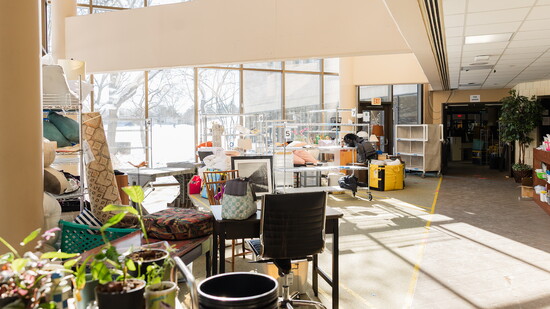
Since moving into the space in July 2019, HouseN2Home has expanded steadily, transforming what began in garages and basements into a volunteer-powered system capable of furnishing hundreds of homes each year. Inside “storage,” it’s part warehouse, part workshop. A repair shop restores sturdiness to furniture, a paint shop updates tired finishes, and a sewing team re-covers and refreshes fabric details—keeping quality items out of landfills and giving them new life.
HouseN2Home is largely volunteer-run, with roles ranging from organizing and repairing furniture to painting pieces and prepping homes for move-in. Volunteers are always needed, as the number of families they can serve is directly tied to the number of hands available.
It’s those who experience move-in day who see the transformation happen in real time. An empty room becomes a child’s bedroom. A living room becomes a place to exhale. A kitchen becomes a place where someone bakes again.
And a family that has carried far too much for far too long walks into something once unimaginable given their circumstances—a home they can be proud of.
To learn more, volunteer, or donate, visit housen2home.org.