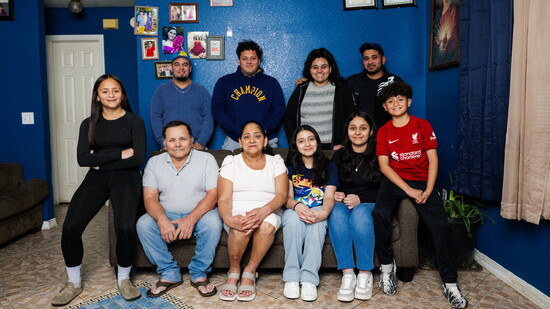
Gatherings at the Martinez household are raucous, laughter-filled affairs, with more than 50 relatives filling the home of family anchors Miguel and Rosa. Three generations crowd the kitchen and living room—cooking, trading good-natured ribbing over plates of food, or breaking into games like Jenga or “balloon stomp,” a frenetic contest that ends only when one person is left standing with an intact balloon tied to their ankle.
With 13 adult children between them, Miguel and Rosa are also grandparents to 31 grandchildren, ranging in age from 5 months to 25 years old. One of their seven sons, William, lives with them, while the rest of their children and grandchildren reside near their home in East Rogers, turning frequent get-togethers into a rhythm of everyday life.
The liveliness of these gatherings belies a far more difficult past. Originally from Metapán, a city in northwestern El Salvador near the Guatemalan border, the family fled their homeland in two waves—Rosa and four of her children arriving in Arkansas in 2017, followed by another 15 family members in 2018. In a Central American country shaped by decades of civil war and gang violence, daily life in El Salvador was marked not only by deep poverty, but intense fear.
“The violence at that time, we were really scared that anything would happen to any of us,” says Rosita Martinez, 24, the youngest of Miguel and Rosa’s children. “
In El Salvador, the Martinez family worked in agriculture, but job opportunities were scarce, and people in their city who found work were often robbed. In the early 2000s, one of Rosita’s brothers and her father went to the United States to work, to help provide for their family back home. But because of this, people in El Salvador assumed the family had money and targeted them for extortion, despite the fact that the Martinezes barely had enough to survive themselves.
Rosita hesitates when talking about the past—she doesn’t feel comfortable revealing all of the painful circumstances that led to their departure from their home country. With the fear and insecurity becoming unbearable, the family applied for refugee status in the United States. Rosita says it was a comprehensive process involving interviews and medical examinations that took a year and a half to complete. To their family’s immense relief, they were able to join the rest of their family living in the U.S., leaving behind the life they had known for the prospect of safety—and opportunity.
Finding Community
Rosita was 15 when her family arrived in Northwest Arkansas—not only did she have to adjust to living in a new country and learning a new language, she also had to adjust to public high school.
The family was assisted by Canopy NWA, a nonprofit organization based in Fayetteville that provides resettlement services to refugees. Canopy NWA helped the Martinez family find jobs, enroll in school, and find housing and furnishings.
“They really help a lot with everything, and they are still there for us at any time,” Rosita says.
While it was difficult at first for her family to adjust, she emphasizes the sense of relief and excitement they felt.
“We really felt different, because it's a different country, a different culture, a different language, but we really felt safe here—like, a lot,” she says.
Rosita, who is now married with a 1-year-old daughter, works at a Head Start program. Her brother William works for a concrete supplier a few miles away from his house. Their siblings' children attend Rogers public schools and are thriving. They can work and live without the constant fear for their own lives and the safety of their children.
“I feel like it's just a safe country, and we have jobs … we have money to eat every day, and to have a home,” Rosita says.
While the hardest part of being away from their home country has been missing the culture, childhood friends, food, and the family they left behind, Rosita says the community of friends and neighbors they’ve found in Rogers has helped make the area feel like home.
“Everything is beautiful here, the people have made us feel welcome,” Rosita says. “And the people at Canopy have made us feel like part of their family.”
“The violence at that time (in El Salvador), we were really scared that anything would happen to any of us."
“Everything is beautiful here, the people have made us feel welcome. And the people at Canopy have made us feel like part of their family.”