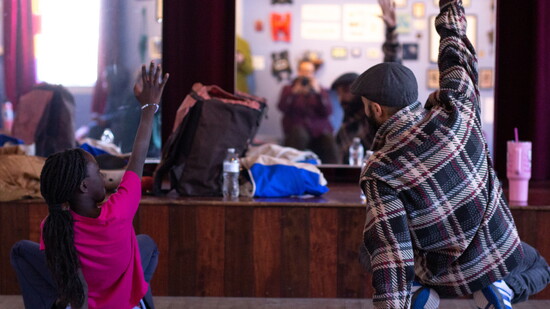
Portland Ovations believes live performance should be within reach for every person in our community. Through its Community Seats program, Portland Ovations partners with local nonprofits, social service agencies, and others to offer tickets to people who might not otherwise attend a show, from newer Mainers and youth programs to families navigating tough seasons. We sat down with Executive & Artistic Director Aimée Petrin and Director of Community Programs & Partnerships Katelyn Manfre to learn how Community Seats works, who it serves, and why access to the arts matters.
Can you tell readers about Community Seats and what sparked it?
Aimée: We’ve been doing this for 10 to 15 years, but episodically. It didn’t have much shape, and we did it when we could.
In the last few years, it has gained real structure. We decided it was time to name it, formalize it, and make it public. It’s always been part of our DNA, but now it’s a true program, not just something insiders knew about.
Katelyn: When I started, there’d been a lot of turnover across nonprofits, so my work has been rebuilding and forming new relationships. Only recently did we gather that work under Community Seats.
Having a named program we can point to lets us say, “This is what we do. Come in through this door.” It’s a natural entry point for organizations to get to know our programming, and those relationships often deepen.
Now people come to us asking to be part of it. One partner said their participants told them, “We never get invited to the fun, cool things in Portland. How do we get invited?” That’s exactly what Community Seats is for.
What gap were you seeing in who was able to come to performances, and why is it important to fill it?
Aimée: The gap shows up in a lot of ways, but the biggest one is socioeconomic. It is also about people who don’t feel welcome or like they belong in Merrill Auditorium or our other venues.
This program is as much about social connection as it is about tickets. It is about what it feels like to be in community.
Katelyn: Many of our partners serve people who are spread out or only together for a short time. Family Promise, for example, walks with families for a period, then they “graduate,” but they’re still part of that wider circle.
Organizations are looking for fun, low-pressure ways to bring people together again. Family-friendly, intergenerational shows are especially popular. Community Seats gives people who don’t see each other regularly a reason to gather, reconnect, and feel part of something.
Why does access to live performance matter?
Aimée: First, coming together. One of the main issues we are trying to address is social isolation. Any chance to bring people together is vital.
Second, we are fortunate that what brings people together here is live performance. The shared experience is incomparable. It can be magical, transformative, and joyful.
Katelyn: There is real value in engaging young people, newer Mainers, and adults who have not seen a live performance in a long time, or ever. We present music and dance from all over the world. People can connect with an art form or culture that is theirs, close to their heart, or completely new.
All the reasons these art forms have survived and crossed oceans for centuries show up in small moments.
I think of the group connected to the Azerbaijan Society that came to 360 Allstars a few years ago: Newly arrived families from Afghanistan, babies and tweens in tow, looking for something to do together. We worked with their director to bring them to this urban circus with BMX bikers, DJs, and breakdancing. The kids had the night of their lives. They got T-shirts signed; they were glowing.
We later heard how much it meant to have that bright spot during a really hard time. Being able to breathe together and experience joy, celebration, and positivity—that is the value for me.
Aimée: And it goes both ways. The energy in the room changes with a broader mix of people.
At Soweto Gospel Choir, a friend told us they sat next to folks who came through Community Seats, including someone from Africa who knew the music and language. That person explained what was happening on stage and brought such joy. Our friend said their own experience was better because of who they sat beside.
This program is not one-dimensional. The impact moves through the whole audience.
How do you choose and build relationships with nonprofits, and how many partners are you serving?
Katelyn: Partners find us in a lot of ways. Some reach out directly. Others come through board members and community connections. I follow up to establish or deepen the relationship.
Some partnerships go back years. With those, I sit down once a year, go through the season, and ask which titles make sense for their community.
We tailor logistics to each organization so it feels easy and welcoming. For some, I send a monthly list of shows, and they request tickets. Others connect around specific titles. Some pick up tickets in advance; others prefer will-call. The goal is always low-barrier.
Right now, we have 17 Community Seats partners, including three new this season, within a larger network of about 40 community organizations we work with each year.
Aimée: Some partners came to us in surprising ways—like Portland Community Squash or the Center for Grieving Children. That is why staying open is so important. We do not want a rigid idea of who “qualifies.” The aim is low-barrier and welcoming.
We also welcome partners from the stage, which gives visibility to their work and changes the energy in the room. Those “We’re here!” cheers are powerful, and artists feel that too.
What kinds of communities do these nonprofits serve?
Katelyn: It is a wide range. We work with youth organizations like Our Place; KidsPeace, which supports families in foster care; and Portland Community Squash, which engages newly arrived immigrant families through sport.
Many partners serve newer Mainers, helping people connect with services and settle here. Community Seats becomes one more way to say, “Welcome. We want you here.”
We also partner with the Equality Community Center. Each year, we bring a group of their youth to a show. This season about 30 teens will get glammed up for a pre-party, then see Kinky Boots together.
Another partner works with survivors of sexual assault and trafficking and includes wellness practitioners and artists across the region. Their community is spread out, so these shared evenings are a rare chance to gather around joy and a shared experience.
The Center for Grieving Children joined us after we worked together during the Broadway tour of Dear Evan Hansen. Getting to know their work more deeply led to a Community Seats partnership.
Overall, we are working with BIPOC communities, underrepresented communities, youth development programs, recent immigrants and asylum seekers, people with disabilities, and others who have historically had less access to performance.
Aimée: Many of these communities have had limited access to live performance, or at least in this moment. And again, it is not just about the ticket. It is about feeling welcome and included—having that sense of belonging. That is the heart of the program.
Can you talk about impact—in numbers?
Katelyn: Last year, we distributed about 600 Community Seats tickets, with a value of around $30,000. That was before the program was fully formalized.
This year, our goal is 700 seats, and we are on track. At most performances, there are between 20 to 40 Community Seats tickets in use. Each organization usually takes 10 to 15.
Aimée: Importantly, we have not had to turn anyone away. That is something we care about deeply.
Initial funding came from the Onion Foundation, and support has grown from there. In some cases, we have to purchase seats due to contractual obligations, so funding helps underwrite tickets and also supports workshops, outreach, and Katelyn’s time with partners. It means we do not have to say no.
Katelyn: More and more, artists and management companies are also initiating outreach. Because Ovations has a dedicated community engagement role, tours will ask, “Who can we connect with?” and we can say, “We already have this network.”
They have been very open. For Kinky Boots, the tour agreed to set aside 30 tickets for the Equality Community Center, even with a tight financial agreement.
We recently presented DakhaBrakha with the State Theatre and reserved a block of Community Seats tickets for partners and for members of the Ukrainian community, including a group referred by a social worker.
Artists and tours increasingly see that it is not just about money. It is about impact.
Aimée: In the early days, we never would have expected this kind of flexibility from Broadway tours, where every seat is accounted for. Now we ask, and no one has said no. People recognize the importance of bringing as many people as possible into live performance.
When you think of Community Seats at its best, what’s one moment that comes to mind?
Aimée: Honestly, there is something at every performance. The Soweto Gospel Choir night is one I come back to. That feeling of, “This is exactly what we hoped for.”
Katelyn: Our Place stands out. We have worked with them for years. It is an after-school program, and they bring kids to evening shows when they can. They love dance, circus, acrobatics—anything high-energy.
Some of them saw 360 Allstars as a student matinee and then asked to come back for the evening performance with Our Place because they loved it so much. That kind of excitement is really special.
We are also growing partnerships in the disability community. Last year, we piloted audio description for A Year With Frog and Toad and invited blind and low-vision adults and kids.
There was a boy, eight or nine, who is blind. He sat with his audio-description headset on and laughed through the whole show. We also organized a touch tour, so people could go on stage after, feel the props and costumes, and talk with the stage management team.
Seeing artists, crew, and audience all leaning into that shared experience is one of my favorite parts of this work.
How has Community Seats shaped your organization?
Aimée: First, we truly love what we do. Seeing people experience the joy of performance fuels us.
Organizationally, this work has widened our perspective. It has given us a deeper understanding of our community and reminded us not to assume we know who will want to come or why. Some of the organizations and reasons have surprised us, in the best way.
That openness applies to our doors, our minds, and our hearts. We are better for it, and our audiences are better for it.
Katelyn: Another shift is how we talk about the work. We have done some version of this for years, but only recently named it, built a webpage, and made it easier to find. We are getting better at telling the story.
We also created a welcome message that plays before shows to set a tone of hospitality from the moment someone decides to come through the end of the night. We are always refining how we present these experiences so people genuinely feel welcome.
Aimée: And there has been a shift in how we think. Like many nonprofits, we used to operate from scarcity: “We can give away this many tickets and no more.”
Thanks to funding and member support, we have been able to loosen that. We are more expansive, not just with Community Seats but across our programs. Moving from scarcity to generosity benefits everyone.
How can people support Community Seats?
Katelyn: Visit portlandovations.org/community-seats. My email is there, so organizations can reach out about becoming partners. There is also information on how to support the program financially. People can make a designated gift, and there are options to donate when they buy tickets.
Aimée: People have specifically asked how to help provide access to the performing arts. Formalizing this program was partly about creating that pathway. There is now a direct way for people to support Community Seats and be part of this work.
This program is as much about social connection as it is about tickets. It is about what it feels like to be in community.
There is real value in engaging young people, newer Mainers, and adults who have not seen a live performance in a long time, or ever.
Community Organizations Say Thanks.
Community Seats currently partners with 17 organizations, a number that's always evolving. Here's what two had to say:
"Portland Ovations plays a vital role in strengthening our community by expanding access to the arts and deepening cultural awareness. Through classical and contemporary music, performance, storytelling, and theater, they create meaningful opportunities for local communities to engage with diverse artistic traditions. The Community Seats program has allowed members and friends of the Azerbaijan Society of Maine to be part of an invaluable and memorable cultural journey, and we are deeply grateful for their commitment to inclusion and belonging." —Tarlan Ahmadov, Director, Azerbaijan Society of Maine
"We have many great memories of going to Portland Ovations shows where our youth have experienced everything from modern dance, to hip hop, to circus arts, to tap dance. As many of our youth are aspiring dancers and performers, it is exciting to have them in an audience appreciating the arts as a viable and celebrated career path." - Libby Catania, Founder, Executive Director, Our Place Portland