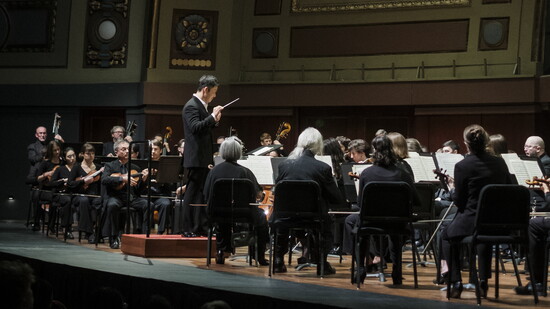
When Earl Lee first came to Ann Arbor, one of the earliest signs that he might like it here was that he couldn’t find a parking spot.
Lee, now in his fifth season as music director of the Ann Arbor Symphony Orchestra, was visiting as part of the orchestra’s search for its next conductor back in 2021. A board member was driving him around downtown, where the streets were crowded and parking scarce.
“I said, ‘That’s a great sign for me,’” Lee remembers. “Difficulty finding parking is a good sign for me that the city’s alive.” That vibrancy and individuality is the undercurrent of what’s made Ann Arbor his musical home away from home.
For Lee — whose home base remains Long Island City in New York with his daughter and wife, a flautist with the New York Philharmonic — Ann Arbor had something he values: a city animated by culture. He found the Ann Arbor Symphony Orchestra similarly alive.
Conductors and orchestras, Lee says, have to discover whether they have a unique kind of chemistry — something like a blind date.
“Sometimes it doesn’t click,” he says. “It’s not that you’re a bad conductor or they’re a bad orchestra.”
With the A2SO, it clicked instantly.
Now, as Lee begins the final season of his initial contract, he has signed on for three additional years. His ambition for that time isn’t easily reduced to ticket sales, repertoire or even a particular artistic milestone. He wants to deepen a relationship: with the musicians, the city, and the music itself.
Orchestras, Lee says, have their own DNA, and over years of working together, a music director can help shape how that orchestra makes music. He hopes eventually audiences might recognize something distinctive in what he and the A2SO have created together — a sound that comes not from imposing his identity on the musicians, but from their evolving partnership.
Lee knows what that collaboration feels like from the other side of the baton.
Before he became a conductor, Lee trained as a cellist, earning his master’s degree from Juilliard. Then, about a year after graduation, the middle finger on his left hand began curling inward when he played. In July 2008, he was diagnosed with focal dystonia, a neurological movement disorder.
For roughly two years, Lee tried to retrain his hand. He remembers practicing six or seven hours a day, sometimes spending 30-minute stretches simply lowering and raising one finger.
“I would do that for a full week,” he says, “and find out that it hadn’t gotten better.”
Every evening, he asked himself whether it was time to do something else. But one answer kept returning: he loved performing.
In October 2010, Lee decided to try conducting. Relying on the advice of several conductor colleagues, he went back to school at the Manhattan School of Music — there, he began his musical Act II.
The cello never entirely left his life — or his conducting. Lee still sometimes puts a score on a music stand, takes out his cello and works through phrases while imagining himself as a player looking toward an “imaginary Earl” on the podium.
“I try to figure out, what do players really need in their perspective?” he says.
It was during these uncertain years surrounding his injury that Lee first encountered pianist Nobuyuki Tsujii, who won the Van Cliburn International Piano Competition in 2009. Watching Tsujii, who has been blind since birth, perform at the highest level gave Lee “a lot of mental strength to carry on.”
He particularly remembers Tsujii playing Schumann chamber music — a work with what the former cellist affectionately calls a “juicy cello part.”
Remarkably, Lee has never heard Tsujii perform live. He’ll finally have the chance this season, when the pianist makes his Ann Arbor debut in an A2SO-presented recital April 18 at Rackham Auditorium.
Lee is equally interested in welcoming audiences who may be encountering classical music for the first time. His programs often pair an established work — something that provides a “hook” — with music by living composers. When he speaks from the stage, he doesn’t aspire to a grand lecture.
“I just try to speak to them like they’re my brothers and sisters,” he says.
For Lee, music without words offers listeners something that opera and other narrative forms of music cannot: the freedom to make the story their own. Ten people, he says, can hear the same piece 10 different ways.
“It’s yours,” Lee says. Even surrounded by thousands of people, “it’s your moment, and it’s your space.”
That individuality exists within a collective — much like an orchestra itself.
As the A2SO approaches its centennial in 2028, Lee hopes it will become an even more integral gathering place for its community. An orchestra, he says, offers its own model for communal life: more than 60 people with different backgrounds and personalities, each contributing something, “sometimes supporting, sometimes being supported,” all working toward something they can create only together.
Each bringing what’s theirs into something that could only be called ours.
“In that sense,” Lee says, “it’s how we should live our lives.”
Learn more at a2so.org