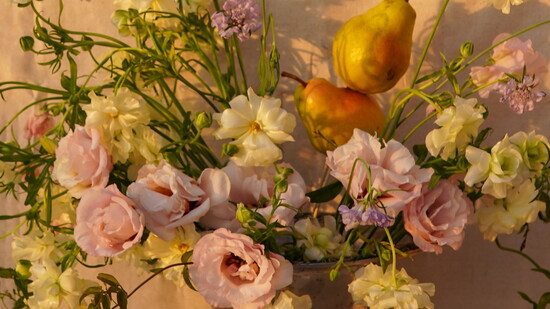
Florals don’t need instruction to be understood — they need intention. In this arrangement by Hive Interiors floral designer Lauren Miller, flowers are treated not as decoration, but as still life: observed, composed, and allowed to move naturally rather than forced into perfection. Soft blush blooms spill outward from a vintage champagne vessel, nodding gently to celebration and romance.
The arrangement is deliberately restrained. Negative space is given room to breathe, allowing the eye to pause and return. Individual stems remain visible and expressive, imperfect by design. Nothing is overly polished, because beauty often lives in what’s left undone—in knowing when to stop rather than add.
Though the arrangement began without intention or symbolism, a heart subtly emerged in the final form. Not illustrated or obvious, but suggested through curve, movement, and balance. It’s a reminder that meaning doesn’t always need to be constructed—sometimes it reveals itself naturally when space is allowed for things to unfold.
In rethinking the bouquet, the gesture shifts from tradition to sentiment. As an early welcome to spring, blush, cream, and soft lavender feel optimistic and light, while the aged vessel grounds the composition with history and tactility. Styled this way, florals become less about symbolism and more about observation—thoughtful, layered, and quietly romantic.
THE ARTIST’S APPROACH
Styled through an editorial lens, the composition was intentionally layered to feel grounded and tactile. Pears were introduced as part of the still life styling, adding weight, texture, and an unexpected sense of balance. Their presence anchors the softness of the blooms, offering contrast and giving the eye a place to rest.
Natural movement guided placement, allowing stems to arc and settle organically within a timeworn vessel marked by patina. The photographs were captured at dawn, when soft morning light filtered gently across the canvas backdrop. The diffused light allowed shadows to fall naturally, becoming part of the composition.
The goal was not perfection, but presence— shaped by light, shadow, and restraint.