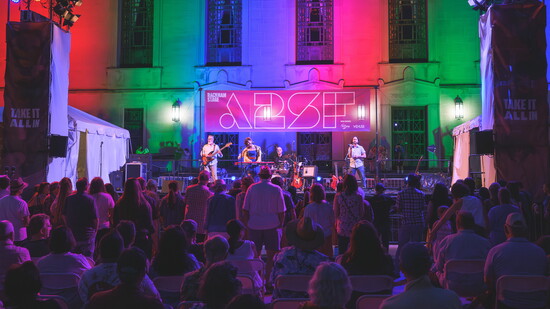
In Michigan, we put a lot of expectations on our summers, eager to take advantage of every activity before the fleeting season slips away. And on a warm June evening in Ann Arbor, that urgency transforms into something distinctly communal. As golden-hour settles over the city, something special begins to stir — a vibrant tapestry of sound and light that seems to rise from the pavement itself. For the uninitiated wandering toward Ingalls Mall, the sight of thousands gathered under the open sky often sparks a wide-eyed curiosity, leaving many to wonder: “What exactly am I looking at?”
That something special is the Ann Arbor Summer Festival, a two-week celebration running June 12-28.
"It’s the best expression of our community," says Michael Michelon, the festival’s executive director. It’s a place where, on any given night, the stage becomes a bridge between the familiar and the global. At seven o’clock, you might find a local student group or a neighborhood fan-favorite setting the tone for the evening. But just ninety minutes later, that same stage welcomes an internationally touring ensemble. This deliberate interplay between friends and neighbors and world-class talent creates a balance that is rare to find elsewhere. The result: a multi-generational experience that serves as a living, breathing manifestation of the city’s unique culture.
The festival’s current vibrant identity is the result of a decades-long evolution from its founding vision. Founded in 1984, the original vision, shared by university and city officials, was for a major national, destination festival designed to bring life to the campus during the “summer doldrums.” In those early days, organizers looked to prestigious models like the Stratford Festival. They imagined a program deeply connected to the University of Michigan’s professional theater department, utilizing the Power Center, a premier space that typically sat dark during those warmer months.
A main catalyst for the organization's evolution was a physical one: moving from a parking structure to the green space of Ingalls Mall. As regional tastes shifted toward more diverse, accessible arts, this move allowed the festival to expand, transforming Top of the Park — the festival’s free outdoor program of nightly music, movies, and community gathering — from a smaller accompaniment into a core piece of cultural infrastructure. What began as an effort to fill a seasonal gap has since become a defining part of Ann Arbor’s summer, a place people don’t just visit, but one they feel they helped create.
“It's less about circling something in the calendar as much as ‘look at this special place that exists’,” Michelon says.
While many large-scale festivals anchor themselves to a pre-planned concept, A2SF takes a more organic approach. Michelon notes that while there isn't a static, overarching theme in any specific year, every season eventually reveals its own unique personality. The theme of the festival is cultivated in real-time, appearing only once the people are on-site and performances begin. It’s a collective experience where the audience brings the theme with them, and the organization discovers the true spirit of that year’s event only after the final curtain falls. This truly allows the festival to breathe and take on a life of its own.
Among the highly anticipated features for the 2026 season is Summer Break by Flip Fabrique, a world-class contemporary circus company from Canada. Performing in, out of, and even off a bus that rolls right onto the site, the troupe embodies the "strolling up and seeing something amazing" energy that defines A2SF.
While the circus takes over the streets, some familiar favorites take the stage. On June 19, The Avett Brothers join forces with Mike Patton, legendary frontman of Faith No More and Mr. Bungle, for AVTT/PTTN at Hill Auditorium. The next night, June 20, Ira Glass brings his new show, Stories for a Saturday Night, to the festival — a performance that leans into the intimate, world-class storytelling local audiences have come to expect from the legendary host.
Looking toward the future, the festival is focused on becoming "core cultural infrastructure" for the region. A primary goal is restoring the festival to its full 21-day season. To support this growth, the organization is embarking on a five-year plan to invest in physical infrastructure that can withstand Michigan's increasingly variable weather. This includes the vision for a covered stage and audience areas that are flexible and resilient, ensuring that it remains a vibrant gathering place reflecting the very best of Ann Arbor.
One of Michelon’s biggest dreams is for A2SF to extend its magic beyond the month of June. Michelon highlights the success of out-of-season projects like Monuments — the hauntingly beautiful installation by artist Craig Walsh that projected living portraits of community leaders into the canopy of trees at Wheeler Park — as a blueprint for the future. By creating these one-off opportunities throughout the year, the festival aims to remain a constant, vibrant thread in the community.
Whether through large-scale visual art in the fall or a three-week marathon in the summer, the future of A2SF remains anchored in that same “surprise and delight” that’s defined it for more than 40 years.
The festival, Michelon says, is “an enduring treasure that creates community through shared arts experiences.”
Learn more at a2sf.org.