For years, neutral interiors promised calm but often delivered sameness. Beige became shorthand for “safe,” and safe quietly stripped homes of their personality. In an era where listings, mood boards, and social feeds blur together, neutrality became less of a choice and more of a default. Rooms softened into one another. Homes became interchangeable. Calm, somewhere along the way, lost its character.
This home, belonging to local real estate agent and Cave Creek resident Madison Wetter, offers a confident alternative — one where color isn’t an accent, but the foundation. From the moment you step inside, it’s clear this is not a space designed to fade quietly into the background. It’s a home that takes a stance, one rooted in individuality, curiosity, and the belief that design should reflect the life unfolding inside it.
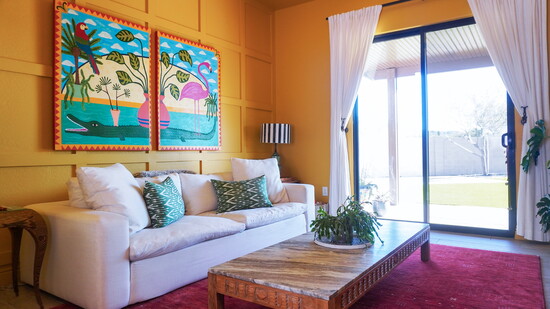
Rather than following trends, Madison approaches his space the same way he approaches design-minded real estate: with intuition, patience, and a willingness to take risks that feel personal rather than performative. Saturated yellows, deep teals, and layered pattern move effortlessly from room to room, creating a home that feels collected instead of styled. The palette is bold, but never chaotic. Each color choice feels intentional, grounded, and lived in — proof that color doesn’t overwhelm when it’s used with confidence and care.
This isn’t a home designed to impress at first glance. It’s one that reveals itself slowly. Pattern, texture, and unexpected choices are treated as essentials rather than finishing touches. Animal prints coexist with richly colored walls. Statement pieces sit comfortably beside quieter moments. There’s a sense of ease to the way everything lives together, as if the rooms were assembled organically rather than arranged all at once. Nothing feels overly precious, and nothing feels accidental. The result is a space that feels curious, layered, and deeply personal — one that invites you to linger.
Much of the decor has been thoughtfully sourced from Tierra del Lagarto, a local Scottsdale store known for its globally inspired furnishings and accessories from Morocco, India, Indonesia, and Turkey. These pieces bring texture, history, and soul into the space — objects that feel traveled, tactile, and imperfect in the best way. They introduce a sense of place beyond geography, grounding the home in a global perspective while still feeling distinctly personal.
Rather than filling rooms quickly, Madison has curated them over time, allowing each piece to earn its place. This approach resists the urge for instant completion. Instead of chasing cohesion, the home embraces evolution. Objects arrive slowly. Stories accumulate. Rooms are allowed to grow into themselves. It’s a reminder that the most compelling interiors aren’t assembled overnight — they’re lived into.
That patience is what ultimately sets the home apart. In a culture of instant design gratification, where inspiration is endless and attention spans are short, this space pushes back against the idea that a home must be finished to be successful. Here, the unfinished feels intentional. The layered feels thoughtful. Design becomes a process rather than a product.
At the heart of the home sits a piano — not as a functional instrument, but as a deeply personal statement. Inherited from his mother, who played, the piano now lives on as a sculptural anchor within the space. Madison doesn’t play himself, yet its presence is deliberate. It serves as both memory and art, honoring a family connection while adding weight and gravitas to the room. Like much of the home, its value isn’t defined by utility, but by meaning. It stands quietly, holding history, emotion, and a sense of continuity.
What truly brings the home to life, though, isn’t just the color or the objects. It’s how effortlessly daily moments unfold within it. Sunlight shifts across painted walls throughout the day, changing the way colors read and rooms feel. The piano waits mid-song, a reminder of the past woven seamlessly into the present. Dogs pause in doorways, catching the light at just the right moment, grounding the space in warmth and familiarity. These small, unplanned details soften the boldness of the design and remind us that this is, above all, a lived-in home.
As a real estate professional, Madison understands how spaces make people feel — and how often homes are stripped of personality in the name of broad appeal. He sees firsthand how fear of “too much” color or character leads to interiors that feel safe, but forgettable. This home quietly challenges that thinking. It suggests that warmth, individuality, and expression aren’t liabilities, but strengths. That a house can be both expressive and inviting. That color, when used thoughtfully, doesn’t alienate — it connects.
What’s happening inside this home reflects a much larger shift happening in design right now.
Color, Pattern, and the Shape of 2026 Design
What’s happening in design right now — and what’s shaping into 2026 — supports precisely this kind of interior language. After a decade dominated by minimalism and muted palettes, designers and homeowners alike are pivoting toward rich, intentional color that feels experiential rather than decorative. Rather than seeing color as something to balance or suppress, there’s a growing embrace of palettes that feel emotional, contextual, and anchored in story.
2026 design trends aren’t about loud palettes for their own sake, but about expressive environments that resonate with daily life. Rooms that feel curated — not curated for content. Surfaces that invite touch. Layers of pattern that reward lingering rather than scanning. In this shift, color becomes a tool for connection — to memory, to place, and to personal narrative.
In practical terms, this means embracing hues that read differently as light changes; pairing unexpected tones that feel surprising yet coherent; and allowing pattern to be a companion to color rather than a competitor. In Madison’s home, these principles show up in unexpected corners: a saturated doorway that frames a moment, a rug that dialogues with wall color instead of receding from it, an accent chair that doesn’t whisper but doesn’t shout either.
That same mindset extends to the details. Metals are mixed freely — brass alongside blackened finishes, warm tones paired with cooler accents — a choice that once felt off-limits, but now reads intentional. In 2026 design, cohesion no longer comes from matching everything perfectly, but from layering elements that feel collected over time.
This isn’t a rejection of simplicity so much as an evolution of it. The design conversation in 2026 centers on purposeful presence, not minimal absence. It recognizes that homes aren’t galleries — they’re places of living, memory, and identity. In this context, color isn’t an afterthought. It’s a vocabulary. A reminder that homes don’t need to appeal to everyone — only to the people who live there.
A collected home is built slowly, shaped by memory, intuition, and bold choices that reflect real life rather than trends or universal approval.