Darla Shaw knows a thing or two about underdogs.
She’s been one herself—many times, in fact, over her nearly nine decades of life. But because of that—in defiance of it, even—Darla has made it her mission to support the underdog. She says she would not be where she is today if she hadn’t had someone in her corner.
For Darla, that someone was her father, Robert Hall. And so, throughout the years, she’s made a point of being that person for others, too.
But we’re getting ahead of ourselves.
Darla was born in 1938 in a hospital in Illinois. Her father worked for General Electric, so the family was frequently in motion, moving from state to state.
“I was very, very shy,” Darla recalls. “I was an only child, and it was challenging to always be adapting to new schools and new people.”
We’re sitting in the apartment that she shares with her husband of 68 years, Ben Shaw. Last year, the couple moved from their home in Ridgefield to a retirement community in Danbury—Keystone Place at Wooster Heights—because Darla needed some extra assistance with her health.
It’s hard to reconcile the woman sitting before me—donning a quirky shirt covered in music notes, a red lip, and one earring shellacked in sheet music (“My other ear is infected and I didn’t want this earring to feel neglected!”)—with the shy, quiet child she describes.
“I had the most amazing father,” she says. “I didn’t see a lot of him because he was always traveling for work. But whenever I spent time with him, it was special. He always told me, ‘Darla, if you work hard enough, you can do whatever you want. You’re gonna fail, and that’s okay. You’re gonna learn. And there’s gonna be people who don’t like you, no matter how hard you try. It’s more important that you like yourself.’ I would never be the person I was if it wasn’t for him.”
Darla received her undergraduate degree from Fairleigh Dickinson University and settled on a career in teaching. In 1966, she moved to Ridgefield with Ben, their son Dyke, and their daughter Kobi.
For three decades, she worked in the Ridgefield Public School system as a teacher, language arts coordinator, and interim assistant high school principal. It was during this tenure that someone else saw something in her.
“The Superintendent said to me, ‘Darla, you’re creative, you’ve got leadership skills, you have a wonderful personality, the kids love you… but you’re so shy.’”
He referred her to Toastmasters, hoping it might help. It was the last thing she wanted to do.
“Toastmasters was so difficult,” she reflects. “It was all men, and so many of them didn’t want me there. But it built in me a strength and self-confidence that I had never had before.”
She wasn’t imagining the resistance. Toastmasters, an international organization focused on public speaking, communication, and leadership skills, did not officially allow women to join until 1973. But it proved pivotal in her career, helping her learn to speak with confidence.
That newfound confidence opened a door Darla hadn’t even considered: teaching at the college level. Darla had already received her master’s in education from NYU, but she hadn’t considered becoming a professor.
“I was an adjunct at Fairfield University, Sacred Heart, Southern Connecticut State University, and WestConn,” Darla says. “But I would have to get my doctorate to become a college professor—and although I’m bright and great at research, I am not very good at math.”
Darla was accepted into the doctoral program at the University of Bridgeport. She was one of two women in a cohort of 25 students.
“I was voted the person most likely to leave the program!” she recalls. “I was ready to give up. But I went to study groups every single weekend. If I’m motivated, I’m not going to let people put me down and tell me that I can’t do something.”
Once again, her father’s words proved true. Darla persevered, earning her doctorate in education in 2000 at age 62.
Soon after, she became a professor of Education and Women’s Studies at Western Connecticut State University (WCSU). She was offered a similar position at a more prestigious school, but accepted the role at WCSU because she wanted to work with the underdog.
“I taught special education, remedial reading, English as a Second Language,” Darla says. “I always worked with students who needed extra support. I can relate to them—I was the shy person who needed the extra support and got it. I wanted to be that person for my students.”
Darla became professor emeritus in 2020. She is currently battling cancer for the fifth time—but with the schedule she keeps, there is nothing “retired” about her.
“I’m still learning and teaching in so many ways,” she says. “I have to do that to survive—because if I give this up, it’s all over for me.”
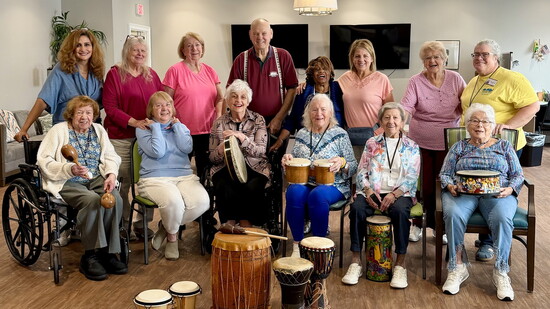
When Darla was in her mid-60s, she decided to learn to play the accordion. In her 70s, she took up the steel drum. Not bad for someone who says she didn’t have a lick of musicality. She has been a member of the Long Lake Kazoo Band and started the Founder’s Hall Band in Ridgefield. Now, at Keystone Place, she has started a drumming circle that meets every week.
“I was not musical at all,” she says. “I’m still not a very good musician. But I do the best I can.”
Walking down the hallway to the cheerful beat of “Oh! Susanna,” you’d never know it.
Darla sits at the top of a large circle, leading a group of 14 retirees playing everything from the washboard and tambourine to the maracas and bells. What began as a small group after she moved into Keystone Place has grown to nearly 20 weekly participants, including members from the memory care unit.
“We had two, maybe three people to start,” she says. “But I kept finding people who were responsive, or had light needs, and wanted to become engaged. Now we have people participating from independent living, assisted living, memory care, we have staff participating. Our oldest participants are 102 and 103. They love it!”
Getting people involved, she says, means more than putting out an invitation. She seeks people out, giving them a reason to believe they have something to contribute.
“There was a man who rarely left his room,” she says. “So I talked to him one day. I told him we needed him, that he was going to be good at this. I didn’t think he was going to show up, but he did. And that’s what’s so meaningful to me.”
Darla visits the memory care unit each week to put on performances, play music, and tell stories. It’s the same philosophy she brought to her teaching career.
“When I was a teacher, I taught entirely through the arts. And I find that that’s when people learn best, through music, and chanting, and clapping, and dancing, and plays. So that’s what I tried to do here.”
She brings that same approach to her work in the community, frequently giving presentations for the Ridgefield Historical Society, Weir Farm, Keeler Tavern Museum and History Center (KTM&HC), Mark Twain Library, and The Meetinghouse. She has taken on the roles of historical figures with ties to Ridgefield, including suffragette Alice Paul, sculptor Alice Hyatt Huntington, Battle of Ridgefield heroine Sybil Ludington, and magazine editor Abigail Goodrich Whittelsey.
Many of her presentations involve role-playing: Darla dresses as the character, embodies her, and answers questions as that person, drawing largely on her research.
“There are so many women who are so important that don’t have big name recognition,” she says. “So I try to take on roles and write scripts about those people—like Fanny Crosby, a local woman who wrote more hymns than anybody ever.”
She has also spent years working with organizations focused on helping people find their footing, including The Center for Empowerment and Education, the Cultural Alliance of Western Connecticut, The Bridge to Independence and Career Opportunities (TBICO), and the Federal Correctional Institute (FCI) in Danbury.
At FCI, Darla met Jane Goodall, who started her Roots & Shoots program there. Darla later traveled to Tanzania, where she spent a summer with Jane.
“Whenever you expand your horizons and learn anything, it’s going to be something special,” she says.
This belief has taken Darla a long way—from the classroom to the stage, from Ridgefield history to Tanzania, and from learning the accordion to performing stand-up comedy.
At the end of the drumming circle, Darla lets the group know that she won’t be there next week because she’ll be at Sloan Kettering for chemotherapy. But she hopes the group will still meet without her.
In the same breath, she tells us she has no intention of ever slowing down.
“I hear people saying all around me, ‘I’m bored!’ and I think, ‘How can you be bored? There are so many things to do?’ I’ve never been bored a day in my life.”
Darla’s upcoming schedule certainly reflects that. In the coming months, she’ll take on the role of Jane Goodall for KTM&HC’s annual Ghosts of Ridgefield tours, give a talk on Ridgebury and its impact on Ridgefield, present a program on Christmas Through the Years in Ridgefield, and reprise her role as headmistress at the Peter Parley Schoolhouse.
And then there’s the bit that’s a little less scripted: stand-up comedy.
Darla’s friend convinced her to take the Christine O’Leary Stand-Up Comedy Workshop at Ridgefield Playhouse. Then, apparently overcome by her own nerves, the friend never showed up—leaving Darla to take the class alone.
“Comedy is the last thing I ever wanted to do,” she says, quickly clarifying that by “last thing,” she actually means the hardest. “There’s nothing harder!”
But Darla stuck with it. When she moved to Keystone Place, she started finding material in assisted living. It may not sound like the most exciting topic, she admits, but she tries to find the humor in it.
“I can’t do the same material,” she says. “I get bored.”
Through all of Darla’s different chapters, there has been one constant: Ben. The two met at a Vic Tanny’s gym. Ben’s friend Joe was dating Darla. When Joe decided to join the Marines, he asked Ben to “keep an eye out for Darla.”
“The rest is history,” Ben says. “We’ve been married 68 years—and I’m still keeping an eye out for her.”
Together, they’ve always had their own lanes. Ben is the domestic one—cooking, cleaning, gardening, and playing hockey. Darla is the intellect—the teacher, the eclectic, the ideas person, and the zany musician. He tends to the practicalities; she tends to the possibilities. They make a pretty good team.
Maybe that’s part of why Darla has kept saying yes—to the accordion, the steel drums, the history lessons, the comedy class, the next research project, the next adventure. She has always had someone beside her who believed she could.
And now, after nearly nine decades of learning, teaching, exploring, and encouraging others, Darla is still doing what she has always done: showing up, trying something new, and looking for someone who needs a little encouragement.
“They always say you need at least one person in your life who believes in you and supports you. So many people get lost because they don’t have that one person. If I can be that one person for somebody else, I think that’s why it’s so important to me.”
“I’m still learning and teaching in so many ways. I have to do that to survive—because if I give this up, it’s all over for me.”—Dr. Darla Shaw