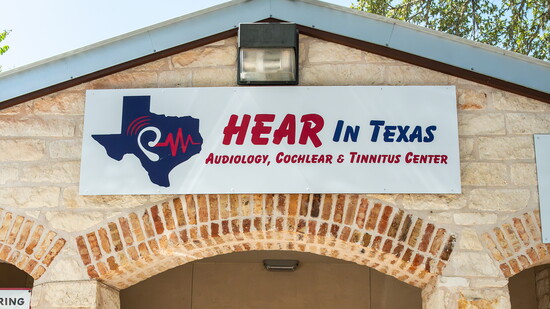
Ask Carlos Miranda who the ideal patient is at Hear in Texas, and he doesn’t hesitate:
“Someone with ears.”
Fair enough.
Spend a little time with Carlos and Jason Bernal, and you quickly realize this isn’t your typical medical practice.
They laugh a lot. They give each other a hard time. There are gentle, giant office dogs roaming around. But somewhere between the jokes and stories, something else comes through loud and clear: They genuinely care about the people who walk through their doors.
It’s a culture that Sally Miranda, Au.D., founder and owner of Hear in Texas, has been intentional about creating from the beginning.
“While clinical excellence is at the core of everything we do, you’ll quickly see this is no cold, sterile medical office,” she says. “This is advanced hearing care delivered with genuine heart and soul.”
And a big part of that heart is reserved for the veteran community.
Co-owner and chief operations officer Carlos and director of business and community relations Bernal are veterans themselves. Both served in the United States Air Force, and Bernal continues to serve in the U.S. Navy Reserve. That connection has helped shape much of the mission at Hear in Texas, particularly as they’ve learned how many veterans are living with hearing loss or tinnitus without realizing the resources available to them.
“A lot of veterans don’t even know they have hearing loss,” Carlos says.
Dealing with hearing loss isn’t always as simple as turning up the television.
Tinnitus and hearing loss are among the most common issues the practice sees in veterans. Symptoms can affect sleep and contribute to anxiety, teeth grinding and clenching, and even cognitive decline. This eventually changes how someone interacts with the people around them. Bernal says many people adapt, sometimes without realizing how much they’ve withdrawn.
“People with hearing loss start to isolate,” Carlos says. “It’s hard to be a part of the conversation, so you sit quietly.”
That is why the philosophy at Hear in Texas goes beyond treating a pair of ears.
“When we treat the person, we treat the family,” Carlos says.
It’s a statement that seems to sum up the practice pretty well.
Hear in Texas opened its first location in New Braunfels and has grown to nearly 7,000 patients in just four years, drawing from 147 Texas cities and several states. The Dripping Springs location was a natural extension, allowing the practice to better serve patients and veterans throughout Central Texas.
Every provider at Hear in Texas is a Doctor of Audiology, and the practice is built around what Carlos calls “needs-based medicine.” In other words, the goal isn’t to sell someone a hearing aid simply because they walked through the door.
“If all you need is ear wax removal, then that’s what we do,” he says.
A typical consultation includes an examination of the inner, middle, and outer ear and an audiogram, along with additional testing when appropriate. The idea is to look at the whole picture and determine what is actually causing the problem before deciding how to treat it.
For veterans, Hear in Texas has taken that same philosophy several steps further.
As an approved Department of Veterans Affairs (VA) Community Care Network provider, the practice has worked to make navigating care easier, including creating a step-by-step referral guide and participating in the VA’s External Provider Scheduling system. The technology allows the VA to see appointment availability and schedule veterans directly, helping eliminate some of the delays that can stand between a patient and care.
They also created the Veterans Resource Fair, held twice a year, which brings together Community Care providers from specialties including cardiology, neurology, and other areas so veterans can meet providers and better understand the resources available to them. The group is working toward establishing the effort as a nonprofit, with hopes of eventually helping veterans with needs the VA may not cover.
For Carlos and Bernal, it comes back to simplifying the process for people who have already spent plenty of time navigating complicated systems.
And the office dogs help, too.
The resident Bernadoodles—”Pawdiologist” Hear-O and “Dogtor” Audi-O—weigh well over 100 pounds and seem to have an uncanny ability to know when a patient could use a little extra reassurance. They are big, lovable, and very much part of the family atmosphere that Hear in Texas has intentionally created.
“We are like family,” Carlos says. “When that patient walks in, you treat them that way. That’s what they deserve.”
Maybe that’s the simplest way to explain Hear in Texas. Yes, they help people hear better. But they’re also helping people get back into the conversation, back to the dinner table, back to concerts, church, and everyday life. Everyone deserves that.
Which means Carlos is right: If you have ears, you’re their kind of people.
HearInTX.com | @hearintexas