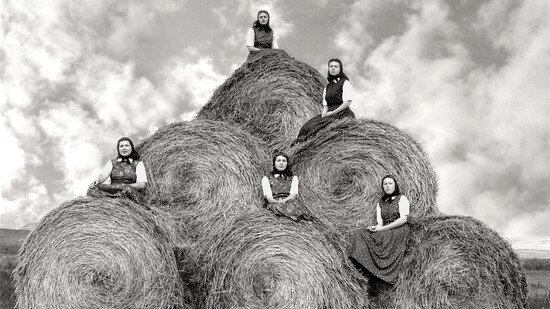
The year is 1536. An Austrian hatmaker’s strong pillars of faith have bound him to a stake—pillars like the belief in separation of church and state, pacifism, and a refusal to swear oaths. It’s hard to imagine in our age—and especially in our country—this type of religious persecution, but the Anabaptists in sixteenth century Europe were perfectly familiar with it—to the point of near extinction. But thankfully today, the Hutterites, named after the aforementioned hatmaker Jakob Hutter, live peaceably across pockets of the Great Plains, Western Canada, and Montana.
It’s been over a century since the Hutterites immigrated to the Americas and settled Montana’s rural landscape. Now dozens of Hutterite colonies call the Treasure State home, and with a steadily growing population, the need to create more colonies is rising. Faith, family, agriculture, shared responsibility, and communal living are tightly woven principles in their communities. Also called Bruderhöfe, the communities typically consist of 80 to 150 individuals and belong to one of three main branches: Lehrerleut, Dariusleut, or Schmiedeleut. While subtle customs vary among these groups, their core tenets remain identical.
One such community is the Pondera Hutterite Colony near Valier. With the colony’s construction taking approximately two years, the community moved there in 1994 and began setting up the agricultural and communal operations in its new home. Thirty years later, Pondera Colony has become an established part of the surrounding agricultural region. This agricultural indwelling is exactly how I found Jonathan Waldner, a representative of Pondera Colony, by stopping at a pop-up Hutterite farm stand this summer. After bagging up my tomatoes, Jonathan was gracious enough to tell of the community’s early years.
In the beginning, the Pondera colony went door-to-door to sell their vegetables, and participated in the Great Falls farmers market, eventually branching out into other markets. They started small, selling a little at a time while working to establish themselves within the community. By 1997, the community returned its focus toward the Flathead region, expanding its vegetable sales and connections with customers.
Of course, their work changes with the seasons. In the summer, members grow vegetables while maintaining extensive livestock operations and producing feed for their animals. “The colony has approximately 40,000 to 50,000 laying hens and around 360 dairy cows,” Jonathan says. “Making agriculture not simply an occupation, but the foundation of the community’s way of life.”
Winter on the other hand provides time for other traditional activities, including sewing and making clothing and blankets. The rhythm of the year reflects a philosophy in which work is shared, and individual responsibilities contribute to the needs of the entire community. For people unfamiliar with Hutterite life, the communal structure is very different from the individualistic traditions often associated with the American West. Members share resources and responsibilities, work together, and raise their children within the community. Yet the communities are not isolated from the world around them. Pondera Colony’s presence at farmers' markets throughout western Montana, for example, shows how Hutterites interact directly with their neighbors while maintaining their own cultural traditions. These traditions are also based in the foundation of education, as Jonathan notes.
“I teach the children at Pondera Colony about farming as well as the German language, helping connect younger generations with both the practical skills and cultural heritage of their community,” Jonathan says. For Hutterites, passing knowledge from one generation to the next is an essential part of maintaining a way of life that has endured for centuries.
As more people encounter Hutterite communities through farmers' markets, agriculture, and personal relationships, there is an opportunity to better understand the people behind the farms and businesses. What began as a small effort to establish the Pondera colony through vegetable sales has grown into a community that has spent three decades farming, raising families, preserving traditions, and deepening their community relationships. Pondera’s story is a reminder that Montana’s identity is shaped by the communities of people, however unostentatious, who work together to make those spaces home.
About the Photographer
Having spent decades capturing the heart of the American West, Laura Wilson is one of our era's most respected documentary photographers. Her books of photography include Watt Matthews of Lambshead, Avedon at Work: In the American West, Grit and Glory: Six-Man Football, That Day: Pictures in the American West, The Writers: Portraits, and Hutterites of Montana.