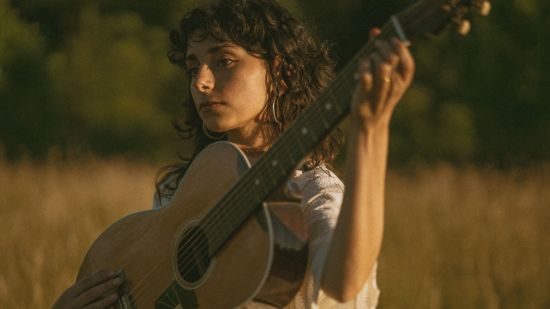
There's a Sicilian folk song called E Vui Durmiti Ancora. It translates to "and you're still sleeping." The tradition: a man stands beneath a woman's window and serenades her, hoping she'll come out. In the original, she doesn't appear — he figures she must be asleep.
Amanda Pascali's read on it? She's not sleeping. She's leaving him on read.
That's Amanda in a nutshell. She takes something ancient — a song sung across southern Italy for generations — and makes it feel as if it were written last week. Without losing any of what made it matter in the first place. Most people can't pull that off with last week's news.
She lives just north of the UT Campus now. She's a PhD fellow at UT studying ethnomusicology and anthropology. She just released her debut album, Roses and Basil, recorded in Fort Worth. She's toured the Northeast and Midwest, played Mountain Stage in West Virginia — NPR-distributed — and has a folk festival in the Czech Republic on the calendar.
Where She Comes From
Amanda's last name is Italian. Her dad grew up in Romania under a communist dictatorship. He spoke out against the government and was sent to a forced labor camp for two years. Eventually, he was granted asylum in the United States and arrived in New York City.
In New York, he met Amanda's mom. She was born in Cairo and raised in Paris. French was her first language. They fell in love, had Amanda, and she grew up in Houston, which is the most diverse city in the country.
"My great-grandfather died with a sickle in his hand," she said. "And now I'm standing on a stage playing those songs."
She picked up a guitar at twelve. Not because she had some plan, but because she didn't have a box. She was the kid who brought "weird" food to lunch and spent most of her time around adults. Music became the space she made for herself. The place she didn't have to explain anything.
She noticed early that when she played and sang, people stopped and actually listened. She understood that kind of attention was a platform. She's been using it responsibly ever since.
Translator, Traitor, Artist
There's an Italian expression, “traduttore, traditore,” which means translator, traitor. The idea is that the moment you translate something, you've already betrayed the original. You changed it.
Amanda doesn't argue with that. She leans into it. What she does with these Sicilian folk songs isn't translation in the textbook sense. It's closer to rewriting. Reimagining. Taking a song from another century, another language, another world entirely and asking: what's the version of this that someone right now can actually feel?
She won a Fulbright Fellowship to do exactly that — spending time in Sicily, living the research. Near the end of the fellowship, she set up a camera on a rooftop in a small seaside town, played the material she'd been working on, and posted it online.
It went viral. La Repubblica, Italy's biggest newspaper, interviewed her. Messages started coming in from the Sicilian diaspora scattered across Europe and the U.S. People she'd never met, telling her she'd told their story.
There were also haters. People who felt she had no business touching these songs. She didn't grow up speaking Italian. She learned it in school, fell in love with it, then earned the fellowship that let her go deep. The criticism didn't stop her. There's a lot less of it now.
"If I sang these songs in the original language, there's no need for me," she said. "That's better left to someone from that part of the world. What I'm telling is a different story — the story of the diaspora. The people who moved away. The people several generations removed."
Roses and Basil
The album came together in Fort Worth with producer Robert Ellis, a Texas guy through and through. Amanda describes what he brought to the table as "Texas flavor to Sicilian music," which she says, with full confidence, is unprecedented. It's a mix of traditional folk songs and originals, sung in Sicilian, Italian, and English, sometimes mid-sentence, because that's genuinely how Amanda thinks.
She performs with her husband, Addison Freeman, who plays mandolin, violin, and cello and handles string arrangements for the studio and for live shows. On their recent two-week tour that took them to West Virginia, Chicago, Minneapolis, Madison, Boston, and New York, their guitarist was a friend from Sicily making his first-ever trip to the United States.
His specialty? Bluegrass.
That detail — a Sicilian bluegrass musician on his first trip to America, touring with a woman from Houston who translates Sicilian folk songs — tells you most of what you need to know about what Amanda has built.
And Now, Austin
Amanda is still figuring this city out, which she's the first to admit. She takes the same bus to UT every day and only recently noticed it stops at other places. Although she moved to Austin almost a year ago, she says there is still so much to discover: sitting in with other musicians at world music nights, dancing two-step and swing with her husband around town.
"This city is deceptively small," she said, "but it has a world inside it made up of little other worlds."
She's got a wishlist: the 04 Center, the Paramount, Cactus Cafe. In the meantime, she told me Batch Craft Beer — where kids run around, dogs show up, and the whole thing feels like a neighborhood gathering — reminds her of southern Europe. That's a real compliment.
She played at the Kennedy Center. She appeared in the European Parliament, where she was introduced in the program as an ambassador for the Sicilian language abroad.
When I asked what she wants people to take from Roses and Basil, she said she doesn't make music for herself. She makes it for the people who came before her and for everyone listening now who maybe never felt like they had a box either.
Her great-grandfather worked the fields. Her dad survived a labor camp. Her mom crossed an ocean. And now Amanda Pascali is on stages across the world, singing their songs in a language of the heart that needs no translation.
That's a story worth telling.
Follow Amanda at amandapascali.com and on Instagram @amandapascali. Roses and Basil is available on all streaming platforms.