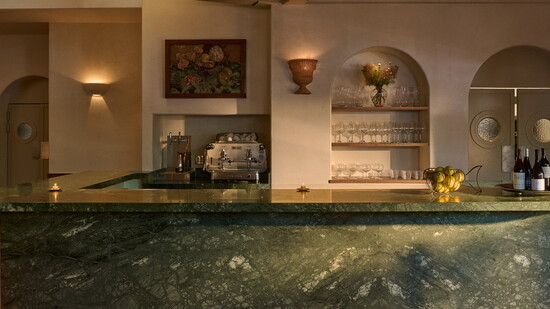
“I wanted Ancora to feel comfortable, established, almost like it had always been here,” Luca Crestanelli says.
That feeling matters to him. Ancora is polished, but not formal. The bar feels easy to settle into, the tables feel close enough to give the room some life, and nothing about the space asks for too much attention. Crestanelli wants people to notice how they feel there more than how carefully everything was put together.
The name helps explain where he is in his career. Ancora can mean “again” in Italian, and it can also mean “anchor.” He liked both meanings.
“At this point in my career, I’m not trying to reinvent who I am,” he says. “In some ways I’m coming back again to the things I’ve always loved about restaurants—simple food, hospitality, familiarity, consistency.”
Crestanelli grew up in Verona, later cooked in Los Angeles, spent years in the Santa Ynez Valley, and eventually came to Montecito. Each place changed the way he thought about restaurants.
“Los Angeles taught me energy and about many ways people live and eat,” he says. “Santa Ynez taught me about ingredients, but especially community. It’s rewarding to become part of people’s lives. And Montecito is about continuity.”
That last part feels especially true at Ancora. Crestanelli is not building the restaurant around spectacle or one big experience. He is more interested in the kind of place that starts to feel familiar after a few visits.
“People here understand simplicity when it’s done well,” he says. “They appreciate beautiful ingredients, seasonality and good hospitality, but they don’t necessarily need a lot of complication around it. Not for their everyday.”
The roots of that approach go back to Verona. When Crestanelli talks about the food he remembers growing up, he does not talk about elaborate meals. He remembers things that were simply part of life: something cooking for hours, a basic pasta, roasted meat, vegetables that happened to be in season.
“No need to say it was in season or local,” he says. “It simply was.”
There is something revealing in that answer. Much of what gets described now as seasonal, local or ingredient-driven was not a philosophy to him then. It was just food.
That memory still shapes the way he cooks.
“The simplest ones probably carry the most memory for me,” he says of the dishes at Ancora. “They’re not about showing technique. They’re about doing something very recognizable as well as you possibly can.”
The restaurant follows the same instinct. The point is not to prove how much thought went into every detail. It is to make the whole experience feel natural enough that people want to come back.
That may be why the restaurant feels less like a statement about what comes next and more like a collection of things he knows matter after years spent cooking and hosting in different places.
That is where the other meaning of Ancora comes in.
“The idea of an anchor also feels important,” Crestanelli says. “A restaurant can become a place where people connect, both in the community and the team that works it.”
He keeps his idea of a successful night simple too.
“I hope they leave happy and already thinking about coming back,” he says. “I would rather they remember that they ate really well, they were taken care of, the room felt good, and they had a great evening.”
He is not asking for much more than that.
"I’m coming back again to the things I’ve always loved about restaurants."
"The simplest ones probably carry the most memory for me. They’re not about showing technique. They’re about doing something very recognizable as well as possible."