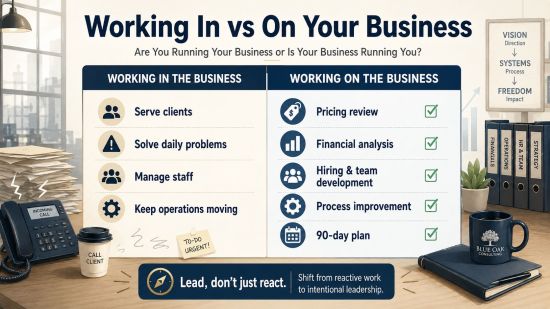
If you ask most small business owners what they spend their time on, the answer sounds productive: serving clients, managing staff, handling operations, solving the problems that show up every day. All of that is necessary. But it describes working in your business - not on it.
The distinction matters more than most owners realize, and it tends to become most visible at the moments when growth stalls, margins erode, or the owner simply cannot take a week off without the business wobbling.
What Is the Difference Between Working In and On Your Business?
Working in your business means doing the work. Delivering the service. Managing the day-to-day. Answering calls, supervising jobs, keeping the wheels turning. For most small business owners, this is where the majority of their time goes - understandably so. It is often what they are best at, and it is always what feels most urgent.
Working on your business means stepping back from daily execution to focus on the systems, strategy, and structure that determine where the business is headed. Pricing reviews. Financial analysis. Hiring and team development. Process improvement. Long-term planning. These are the activities that build a business capable of growing, scaling, and eventually running without the owner's constant presence.
Think of it like being both a player and a coach. As a player, you are on the field executing. As a coach, you are studying the game, adjusting the strategy, and developing the team. Most small business owners are excellent players. What limits their growth is not playing ability - it is the absence of coaching time.
How Do You Know If Your Small Business Is Ready to Grow?
The honest answer is: not when revenue is climbing, but when the business can sustain that growth without the owner absorbing all the pressure. That requires financial systems, documented processes, and visibility into the numbers that most owners have not built yet - because they have been too busy working in the business to work on it.
A business that is ready to scale has a few things in place. The owner can read their financials and act on them. Pricing reflects actual costs and margins. Cash flow is tracked and understood. And there is someone - whether internal or a fractional CFO - helping translate the numbers into decisions.
What Financial Systems Do You Need Before You Can Scale?
This is where working on the business becomes concrete. Scaling without financial infrastructure is like adding floors to a building without checking the foundation. The most common gaps are:
No reliable cash flow visibility. The owner finds out about a cash shortfall when it is already happening, not weeks ahead.
Pricing that has not kept pace with costs. Revenue is growing but margins are shrinking, because no one has reviewed what it actually costs to deliver the work.
No monthly financial review cadence. The P&L exists, but no one is reading it with strategic intent on a consistent schedule.
No leading indicators. The business tracks lagging numbers - last month's revenue, last quarter's profit - but has no forward view into what is coming.
These are solvable problems. But they require time and attention that can only come from stepping outside the day-to-day.
How Do You Stop Reacting to Financial Problems and Start Planning Ahead?
It starts with protecting time for on-the-business work. Even a few hours per month, held consistently, changes how a business operates over time. Block it. Treat it like a client commitment.
Getting the right partners in place matters just as much. A fractional CFO is not an expense - it is the investment that creates the space for an owner to lead rather than just execute. For small businesses asking what a fractional CFO actually does, the simplest answer is this: they handle the financial visibility, analysis, and strategy so the owner can make better decisions faster, without needing to become a finance expert themselves.
A Final Thought
The goal of building a business should be to create something that serves its customers, supports its team, and gives its owner genuine freedom - financially and personally. That does not happen by accident, and it does not happen while you are too busy to look up.
The most important work you will do for your business is often the work that looks least like work. Protect time for it.
Chris Thomas is the founder of Blue Oak Consulting, a fractional CFO firm serving small businesses across North Texas. Visit www.blueoakconsulting.net to learn more.