Think about the last time a customer pushed back on your service-call fee. A crew is standing by, the schedule has an opening, and the person on the phone hesitates at the charge. It is the easiest thing in the world to say do not worry about the fee, we will take care of you. A plumbing and drain contractor across the north Dallas suburbs, doing around six million dollars a year, waived that fee so often it had practically stopped being a fee at all. Every waiver felt small and generous in the moment. Added up across a year of service calls, they came to real money the business never saw.
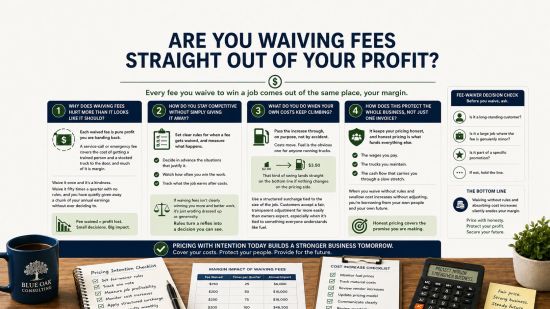
Why does waiving fees hurt more than it looks like it should?
Because each waived fee is pure profit you are handing back. A service-call or emergency fee, often somewhere between two and three hundred dollars, is not padding. It covers the cost of getting a trained person and a stocked truck to the door, and much of it is margin, the money left after the job's real costs are paid. When you waive it, you do not lose a slice of a big number. You lose the part that would have been profit. Do it once and it is a kindness. Do it fifty times a quarter with no rules, and you have quietly given away a chunk of your annual earnings without ever deciding to.
How do you stay competitive without simply giving it away?
You set clear rules for when a fee gets waived, and you measure what happens. The goal is not to become rigid. It is to stop waiving on instinct. Decide in advance the situations that justify it, a long-standing customer, a large job where the fee is genuinely minor, a specific promotion, and hold the line the rest of the time. Then watch two numbers together. One is how often you actually win the work. The other is what the job earns after costs. If waiving fees is not clearly winning you more and better work, it is just erosion dressed up as generosity. Rules turn a reflex into a decision you can see.
What do you do when your own costs keep climbing?
You pass the increase through on purpose, not by accident. Costs move. Fuel is the obvious one for anyone running trucks. A jump from under three dollars a gallon to three and a half, the kind of swing crews have lived through, lands straight on the bottom line if nothing changes on the pricing side. The answer is a structured surcharge, a small, clearly explained add-on tied to the size of the job rather than slapped uniformly on every ticket. Customers accept a fair, transparent adjustment far more easily than owners expect, especially when it is tied to something everyone understands like fuel. What erodes a business is not the rising cost. It is absorbing it silently while your pricing pretends nothing happened.
How does this protect the whole business, not just one invoice?
It keeps your pricing honest, and honest pricing is what funds everything else. The wages you pay, the trucks you maintain, the cash flow that carries you through a slow stretch, all of it comes out of margin. When you waive without rules and swallow cost increases without adjusting, you are not being generous to customers. You are borrowing from your own people and your own future. Setting fee-waiver rules and passing through real cost increases is not about squeezing the customer. It is about making sure the price you charge actually covers the promise you are making.
A Final Thought
There is dignity in charging fairly for good work. A price that quietly fails to cover its costs helps no one, not the customer who comes to depend on it, and not the team whose livelihood rests on the company staying strong. Pricing with honesty and care is a quiet form of stewardship, making sure the good work you do can keep being done for the people who count on it.
Chris Thomas is the founder of Blue Oak Consulting, a fractional CFO firm serving small businesses across North Texas. Visit http://www.blueoakconsulting.net to learn more.
Article by Chris Thomas
Photography by AI Generated