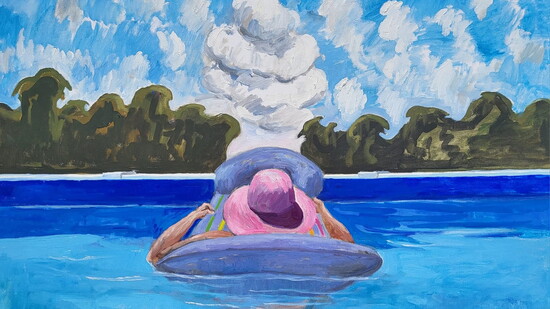
At 93 years old, John Franklin Sauers still loads up his easel, heads outdoors, and paints plein air. For the Harford County native, making art has never been about simply recording what he sees. Instead, his work explores something deeper: the relationship between people, landscape, and the responsibility that comes with both.
Over decades of painting, sketching, teaching, and observing, Sauers has built a body of work rooted in place, shaped by curiosity, and guided by a quiet philosophy that has remained remarkably consistent. “My main theme, which I still pursue, is the concept of God in nature,” Sauers said.
That idea has become the foundation of a career spanning more than seven decades and multiple creative chapters, from graphic design and urban sketching to plein-air painting, museum exhibitions, and mentorship.
Born and raised in Harford County and now living in Darlington, Sauers developed an appreciation early for open landscapes and the rhythms of rural life. Though he later spent years living and working elsewhere, including a significant chapter in Southwestern Virginia, his connection to Maryland remained a constant influence.
Sauers' artistic path began early. After earning a scholarship to the Maryland Institute College of Art in 1951 and later serving in the Army before returning to complete his education, Sauers launched what he jokingly describes as one of two careers. “There are three ways to survive as a fine artist,” Sauers said. “Be born wealthy, marry money, or get a day job. I chose the latter.”
That day job became a 35-year career with Baltimore Gas and Electric, where he worked to create advertising layouts, illustrations, and presentation materials. At the same time, he continued developing as a fine artist.
During his lunch breaks, Sauers would walk through downtown Baltimore with a sketchbook in hand, documenting streets and neighborhoods as the city transformed. His charcoal studies eventually became what he calls “The Vintage Series,” preserving scenes that no longer exist.
Yet regardless of whether he was sketching city blocks or mountain views, nature remained central. Sauers’ paintings are known for vibrant landscapes, bold composition, and recurring imagery drawn from agricultural life, including barns, fields, woodlands, and one of his most recognizable symbols: round hay bales. “I use the round hay bales as a circular form and represent basically the fecundity of the earth,” Sauers said.
For him, the subject goes far beyond farming and represents his views on preservation. “Hay is used for feed for livestock, and then that livestock becomes part of the food chain for humans,” he said. “We’ve been given something. Let’s protect something because we depend on that for our survival.”
That philosophy has shaped both his artwork and his broader perspective on conservation and stewardship. After retiring in 1990, Sauers and his wife moved to Virginia, where he became a resident artist at the Arts Depot and later received artist residencies at the renowned William King Museum in Abingdon. Teaching and mentoring became an important part of his life as he instructed painting and drawing while continuing to build his own artistic practice. Eventually, he returned to Maryland and to the landscapes that first inspired him.
Over the years, his work has appeared in museums and galleries across the region and earned recognition nationally. Recent honors include being named a Harford Living Treasure, recognition from the State of Maryland for his artistic contributions, and the 2024 Harford Land Trust Conservationist of the Year Award.
Despite the accolades, Sauers remains focused less on achievement than on continuing to create. “You live within the spirit of place, and out of the spirit of place something develops, and that’s the beauty of art,” Sauers said. “It opens up questions. This is my life.”
For Sauers, that work continues, one sketch, one landscape, and one moment of wonder and appreciation at a time.
You live within the spirit of place, and out of the spirit of place something develops, and that’s the beauty of art.