For nearly three decades, Chelsea Art Group has helped redefine how art lives within the home. Founded in 1996 by Donald Christiansen, alongside partners Hendra Josiah and Sylvia Roth, the New York–based art consultancy has built its reputation on one guiding principle: great art should not only be collected, but lived with.
Operating by appointment in New York City, Chelsea Art Group advises homeowners, collectors and designers on building thoughtful, personalized collections that reflect both aesthetic ambition and emotional connection. From emerging voices to museum-caliber works, the firm approaches art not as decoration, but as an essential architectural and narrative element of a space.
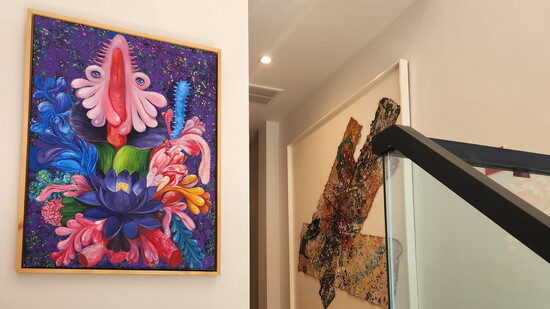
That philosophy was brought vividly to life during The Art of the Home, a recent immersive showhouse experience that transformed a private Bergen County residence in Upper Saddle River into a living gallery. Designed to demonstrate the power of art integrated thoughtfully into residential environments, the showcase paired blue-chip and contemporary works with leading interior designers, allowing visitors to experience how scale, materiality and emotional resonance shift when art is placed in context.
“The goal was to show what happens when art isn’t isolated on a white wall,” Christiansen shares. “When it’s part of the architecture of daily life, it becomes something you understand differently.”
The showhouse reflected Chelsea Art Group’s core belief that meaningful collecting begins with exposure—seeing exceptional work in real spaces, guided by expertise. Rather than presenting art as untouchable or intimidating, the installation invited visitors to imagine how museum-level pieces could exist naturally within their own homes.
Throughout the residence, designers collaborated closely with Chelsea Art Group to curate installations that felt intentional and lived-in. In the lawn and exterior spaces, Vik Muniz’s Mnemonic Vehicle series anchored the experience with sculptural reflections on memory and desire. The enlarged recreations of childhood toy cars—fabricated in industrial materials—explored nostalgia, aspiration and the objects we carry with us through time.
Inside, the lower stairwell and gallery featured commanding works by Didier William, whose layered surfaces and repeated eye motifs reimagine the Black figure with spiritual symbolism and contemporary urgency. The wine lounge and cellar paired Emil Lukas’ luminous string and bubble-wrap compositions with Tom Baril’s refined photographic studies, creating a space defined by quiet rhythm and restraint.
In the grand stairwell and foyer, works by Artur Lescher, Robert Beauchamp, Richard Dupont and Philip Taaffe demonstrated how abstraction, form and material can guide movement through a home. Nearby, the dining room presented contemplative pieces by Ching Ho Cheng and Naama Tsabar, where fragility, tension and silence created a meditative atmosphere for gathering.
Other rooms highlighted the emotional range of art in domestic settings. Willie Cole’s sculptural iron works transformed a transitional hallway into a space charged with cultural memory. Vik Muniz’s Postcards from Nowhere appeared in the kitchen and breakfast nook, reconstructing familiar travel imagery into layered meditations on distance and perception. Powder rooms featured Peter Fisher’s New York City photography, proving that even intimate spaces can carry artistic weight.
One of the showhouse’s most striking moments came through the inclusion of historical works by artists such as Larry Rivers, Sam Gilliam, Lee Krasner and Antonio Saura, positioned alongside contemporary voices. A rare public presentation of Gilliam’s Upside Down Man, on view for the first time after more than 40 years in a private Washington, D.C., collection, underscored the exhibition’s depth and curatorial ambition.
Throughout the home, the art did more than fill walls. It shaped mood, movement and conversation. Visitors lingered. They asked questions. They imagined.
That response, Christiansen says, is the point.
“Our role is to help people identify work of lasting significance and place it where it can be enjoyed every day,” he notes. “Art shouldn’t feel distant. It should feel personal.”
Chelsea Art Group’s approach emphasizes discretion, education and long-term relationships. Rather than focusing on transactions, the firm works closely with clients to develop collections over time—whether acquiring a signature statement piece, expanding an existing collection or curating an environment with a distinct point of view.
The showhouse also carried a philanthropic mission, with proceeds benefiting the Tunnel to Towers Foundation, further reinforcing the idea that art and design can serve a broader purpose beyond aesthetics.
As interest grows in integrating fine art into residential design, Chelsea Art Group continues to lead the conversation—showing that when art is placed thoughtfully, it doesn’t just elevate a home. It transforms how that home is experienced.
For Christiansen and his partners, the message is clear: art belongs where life happens.
To learn more or begin a private consultation, reach Chelsea Art Group at info@chelseaartgroup.com or 908-656-4804. More information is available at chelseaartgroup.com.