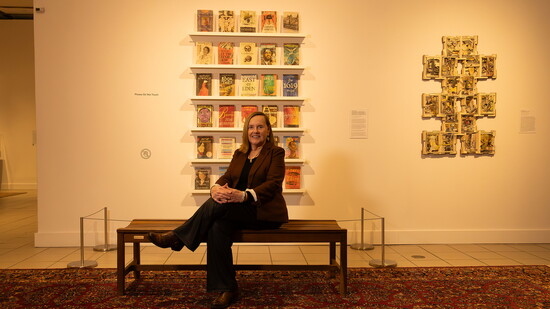
The city of Morristown has one of the most vibrant and artistic cultures in New Jersey. So much of it began as the vision of one remarkable woman, Kadie Dempsey, who has been a strong force in raising awareness of social justice issues, building communities, and using the arts to uplift people, especially women, for most of her life.
“As women, we are naturally nurturers, it’s why I’m good at my job, I care about people. It’s why I’m good at community building, I want to take care of everybody,” said Dempsey.
Before bringing her talents to Morristown, first as Director of Arts in Community at Morris Arts and now as Director of Community Engagement at MPAC, she used photography to put a face on people who often remained invisible. An early project was “Hidden Hungry,” commissioned by Wakefern Food Corporation (ShopRite) for its Campaign on Hunger. Dempsey said, “It revealed the quiet, often unseen struggle of food insecurity among working people.”
She then focused her lens on women who experienced trauma. The photos were part of an exhibition called “Recovery.” Dempsey recalled that it was done in black and white, with “each portrait paired with the woman’s personal narrative and the healing modalities that supported her recovery.” The exhibition was presented at the International Conference for Survivors as a temporary installation at the Morris Museum for a fundraising event and was displayed at Drew University’s library.
Morristown gained a great deal when Dempsey brought her passion to Morris Arts, where she created the Pumpkin Illumination. It literally came to her as a vision while she was looking at the pond in front of the Vail Mansion. She was hit by the notion, “it would be cool to have pumpkins illuminated in it.” As those who have attended know, it isn’t a passive event. Students make masks, and residents bring carved pumpkins. It’s interactive, demanding community participation. This is exactly the way Dempsey likes it.
There’s much more to her tenure at Morris Arts than pumpkins. She helped design a mentoring program at Morristown High School to help young artists strengthen their portfolios for college admissions. She noted, “Some of their artwork explored difficult or disturbing themes.” During this time, she worked with a woman who also served as her mentor. The provocative art alarmed this woman, but not Dempsey. She countered, “I encouraged my mentor to appreciate the disturbing images as a positive outcome of how art can help young people express what they are navigating in the modern world.”
When she started at Morris Arts, it was run by a small staff of women. While not lucrative, Dempsey, a single mother at the time, was drawn to it because it was fulfilling to utilize the arts in a way that hadn’t been done before. It was clear that “the arts can impact communities and women in powerful ways.” She explained, “I created my own life and my own job. I took a little bit of this and a little bit of that.”
Dempsey’s impact on the community went into high gear after she was introduced to the term “Creative Placemaking.” A colleague explained to her that she was already putting this concept into practice without even knowing it. He encouraged her to earn a certificate in Creative Placemaking at the Edward J. Bloustein School of Planning and Public Policy at Rutgers University. “This was an eye-opener for me, to see how art fit into urban planning and community development. I believe the arts are essential to creating vibrant, livable communities.”
Dempsey brought this new insight to MPAC and CORE Creative Placemaking, a firm dedicated to transforming public spaces into vibrant, inclusive, community-centered places. Her partner at CORE is her husband, the NJ-based artist Dan Fenelon.
Near and dear to Dempsey’s heart is MPAC’s Creative Aging Program, which goes well beyond crafts. More like a college course, it meets twice a week for 10-weeks and culminates in a show. “It uplifts me,” said Dempsey. “I see the power of the arts bringing people together like an old-time sewing circle. It’s not just art, but the process and community, making the art together.”
Dempsey was also instrumental in MPAC’s Inclusion initiative, which began as a commitment to better serving Morristown’s diverse community. “It has since become woven into the organization’s programming philosophy, resulting in multiple free, outdoor community events, ” said Dempsey. “Inclusion is no longer a separate project; it’s part of the heartbeat of the institution.”
Then there is Theatre of Light, which has become an annual event featuring performances, ice sculpture, fire dancing, and more. “It’s about upliftment. When you see kids walking around with crowns with lights, you can’t help but be happy.”
Dempsey may have brought light to Morristown through her initiatives, but what lights up her face is talking about the blooming creative community of women in town. “Empowering women creators is one of my greatest passions. I believe in helping women see possibilities in themselves that they may not yet recognize.”
Women don’t always recognize their own artisticness, downplaying it. Dempsey said, “A woman will say I’m not an artist, but I knitted a hat. Women sew and make quilts. Women can do things that people may think are not art. Cooking, sewing, juggling work and family, there’s an art to that.”
Expanding on this subject, Dempsey said, “Women need each other at every age and stage. In a world that bombards young and older women with unrealistic messages, creative communities become places of truth, encouragement, and belonging. I am fortunate to have friendships with women in their 20s through their 90s; we learn from each other, inspire each other, and remind each other of our own magic.”
Dempsey concluded, “When women are seen, supported, and celebrated, they thrive. And when women thrive, the creative community becomes richer, more inclusive, and more imaginative for everyone.”
Empowering women creators is one of my greatest passions, helping women see possibilities in themselves that they may not recognize.
When women are seen, supported, and celebrated, they thrive. And when women thrive, the creative community becomes richer, more inclusive, and more imaginative for everyone.