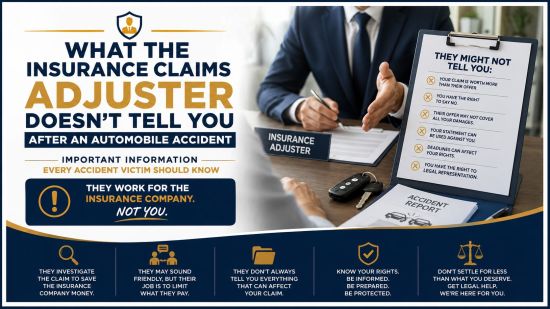
After an automobile accident, one of the first people you will likely hear from is an insurance claims adjuster.
The adjuster may sound friendly, professional, and helpful. Most are. However, many accident victims mistakenly believe that every adjuster involved in the claim is looking out for your interests.
That is not always the case.
One of the most important things to understand after an accident is that there is a significant difference between:
Your Insurance Adjuster
The At-Fault Driver's Insurance Adjuster
Understanding that difference can help you make better decisions and avoid costly mistakes.
PART ONE: YOUR INSURANCE ADJUSTER
Who Does Your Insurance Adjuster Work For?
Your insurance adjuster works for your insurance company.
You pay premiums to that company, and the company owes certain obligations under your policy and applicable law.
That does not mean the adjuster is your personal advisor or attorney.
However, your insurer generally has contractual obligations to you that do not exist between you and the at-fault driver's insurance company.
What Your Insurance Adjuster May Not Tell You
1. You May Have More Coverage Than You Realize
Many accident victims focus entirely on the at-fault driver's insurance.
Your own policy may include valuable benefits such as:
Medical payments coverage
Personal injury protection
Collision coverage
Rental reimbursement coverage
Uninsured motorist coverage
Underinsured motorist coverage
Enhanced underinsured motorist coverage (in some states)
GAP coverage
Many people never ask what benefits are available under their own policy.
2. You Can Request a Copy of Your Policy
Many people have never read their insurance policy.
Your policy is a contract.
It contains important information regarding:
Coverage
Exclusions
Deadlines
Reporting requirements
Benefits
You have a right to understand what coverage you purchased.
3. There May Be Additional Insurance Available
Sometimes more than one policy applies.
Examples may include:
Household policies
Umbrella policies
Policies covering other vehicles
Resident relative policies
A thorough coverage investigation can be important in serious injury cases.
4. Your Own Statements Can Affect Coverage
Many policyholders assume conversations with their own insurer are informal.
They are not.
Statements regarding:
How the accident occurred
Who was driving
Injuries
Vehicle use
can affect coverage decisions. So, you should always provide accurate information.
5. Settlement May Affect Other Rights
Settling one portion of a claim may affect another.
For example:
Property damage claims
UM/UIM claims
Medical payment claims
may involve different considerations.
Before signing releases, understand what rights may be affected.
PART TWO: THE AT-FAULT DRIVER'S INSURANCE ADJUSTER
Who Does the Other Driver's Adjuster Work For?
This is perhaps the most important point in this guide.
The at-fault driver's insurance adjuster does not work for you.
The adjuster works for:
The insurance company; and
The insured driver who purchased the policy.
The adjuster's job is to investigate, evaluate, negotiate, and resolve claims on behalf of the insurance company.
That is not a criticism. It is simply the nature of the relationship.
What The Other Driver's Adjuster May Not Tell You
1. The First Settlement Offer May Not Be the Best Offer
Shortly after an accident, you may not know:
The full extent of your injuries
Whether future treatment will be necessary
Whether surgery will be required
Whether permanent injuries exist
A quick settlement may close your claim before these questions are answered.
2. Your Injuries May Become Worse
Many accident victims initially experience:
Mild soreness
Stiffness
Minor discomfort
Days or weeks later, symptoms may become significantly worse.
What appears to be a minor injury immediately after an accident may develop into something much more serious.
3. Recorded Statements Can Have Consequences
Many people assume recorded statements are routine.
What they may not appreciate is that:
The recording becomes permanent;
It may be reviewed years later;
It may be compared to medical records;
It may be used during litigation.
Every recorded statement matters.
4. The Insurance Company May Question Your Injuries
Even when an accident clearly occurred, disputes sometimes arise concerning:
The severity of injuries;
Whether treatment was necessary;
Whether symptoms are accident-related;
Whether prior conditions contributed.
These issues frequently become part of the claim evaluation process.
5. Social Media Can Affect Your Claim
Many accident victims do not realize that public social media posts may later be reviewed.
Photographs and comments can sometimes be taken out of context and used to challenge portions of a claim.
6. The Insurance Company May Not Explain Every Available Source of Recovery
The other driver's insurance company generally evaluates its own insured's exposure.
It may not be responsible for identifying:
Your UM/UIM coverage;
Additional household policies;
Umbrella coverage;
Other available benefits.
Those issues often require independent investigation.
7. Time Can Affect Your Claim
Evidence may disappear.
Witnesses may become difficult to locate.
Surveillance footage may be erased.
Memories fade.
Prompt action is often important.
8. Insurance Policy Limits May Be Important
Many accident victims assume that all drivers carry substantial insurance.
Some drivers carry only minimum limits.
In serious injury cases, policy limits may become a critical issue.
Understanding available coverage is often one of the first steps in evaluating a claim.
What Neither Adjuster May Tell You
Regardless of which adjuster you are speaking with, there are several things that accident victims often learn only later.
Your injuries may take time to develop.
Your vehicle may be worth less even after repairs.
Medical bills may contain errors.
Additional insurance coverage may exist.
Future medical treatment may be necessary.
Settlement documents can permanently close claims.
Small mistakes early in the process can have significant consequences later.
Questions Every Accident Victim Should Ask
After an accident, consider asking:
What insurance coverages apply?
What are the liability policy limits?
Do I have UM/UIM coverage?
Are there additional policies available?
Should I provide a recorded statement?
What documents am I being asked to sign?
Have all injuries been diagnosed?
Have all medical bills been identified?
Could future treatment be necessary?
Have I fully understood the consequences of settlement?
The Most Important Thing to Remember
Insurance adjusters perform an important role in the claims process.
Most are professional, courteous, and knowledgeable.
However, no insurance adjuster—whether from your company or the at-fault driver's company—can be expected to care as much about your future as you do.
You are ultimately responsible for protecting your own interests.
The more you understand about insurance coverage, injury claims, medical treatment, and settlement decisions, the better positioned you will be to make informed choices.
Final Thoughts
Many accident victims assume that insurance claims are straightforward. In reality, injury claims often involve medical issues, legal issues, insurance issues, and financial issues that may not become apparent immediately.
Understanding the difference between your insurance adjuster and the at-fault driver's insurance adjuster is one of the most important steps you can take after a collision.
Ask questions. Gather information. Read documents carefully. Understand your coverage. And remember that decisions made in the days following an accident can affect your rights long after the vehicles have been repaired and the injuries have healed.