Tell our readers a little about yourself.
We’ve lived in Colorado for 12 years and in BackCountry for 7 years. It’s the longest we’ve lived anywhere, so Colorado is home. As a sports family, I’ve been in and around sports my entire life, as an athlete, the wife of a sports executive,and a mom of athletes. My education and interest in sport psychology continue to provide the lens through which I view my personal and professional life.
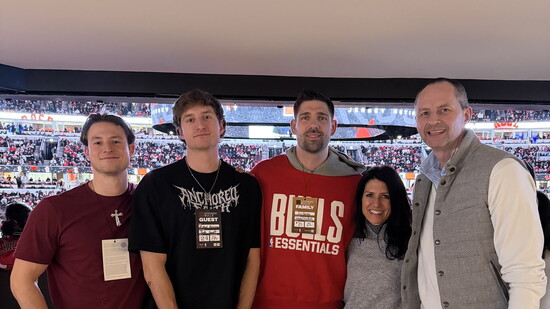
My husband, Arturas, and I have three sons. My husband and oldest son work in Chicago, so we travel back and forth often. Our middle son works in exercise physiology at Resilience Code in Englewood, and our youngest studies Communications and Sports Studies at CU Boulder.
What was your inspiration for Beyond the Scoreboards?
I’ve worked in counseling and sport psychology for over two decades. Most recently, as director of MindCode at Resilience Code, I focused on patients’ mental health and performance. This work deepened my passion for understanding the relationship between the mind, brain and body, and inspired my work to develop athletes’ mental fitness to improve resilience.
I named my business Beyond the Scoreboards because athletes are humans first. When competition ends, WHO you become in pursuit of excellence matters more than the final score. We can’t control outcomes, but we always control our execution. Realizing potential requires thinking beyond scoreboards to develop character and mental endurance.
Why does investing in mental performance matter, and what are some mental hurdles most athletes face?
Investing in mental training is important because you can’t separate the mind from the body. I like to say: the brain believes what the mind tells it and the body responds. Second, talent and physical skill will only take you so far. At some point, the difference-maker becomes how well you can manage your thoughts and emotions, because our psychology guides our physiology.
I define mental performance as the application, evaluation and adjustment of psychological tools in high-stakes settings. Before you can apply the tools, you must first acquire the skills through mental fitness. I describe mental fitness in 4 pillars: Sleep, Mental Nutrition, Mental Training and Mental Recovery. These are critical to building holistic resilience.
Most performance breakdowns, like low confidence or pressure, stem from poor energy management and untrained attention. I teach athletes to self-assess and make real-time adjustments, instead of replaying mistakes or worrying about outcomes.
What are some useful tools you recommend to your athletes?
Mindset is the first tool I address. I contrast an “average” mindset—focusing on things beyond our control—with an “elite” mindset, which views failure as feedback and mistakes as necessary. This isn't just positive self-talk; an elite mindset consists of TRUE statements that are neutral. For example, “mistakes guide adjustments” or “failure is feedback.” Both statements are true and objective. Both statements present an invitation or opportunity to take action, not a requirement. An elite mindset requires leaning into the uncomfortable, accepting responsibility of action and inaction and consistently directing attention to what is in one’s control.
Another powerful tool is the breath. It develops cognitive stability and serves as a bridge to the present moment. Daily breathing practices prep athletes for managing the pressures of competition and maintaining poise under load. These tools help people deploy the best versions of themselves in school, work or relationships.
Can you share what “community” means to you as a successful business owner?
Community means serving others. My hope is a bit paradoxical: helping people realize their unique virtues develops a sense of identity rooted in who they are rather than what they do, which remains stable over time. I believe everyone can learn the tools embedded in mental fitness training to improve the quality of life in all "arenas,” pun intended.
Do you have any lessons learned you would like to share?
The most valuable lesson I’ve learned was on the golf course. It has to do with the power of self-cuing. I often found myself saying, “Don’t hit the ball in the water,” and inevitably…I would hit it in the water. I had to learn: “Where FOCUS goes, energy flows.” Shifting my focus from what I don't want to do to what I want to do (connect smoothly with the ball) was a game-changer.
What’s the best piece of advice you’ve ever received?
Stay curious, be kind and practice gratitude.
What are some of your favorite spots around town in Lone Tree/Highlands Ranch?
My favorite place is on the trails running or hiking in the BackCountry; the mountain views are spectacular. For food, I love Edo Higan for sushi, White Chocolate Grill and Sierra!
To learn more about Beyond the Scoreboards: https://beyondthescoreboards.com
When competition ends, WHO you become in pursuit of excellence matters more than the final score. Realizing potential requires thinking beyond scoreboards to develop character and mental endurance.