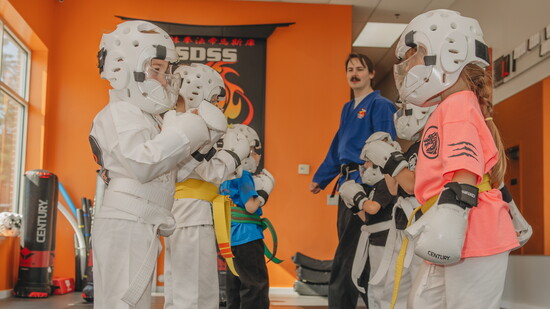
Most parents don’t enroll their children in martial arts because they dream of raising the next black belt. They’re looking for something that’s harder to teach: confidence, discipline, respect, resilience.
The high kicks, one-two punches, and swinging nunchaku may be what draws kids in. But at SDSS Martial Arts in Ridgefield, it’s the life skills developed along the way that keep families coming back.
“From the moment you walk through the door, our main philosophy is community,” says Sifu Chris Roos, who owns and runs the Ridgefield school. “We want the atmosphere to feel like students come first—kids and adults both. At a lot of schools, it can feel like the focus is on the next belt test. With us, we want to make an impact on these kids’ lives. I know that sounds corny, but I really believe it’s true.”
SDSS, founded in 1994, is Ridgefield's longest-running martial arts studio. The school is rooted in the Shaolin tradition of kung fu. SDSS operates many locations throughout Connecticut and the Northeast, with instructors gathering weekly for additional training with Professor Mikael Meyer, a 9th-degree black belt. Chris's martial arts journey began as a young child, and having the ability to further his expertise is something he deeply values.
“That’s something you don’t really get from a lot of martial arts schools,” Chris says. “Many of them train their instructors and leave it there. We’re always re-certifying and re-checking our instructors.”
That commitment to consistency and ongoing training helps set SDSS apart in an industry where “McDojo”—a tongue-in-cheek nickname for schools that prioritize rapid belt promotions over meaningful instruction—has become part of the martial arts lexicon.
Chris explains that there are many disciplines within martial arts—karate, taekwondo, and jujitsu among them—and practitioners often have strong opinions about which is best.
“What people don’t always realize,” he says, “is how much those disciplines actually share. Think of it like this: kung fu is the math, the scaffolding. Physics, chemistry, biology—they all use math; they just apply it differently. Karate, taekwondo, and jujitsu are doing the same thing with kung fu. They’re taking that same underlying framework and applying it in their own way.”
It’s a fitting analogy for a studio that encourages parents to look beyond labels and belt colors and focus instead on the fundamentals.
At SDSS, advancement is tied to the student—not the calendar. Some children move quickly through the ranks. Others need more time to master a technique or develop the focus and self-control each level demands.
“We try to keep a straightforward progression for belt tests,” Chris says, “but everyone is different.”
That philosophy begins with the school’s youngest students. Children as young as three can join, but instructors first offer a free assessment to determine whether a child is truly ready.
“If they’re not going to get anything out of the program yet, we’ll tell the parents,” Chris says. “We’re not interested in having someone pay for classes if their child isn’t ready.”
That same earnestness surfaces when Chris is asked about his favorite part of teaching.
“With kids, the style is a lot less important,” he says. “It’s much more about instilling the values that most martial arts share—self-discipline, self-control, respect, honesty, patience. But the most important skill I teach kids is confidence.”
Chris describes the kind of student who arrives shy and withdrawn or perhaps struggling socially.
“Seeing them become more self-assured, make friends in class, and come out of their shell—that’s definitely the best part of my job.”
While students learn practical self-defense skills—and younger children in particular benefit from the coordination, balance, and strength that training builds—Chris says character development remains at the heart of every class.
Lessons in respect, patience, honesty, self-control, and perseverance are part of each training session, helping students build skills that extend far beyond the studio.
The sense of community extends beyond the mats. Throughout the year, SDSS hosts movie nights, pizza parties, camps, and other events designed to bring families together outside of class.
“We’re always thinking about things we can do to foster that sense of community,” Chris says.
Students at SDSS range from toddlers to people in their 70s, and the first class is always free. After that, students have a range of programs to choose from. Beyond weekly classes, SDSS also runs camps during the summer, school breaks, and holidays.
In an era when many youth activities can feel increasingly transactional, SDSS Martial Arts remains focused on something more enduring. Beyond the kicks, punches, and nunchaku, the goal is to help children develop confidence, character, and a sense of belonging—skills that will serve them long after they leave the mat.
SDSS Martial Arts of Ridgefield is located at 125 Danbury Road. Visit sdssridgefield.com to learn more and book a free class.