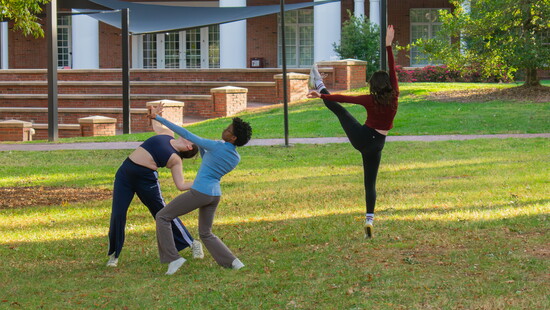
I didn’t just discover somatic movement in a dance studio. I found it years into performing, during a period when stress felt louder than my own thoughts. As someone who grew up expressing myself through performing, I understood movement as art, yet I had never understood movement as communication. Of course, your body is the most accessible and useful tool that you have access to. That realization eventually led me into the study of somatic and dance/movement therapy, and today I am an emerging dance scientist completing my Bachelor of Science in Dance Science at Elon University. Through my work, I have seen how profoundly the body can speak when we learn how to listen.
Somatic movement and dance movement therapy (DMT) are not about learning choreography or performing. They are about reconnecting to the body as a source of clarity and emotional regulation—something everyone can benefit from, regardless of age, background, fitness level, or experience.
What Is Somatic Movement and DMT?
Somatic simply means “of the body.” Somatic movement focuses on noticing physical sensations like breath, tension, posture, and rhythm to move with awareness rather than expectation. Think of it as a connection between your mind, body, and spirit.
Dance/movement therapy is a form of clinical psychopathology that uses movement to support emotional, cognitive, physical, and social integration. In DMT, movement becomes a therapeutic tool much like a language. People often express through the body what they cannot yet express through words.
The Science, Simplified
The body and mind are not separate. Movement directly influences the nervous system, helping regulate stress responses, reduce cortisol, and create a sense of grounding. When we move, we activate neural pathways that link emotional centers of the brain with areas responsible for logic, decision-making, and self-awareness. This is often called integration, and it is essential for emotional well-being.
Somatic practices also help interrupt the body’s tendency to store stress physically through tightness in the chest, shallow breathing, or tension in the shoulders. Research shows that intentional, sensory-based movement supports greater resilience, clearer thinking, and improved mood. When your body feels regulated, your mind can follow.
Who Benefits? (Hint: Everyone)
One of the biggest misconceptions about somatic movement or DMT is that it’s “just for dancers” or is performative. In reality, there is no right or wrong, no scoring and no judgement. If you can breathe, shift your weight, or way side to side, you can participate.
These practices support:
● Stress, anxiety, and burnout in adults and professionals
● Trauma survivors, helping rebuild a sense of safety
● Individuals with Parkinson’s disease, where research shows improved mobility and emotional regulation
● Cancer patients, supporting both physical and psychological recovery
● Children, using movement as a form of play therapy
Movement is universal. It belongs to everyone.
What It Looks Like Day-to-Day
Somatic movement can be incredibly simple. A somatic stretch might involve slowing down long enough to notice where you’re tense, then gently releasing that area through breath and micro-movements. A mindful walk might mean feeling your feet connect with the ground, observing the way your arms naturally swing, or noticing the temperature of the air on your skin.
Even swaying side to side, rocking forward and back, or placing a hand on the chest to feel your breath can shift your nervous system into a more regulated state. These small movements become daily rituals or micro-interventions that bring you back to your body when your mind feels loud.
Finding Support
If you’re interested in exploring DMT, the American Dance Therapy Association provides a directory of board-certified dance/movement therapists across the country. Somatic movement educators can also be found in wellness centers, studios, and therapeutic spaces.
In my own work, I offer private and group somatic movement sessions rooted in science-backed principles, and I share these practices through The Art of Coping, a nonprofit that supports children and teens in healing from trauma. My mission is simple: to make movement feel accessible, grounded, and transformative for every body.
People often express through the body what they cannot yet express through words.