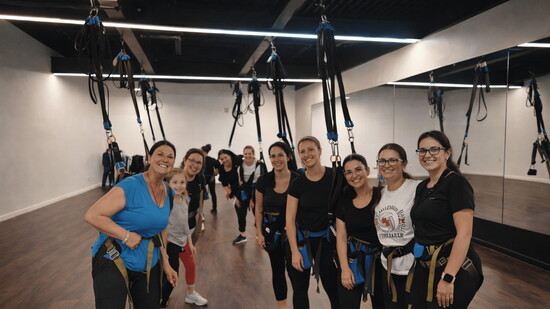
When people think about investing in their health, they often picture long hours on treadmills or high-impact workouts that can be tough on joints. A newer training style—bungee fitness—offers a different approach: high energy, science-backed movement with reduced impact and a serious fun factor.
Bungee fitness combines cardio, resistance training and low-impact plyometrics using a ceiling-mounted harness and elastic bungee system. Participants move through guided sequences of jumps, lunges and flight-style drills while supported by tension from the bungee cord. The result is a workout that challenges muscles and cardiovascular endurance while reducing stress on the body.
Studios such as Flyte Bungee, one of the first dedicated bungee fitness studios on the East Coast, are introducing this training method to clients looking for something beyond traditional gym routines.
The Science Behind the Bounce
At the core of bungee fitness is plyometric training—sometimes called jump training—where muscles exert force in short, powerful bursts. Traditional plyometrics can be demanding on joints because of repeated ground impact. Bungee-assisted movement changes that equation.
The harness and cord system absorbs part of the load, helping reduce joint stress while still allowing explosive movement patterns. That makes it possible to train speed, power and coordination with less pounding on knees, hips and ankles.
Workouts typically blend three components: low-impact plyometrics, aerobic cardio and resistance training. Participants use both body weight and bungee tension to build strength and endurance at the same time.
Instructors say clients can burn roughly 350 to 800 calories per class depending on intensity and experience level.
Strength Without the Strain
One of the biggest appeals of bungee fitness is what trainers describe as “low-impact, high-output” movement. Because the cord assists with deceleration and lift, participants can perform dynamic exercises—jumps, suspended lunges and airborne transitions—without the same landing force found in traditional jump workouts.
That makes the format attractive to a wide range of clients, including those returning to exercise, cross-training from other sports or looking to protect their joints while still pushing intensity.
The constant tension from the cord also adds resistance throughout movement patterns. Muscles engage not only during effort but also during control and return, increasing total workload.
Studios often describe the experience as equal parts cardio session and strength workout—delivered through movement that feels more like flight than repetition.
What to Expect in Class
Bungee fitness classes are structured, instructor-led sessions designed for both safety and progression. Participants are fitted with a harness system sized and adjusted before class begins. Because harness setup and safety checks are required, most studios ask clients to arrive five to 10 minutes early.
Late arrivals are typically not admitted once class starts, since harness fitting and equipment checks are part of the safety protocol.
Clothing guidelines are specific. Participants are generally advised to wear supportive athletic wear, including a secure sports bra, fitted tops and leggings. Many studios recommend avoiding crop tops so the harness does not rub directly on skin. Hydration is also emphasized, as classes are fast-paced and sweat-heavy.
Most sessions run about an hour and include a check-in and setup, warmup, skill-building drills, cardio sequences and cooldown.
A Different Kind of Motivation
Beyond the physical benefits, bungee fitness adds an element many workouts lack—play. The assisted lift and rebound create a sensation of floating and flight that changes how participants experience exertion.
That novelty can help with consistency. Exercise adherence often improves when workouts feel engaging rather than repetitive. Participants report that the combination of music, movement and aerial support makes sessions feel more like training and less like obligation.
Studios also offer varied formats, including beginner classes, multi-class passes and private group sessions. Introductory offers—such as first-class specials or bundled passes—are common for new clients who want to test the format.
Gift cards and private bookings for small groups are also popular, especially for birthdays, team events and social fitness gatherings.
Training for a Range of Goals
Bungee fitness is used by clients with different goals—cardiovascular conditioning, muscle toning, coordination training and weight management among them. Because resistance and intensity can be adjusted through body position and cord tension, instructors can scale movements within the same class.
Bungee fitness can uniquely be geared towards a large variety of athletic abilities. Regardless of your strength and training, everyone starts at a level one class. This gives you all the basics of bungee fitness. Since the bungees are holding about 80% of your weight, these exercises can be done by those who normally have a more limited range of mobility, or struggling with joint issues, they can easily participate in these classes - just like swimming! Flyte Bungee now has a physical therapist on staff with classes dedicated towards those with joint pain.
For athletes, the format can serve as cross-training. For beginners, it can provide support and confidence while building baseline strength and stamina.
As with any fitness program, instructors recommend that participants with medical conditions or recent injuries consult a health professional before starting.
The Takeaway
Fitness trends come and go, but formats grounded in movement science tend to last. Bungee fitness blends proven training principles—plyometrics, resistance and cardio—with modern equipment that reduces impact and increases accessibility.
For people looking to refresh their routine, protect their joints or simply enjoy working out again, harness-based training offers a new way to get off the ground—literally.
And for many first-timers, that first assisted leap is all it takes to get hooked.
Flyte Bungee
Address: 6 Red Schoolhouse Rd, Chestnut Ridge, NY 10977
Phone: (845) 445-8666
Website: flytebungee.com