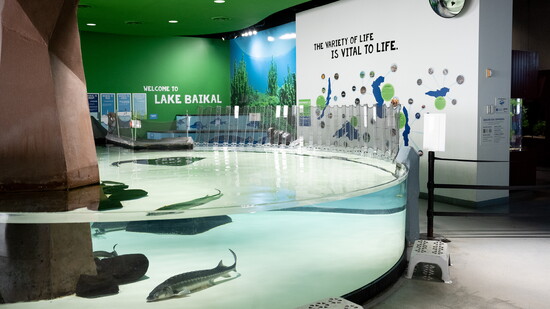
Along the shores of the St. Louis River Estuary in Duluth, something remarkable is happening behind the scenes at Great Lakes Aquarium. Inside a specialized stream-side rearing trailer filled with cold river water, thousands of tiny lake sturgeon eggs are beginning a journey that conservationists hope will help restore one of Minnesota’s most iconic native species.
For Executive Director Jay T. Walker, the project represents far more than fish restoration. It is the realization of decades of vision, collaboration, and commitment to the Great Lakes ecosystem.
“It’s a real, really exciting program,” Walker says. “To see us having a tangible effect on the ecosystem — the work we’re doing is helping bring the species back.”
Lake sturgeon, or Acipenser fulvescens, are often called living fossils. The prehistoric fish have existed for more than 150 million years, surviving since the age of dinosaurs. Once abundant throughout the Great Lakes region, they were nearly wiped out in the early 1900s because of overfishing, pollution, and habitat destruction. In Minnesota, the species is now listed as a Species of Special Concern.
For decades, agencies and Tribal organizations have worked to rebuild sturgeon populations in the St. Louis River, Lake Superior’s largest tributary. Despite progress, populations remain below long-term recovery goals. Great Lakes Aquarium is now stepping into a new role in that restoration effort through a major sturgeon rearing and public education initiative developed in partnership with the U.S. Fish and Wildlife Service, Minnesota Department of Natural Resources, and Fond du Lac Band of Lake Superior Chippewa.
The project began with a practical challenge: finding additional capacity to raise juvenile sturgeon for stocking efforts. Walker says the aquarium initially planned to rear about 2,000 fish for the DNR. Then the U.S. Fish and Wildlife Service approached the aquarium with an unexpected opportunity.
“They had another rearing trailer that they were unable to use because it was too big for where they could put it,” Walker explains.
The trailer — essentially a mobile hatchery equipped with tanks and flow-through water systems — can rear up to 3,500 fish at a time. That meant the aquarium could support not only Minnesota DNR stocking efforts, but also additional fish for the Fond du Lac Band’s restoration work.
Walker was determined to make it happen.
“I was kind of like, ‘I’m gonna make a d*mn spot,’” he says with a laugh.
Fortunately, the aquarium already pulls water directly from the St. Louis River Estuary for cooling systems, making the site ideal for the project. By using local estuary water, the young sturgeon can imprint on the chemistry of their home waters — a critical factor that may help them return to the river to spawn as adults decades later.
This spring marked a major milestone. The trailer is now operational, and the aquarium recently received its first batch of sturgeon eggs.
“We just picked up eggs this week, so there’s eggs actually in the trailer currently,” Walker says. “Our first phase has been going really well.”
If conditions continue successfully, the eggs will hatch into tiny fish within days. By fall, those sturgeon could grow to nearly seven inches long before being released into the river system.
The restoration effort is about much more than science. Because Great Lakes Aquarium is a public-facing institution, the organization wanted visitors to witness and understand the conservation work firsthand.
Plans are already underway for a new 1,300-square-foot exhibit gallery connected to the aquarium. The exhibit will focus on the restoration of the St. Louis River Estuary, the life cycle of lake sturgeon, and the species’ deep cultural significance to Indigenous communities.
In Ojibwe, lake sturgeon are known as “Name,” often translated as “grandfather fish” or “kingfish.”
“It’s a very important fish,” Walker says. “There’s some just fascinating stories that go along with this species.”
The aquarium is working with representatives from the Fond du Lac Band to help shape the storytelling and educational experience within the exhibit, ensuring Indigenous voices remain central to the project.
The exhibit’s centerpiece will eventually feature live juvenile sturgeon from the rearing program itself. Beginning in 2027, visitors will be able to observe some of the young fish before they are released into the wild.
The aquarium plans to keep select fish for an additional year before stocking them, dramatically improving survival rates.
“When they grow for another year and stock, their survival rate goes way up,” Walker explains. “They’ll be so big that there’s no predator that could really take them out.”
Construction on the new addition is expected to begin this summer, with the building portion completed later this year. The exhibit itself is projected to open in fall 2027.
The entire initiative represents roughly a $1.5 million investment, supported in part through Minnesota Legacy funding and the Legislative-Citizen Commission on Minnesota Resources.
For Walker, who recently celebrated 27 years with the aquarium, the project carries profound personal meaning.
“I was here when we started,” he says. “Thinking of what people hoped this facility would become, and now we’re in a place where we can actually get some of those visions into reality — it just brings me a lot of joy.”
That joy extends beyond the aquarium walls. Every young sturgeon released into the St. Louis River represents another step toward rebuilding a healthier ecosystem, restoring biodiversity, and reconnecting communities to a species that once defined the Great Lakes watershed.
And for visitors walking through the future exhibit gallery, the project offers something equally important: a chance to witness conservation in action, right in their own backyard.
353 Harbor Dr., Duluth | 218-740-3474 | glaquarium.org