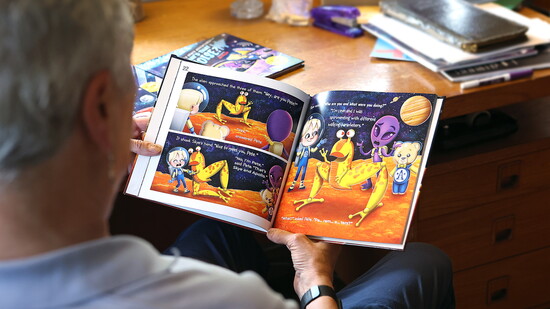
Dr. Kathryn Clark has served as NASA's chief scientist for Human Space Flight, delivered lectures from the North Pole, addressed the United Nations in Vienna, landed an F-18 on an aircraft carrier, and taught aerospace engineering at the University of Michigan. Now, she’s helping children learn about science through her Skyler's Space Adventures book series. Here, we sit down with Clark to discuss her work with NASA, the difference between kids and Congress, and the wonder of science.
Of all your incredible experiences, which one makes you stop and think, "I can't believe I got to do that?"
In many ways, that's an unfair question because they all have their own moments. But I suppose there's very little that's more fun — or more surreal, given how few people ever get to do it — than getting six catapults and traps on the USS George Washington in an F-18. Even the training for that was pretty remarkable.
I got to do that because I was giving a talk at the Navy's 235th Birthday Ball. I spoke about NASA and the Navy working together and all the ways our missions intersect. At the end of the talk, I said, "I'd really like to get one cat and one trap." That's Navy shorthand for a catapult launch and an arrested landing on an aircraft carrier.
Afterward, six admirals came up to me individually and said, "Yes, ma'am. We can make that happen." And they did.
This all happened in mid-August 2001. Less than a month later, after September 11, the ship I was on was in New York Harbor protecting the United States. The captain and crew I had met were now defending the country. That probably made the whole thing even more surreal.
What inspired your love of space?
My dad was really, really excited about space. When I was a little kid, we watched the Mercury missions together. I had patches from all the missions and pictures of the astronauts.
When I was about nine, I was at a friend's house. I had no idea her father was politically connected because, really, what nine-year-old knows that kind of stuff? John Glenn was exploring whether to run for the U.S. Senate, and he happened to stop by. I was sitting on the living room floor with my friend when, lo and behold, John Glenn walked into the room. She didn't know who he was, but I did.
I got up and talked to him. I was wearing a Lucy sweatshirt from the Peanuts cartoons, and he signed the shoulder. It doesn't fit anymore, but I still have the sweatshirt.
You served as NASA's chief scientist for Human Space Flight, working with scientists around the world to coordinate priorities for using the International Space Station to better understand Earth and prepare for journeys deeper into the solar system. What did that role actually involve?
A better description of that role than whatever title they gave me is "chief cheerleader."
The reason to build a space station is to plan missions to Mars. What we were trying to do was build, in orbit no less, something no one had ever built before. This was so new that we had to create the instruments needed to make it happen. We were doing it in some of the most dangerous conditions known to humanity, and we were doing it in 14 languages. What could possibly go wrong? The answer is: everything.
One of my major jobs was to meet with scientists from around the world and talk about how we would utilize this magnificent thing. What did we actually need? We wanted to observe Earth. We wanted to look deeper into space. We wanted to understand what happens to the human body, as well as plants and animals, when they're in space because we're going to need that knowledge.
That was a big part of my role: helping identify what we needed to learn in order to eventually go to Mars.
Space captures our imagination, but what are some of the things about living in space that surprise people the most?
The biggest thing people notice is the lack of gravity. Floating is a funny thing because we're so used to standing up. If you're floating in a spaceship and raise your right arm, your feet are going to go the other way. For every action, there's an equal and opposite reaction.
People are also surprised by sneezing in space, and it's really just Newtonian physics. If you sneeze in space, you will shoot yourself across the ship. Action, reaction. Now, the same thing happens if you puke. It's just messier.
What inspired you to pivot and start writing children's books?
I started writing books for my nephew when I was at NASA, just to make him laugh. When I left NASA, I joined an author group because I still had the bug to write and wanted to see if I could make more out of those books. One of the people there said, "With your background, you could do a lot more with those." So I started writing books with more science in them while still making them funny and engaging for kids.
I love going into schools to read to kids. It takes about six minutes to read the book, and then I stay and answer questions. They ask much better questions than Congress ever asked.
The questions range from "Are there aliens in space?" and "How do you build a spaceship?" to "How do you write a book?" and "How did you stay married while you were at NASA?" They have no filter, and I answer them all. It's just a hoot.
The point is that the kids are laughing while I'm reading the books, which makes me very happy. But the books are also very scientific. Science is actually really fun. It can be scary. It takes a lot of work. But it's really fun.
What makes Skyler's Space Adventures unique?
The stories are kind of Calvin & Hobbes meets NASA. The main characters are Skyler and Apollo the Astro Bear. Skyler has this huge imagination, right? But Astro Bear is an astronaut, so when they run into something challenging, he'll say, "Oh, I remember this from astronaut school."
Now, he doesn't always get the answers right, which is part of the fun. But that's really the idea behind the books: to engage kids in these stories, help them follow along on the adventure, learn new things, and pick up fun facts along the way. The books are funny, but they're also rooted in real science, and the website has some pretty hardcore science on it.
In the first book, the adventure takes them to the moon, so kids can explore the Apollo missions, astronaut photos, mission patches, and even the lunar rover. And in the second book, I'm not going to tell you what planets they visit because you have to solve clues to figure it out. The last page of every book contains clues about where they're headed next. Some of those clues even show up on Pete the Alien's feet because he gets text messages there.
The science behind the second book is astrodynamics — trying to understand how to fly from planet to planet — and the science behind the third book is the electromagnetic spectrum, which most adults don't understand. What a fun challenge that is to write for six-year-olds.
If you could tell every child in Ann Arbor one thing about science, what would it be?
It is arguably the most exciting thing you could pursue because it's so, so big. There are so many directions to explore. Find the thing that excites you and follow it.
To order the books, meet the characters, and explore more, visit auntiekc.com.