The sharp clang of steel on wood echoed through the Wareham as a crowd gathered in the 145 year-old historic hall in November 2025. Instead of golden shovels and dirt, this groundbreaking came with sledgehammers. At the center of it all stood Patrick Schutter, president of BHS Construction, surrounded by major donors, city leaders and project partners. With one strong swing, Schutter and company brought the hammer down, splintering the worn stage boards and marking the ceremonial start of Wareham Hall, a transformative $40 million redevelopment project that will breathe new life into the heart of downtown Manhattan. For sixty years now, BHS Construction has been building more than structures, they’ve been building the very fabric of Manhattan itself.
The story of BHS Construction traces back to a man whose entrepreneurial spirit would shape the Flint Hills region’s construction landscape. In February 1926, Robert M. “Bob” Baril was born in Minneapolis, Minnesota. After making his way to Manhattan, he founded the first of three companies: R.M. Baril General Contractors, Inc., a union-based general contracting company. Not long after came Manhattan Trenching, Inc., and then, alongside business partner Bill Rogers, Baril established Rogers and Baril, Inc. a non-union firm that would go on to shape much of Manhattan’s mid-century growth on November 15, 1965.
In those early decades, the company’s projects could be found all over town. Schools, churches, municipal buildings, and businesses that helped define the look and feel of the growing Little Apple. They built with a craftsman’s pride and a neighbor’s care, taking on everything from classroom additions to community landmarks. As the city expanded through the 1970s and ’80s, their crews were busy laying the foundations for a thriving local economy.
When Bill Rogers retired, Baril brought on his two sons-in-law, Mike Hoover and Bob Landsdowne, marking a new chapter and a new name: BHL Construction—representing Baril, Hoover, and Landsdowne. Under that banner, the company grew rapidly, earning a reputation for reliability and precision.
Meanwhile, a young builder named Wayne Sloan was learning the ropes at his father’s company, Green Construction, where he started working at just 15 years old. After a stint in Wichita with Conco Construction, Wayne returned home to Manhattan and joined R.M. Baril General Contractors. His work ethic and leadership quickly stood out. In 1982, he became a partner in the company—joining Baril and Hoover—and on January 2, 1982, the business was officially renamed BHS Construction, representing Baril, Hoover, and Sloan. Ownership at that time was split with Baril holding 50%, and Sloan and Hoover each holding 25%.
For Wayne, that year marked the start of a remarkable four-decade journey. He guided BHS through a period of steady growth, expanding its scope while keeping its heart in Manhattan. Over the years, BHS built schools, churches, hospitals, and commercial developments across the region; structures that became integral to daily life. Wayne’s personal favorite projects reflected both craftsmanship and community impact: Dick Edwards Ford, the sanctuary space at St. Thomas More Church, and the renovation of the Columbian Theatre in Wamego.
BHS Construction’s offices tell a parallel story of progress. The company began at 1600 Fair Lane, then expanded to 1714 Fair Lane before moving to 612 Pottawatomie, where their shop remains today. Growth pushed them next to 727 Juliette, and in 2018, BHS moved into its current home at 301 S. 4th Street, a modern headquarters that reflects both their craftsmanship and their commitment to community.
In the summer of 2002, Sloan hired a promising Kansas State University student named Patrick Schutter for part-time work, a decision that would shape the company’s future yet again. Over the next two decades, Schutter would learn every aspect of the business, from jobsite management to client relations, embodying the work ethic and values that BHS had been built upon. By 2012, Sloan had become sole owner of the company. Eventually, he passed the torch to a new generation of leaders - Patrick Schutter, Levi Schneider, and his son Zach Sloan, who currently serve as President, Vice President, and Treasurer/Client Solutions Project Manager, respectively.
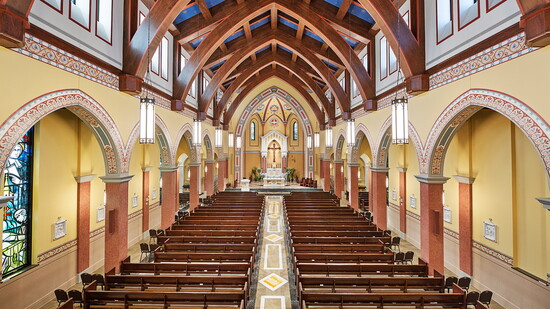
Today, BHS Construction employs 119 people, each one contributing to the company’s ongoing mission to build with integrity, innovation, and purpose. Their portfolio speaks for itself. Recent years have seen high-profile projects like St. Isidore’s Catholic Student Center in Manhattan, Manhattan Tech's Advanced Technology Center, and the magnificent Immaculata SSPX Church in St. Marys, as well as countless educational, healthcare, and commercial developments throughout Kansas.
For Schutter, one project holds special meaning - the renovation of Tallgrass Taphouse, a cornerstone of Manhattan’s downtown revival. “That job represented the best of what we do,” he’s said. “It was about preserving history while creating something that brings people together. That’s the essence of what building should be.”
Now, as BHS Construction celebrates its 60th anniversary, the company has remained steadfast in its mission: build relationships first, and buildings second. That philosophy has shaped more than 2,500 projects across Kansas, with each one built on trust and connection.
And on that day at Wareham Hall, when the sledgehammers fell against the century-old stage, it wasn’t just another demolition. It was a celebration. It was a symbolic bridge between past and future, between the generations who built the city’s bones and those now shaping its skyline. For six decades, BHS Construction has shaped Manhattan from the ground up, building its foundation and defining its skyline. Today, that foundation stands stronger than ever.
“Every building tells a story, and ours has always been about people."
"Building smarter. Building stronger. Building together." Patrick Schutter