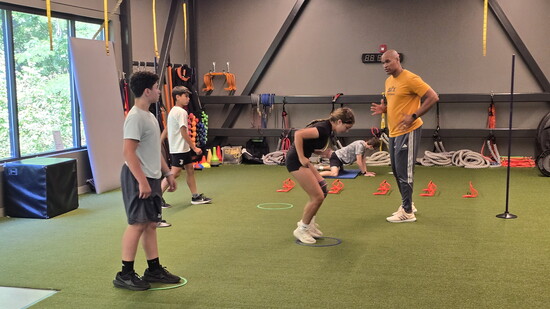
For more than two decades, Julian A. Amedee has trained student athletes to become stronger, faster, and more prepared for competition. But ask the young people who work with him what makes the biggest difference, and many will point beyond the physical results. They talk about confidence, resilience, leadership, and the impact his mentorship has had on their lives both on and off the field.
“I have been training athletes since 2001,” said Amedee. “Once I received my Certified Strength and Conditioning Specialist certification and started training more athletes, I realized this was where my passion for sports and helping/teaching came together.”
Over the years, he has watched athletes transform physically. “I have seen athletes get faster and stronger over time,” he said. “I have seen uncoordinated athletes start to excel in their sport.”
Still, Amedee believes the mental side of training is just as important as the physical side. “This is what I pride my training on,” he said. “It is not just the physical aspects of training that develop a good athlete; the mental aspects also play a role.”
That mindset has left a lasting impression on athletes like Hannah Gore, a former softball player who went on to compete collegiately at Berry College. “I wanted to play softball in college so I decided to take training more seriously,” said Gore. “I heard about Coach Julian because he was training a number of top athletes at Roswell High School, and he had a reputation for being one of the best in the business.”
Gore said the results showed quickly. “I am stronger, faster, and more athletic since training with Coach Julian,” she said. “My skill set as an athlete improved drastically, which helped me compete at the highest level in travel softball and achieve my goal of playing collegiately at my dream school, Berry College.” But for Gore, the biggest transformation came mentally.
“I am one of those athletes who often struggled with confidence on and off the field, regardless of my success,” she said. “Coach Julian played a huge role in addressing that and other aspects of my mental game.” She credits his encouragement and focus on mindset for helping her become more confident and resilient in all areas of life.
“Before working with Coach Julian, my mental game hindered my performance and made me doubt my ability,” she said. “I became more mentally tough and am better equipped to handle challenges, both on and off the field.” Amedee believes resilience is something athletes build through experience, mistakes, and setbacks.
“A major part of my training is built on striving for progress and not perfection,” he said. “Once they start training, they get a lifetime free pass to mess up.” That philosophy has continued to shape Gore long after her playing career. Today, she trains six days a week, prioritizes both physical and mental wellness, and now works with young athletes herself.
“He has also inspired me to pursue a career in coaching youth athletes,” she said. “I strive to instill the same values in my athletes that Coach Julian has instilled in me.”
For Amedee, seeing athletes grow into confident young adults is the most rewarding part of the job. “I take great pride when I see an athlete grow,” he said. “I am honored to be a part of their journey.”