For Eli Slossberg, the path to creating Tye’s House began with an unexpected realization: The life he had built depended on systems he had never learned to navigate without.
Before launching Tye’s House, Slossberg ran a successful business selling e-commerce websites and custom gift boxes to CrossFit gyms and boutique fitness businesses across the country. By early 2020, the company was bringing in more than $50,000 a month, with a team spread across the Philippines, New Jersey and Pennsylvania.
Then the pandemic hit.
“When COVID happened, my revenue went down to $6,000, $7,000 a month,” Slossberg says. “We never recovered.”
The experience forced Slossberg and his wife, Janet Thai, both Marine Corps veterans, to reconsider what it meant to provide for their family. He realized he did not know how to grow food, hunt, fish or perform many of the skills he had once considered basic.
What began as a personal pursuit soon evolved into a larger vision centered on self-sufficiency, community and resilience.
Slossberg immersed himself in wilderness skills, farming, foraging, permaculture and food production. At the same time, he began researching nonprofits, housing models and ways to support people facing difficult circumstances.
Underlying that work was a conviction Slossberg and Thai had held long before his business declined.
“Our faith leads us to love our neighbor,” Slossberg says. “This is what that looks like for our family.”
In 2023, that vision became Tye’s House, a Flemington nonprofit pairing regenerative farming with housing. The organization is now raising money to open its first homes, where residents would live and work alongside the farm as part of the program.
But Slossberg wanted to offer more than a roof.
“What we really settled in is how can we genuinely help these people experience a new life?” he says.
That question became central to Local Food Heroes, Tye’s House’s flagship program, which uses farming and food production to teach practical skills while creating opportunities for connection. With funding from USDA Northeast SARE to test its methods, the program trains veterans and community members in regenerative growing practices.
The idea is straightforward: Food can provide more than nourishment.
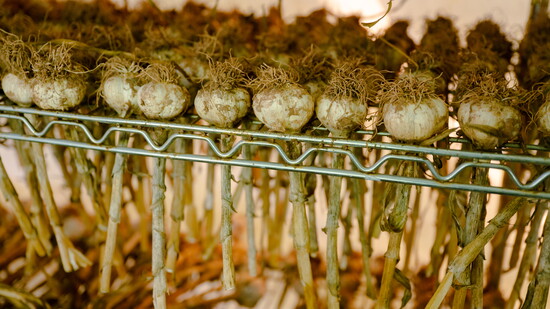
Participants can learn how to cultivate food, develop business skills and understand the process of turning what they grow into products. Sweet Bulb Hot Garlic Sauce, made with garlic grown at the farm, is sold through Local Food Heroes, with proceeds helping fund the organization’s first apprentice home.
“We’re trying to cultivate the farming as the way that we can help pay for the housing,” Slossberg says.
At the center of that vision is community. Slossberg believes strong communities are built through relationships and shared experiences.
The family’s Flemington property, The Farm at Leslie Court, serves as the program’s training ground and a prototype for what Slossberg calls a neighborhood farm. Rather than asking families to drive to a distant farm, he imagines neighbors being able to walk or bike there with their children and pets.
Eventually, membership could provide access to the property, neighborhood events, dinners, educational opportunities and the ability to harvest vegetables, herbs and flowers.
The model is intended to be flexible. If a family has more produce than it can use, Slossberg says that food could be redirected to someone else.
“If somebody is like, ‘Ooh, I have enough vegetables,’ we’ll take your share of produce that week, and we’ll go donate it to the food bank or family in need,” he says.
For Slossberg, giving back does not have to mean completely changing the way someone lives. Instead, he hopes people can find small ways to become more connected to their food, their neighbors and their community.
That philosophy extends to volunteers as well. Slossberg says he has noticed a growing desire among people to build deeper relationships and spend their time in more meaningful ways.
“Fun is becoming helping,” he says.
Working on the farm, helping with projects or sharing a meal can create the kind of connection he believes many people are looking for.
As Tye’s House and Local Food Heroes continue to develop, Slossberg is seeking partnerships with real estate professionals, farmers, families, financiers and businesses that can contribute in different ways.
The long-term goal is to create a model that can extend beyond one Flemington property.
Slossberg imagines neighborhood farms becoming places where people can learn practical skills, spend time outdoors, gather with others and contribute to the community around them. In that vision, food becomes a starting point for something larger.
It can create independence for someone learning to grow it. It can provide income through a product made from it. It can support housing. And when there is more than enough, it can be shared.
Ultimately, Slossberg hopes people will experience what the organization is building and leave wondering one thing:
“Why isn’t this in my neighborhood?”
For Slossberg, that question represents the beginning of stronger communities—places where people know their neighbors, understand where some of their food comes from and have opportunities to contribute in practical ways.
For more information about Local Food Heroes and Tye’s House, visit localfoodheroes.org.
“Our faith leads us to love our neighbor. This is what that looks like for our family.”—Eli Slossberg
Sidebar:
Founded by Eli Slossberg, Local Food Heroes teaches veterans regenerative farming and business skills at The Farm at Leslie Court in Flemington. The program supports Tye’s House to create apprentice housing for those facing hardship. Learn more at localfoodheroes.org.