A radiology report is one of the few documents people read with a dictionary open. Yours might say bulge on one line, protrusion on the next, and herniation in the impression at the bottom, and it is fair to wonder whether you have one problem or three.
You almost certainly have one. The words describe different amounts of the same process. The reason the distinction is worth understanding is not academic. It changes which approaches make sense, and it changes how much weight to put on the report in the first place.
What Is Actually the Difference Between a Bulge and a Herniation?
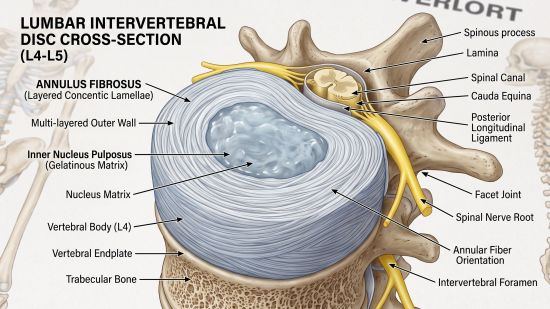
Picture a disc as a firm jelly doughnut squashed slightly flat. The outer ring is a dense, layered wall called the annulus. The center is a softer gel called the nucleus. The whole thing sits between two vertebrae and handles load.
A bulge is the outer wall pushing outward around a broad section of its circumference, usually more than a quarter of the way around, while staying intact. Nothing has escaped. The doughnut has spread, the way a tire spreads slightly under weight.
A herniation is more focal. Inner material pushes into or through the outer wall at one spot. Radiologists subdivide this further. A protrusion means the material is pressing out but its base is still wider than the part sticking out. An extrusion means it has pushed past that, with a narrower neck than body. A sequestration means a fragment has separated entirely and sits free in the canal.
So the rough sequence runs bulge, protrusion, extrusion, sequestration. Each step describes more displacement and less containment.
Why Does My Report Use Three Different Words?
Partly because radiologists describe every level they see, and you have five lumbar discs. Having a bulge at one level and a protrusion at another is ordinary. Partly because the terminology was standardized relatively recently and older reports use it loosely.
And partly because the report describes anatomy rather than diagnosing your pain. This is the part worth sitting with. Disc findings turn up routinely on scans of people who feel nothing at all, and the share climbs steadily with age. Finding a bulge on the scan of a fifty year old is not far from finding a grey hair.
That does not make the report useless. It makes it one input. What matters is whether the finding on the film lines up with the level your symptoms are coming from, and what the examination shows.
There is a practical consequence to this. A report naming findings at four levels can leave someone feeling structurally broken, and that feeling changes how they move. People who believe their spine is fragile tend to guard it, move less, and take longer to get going again. So how a report gets explained is not a bedside nicety. It is part of the outcome.
Does a Bulging Disc Hurt Less Than a Herniated One?
Not reliably, and this surprises people.
A broad bulge can crowd a nerve root if it happens to sit where that root exits, or if the opening is already narrowed by arthritic change. A small focal protrusion pointing away from the nerve may cause nothing at all. Size correlates with symptoms far more weakly than most people expect.
Location has its own vocabulary, and it is worth a glance at your report. Central means the displacement points straight back into the canal. Paracentral means slightly off to one side, which is both the most common position and the one most likely to reach a traveling nerve root. Foraminal means it sits in the opening where the root exits, a tighter space where a modest displacement goes further. Far lateral means beyond that opening. Those words often tell you more about what you are actually feeling than bulge or herniation does.
Two things predict symptoms better than the word in the report. The first is location. A disc that displaces toward the side of the canal where a root travels is a different problem from one that displaces straight backward into a roomier space. The second is chemistry. Inner disc material is irritating when it contacts nerve tissue, which is one reason a modest herniation can hurt considerably while a larger bulge stays quiet.
Which One Responds to Decompression?
Non-surgical decompression works on a specific mechanism, and it helps to know what that mechanism is rather than treating it as a black box.
At HealthSource of Harper's Preserve the work is done on a DOC table, a segmented table that can be positioned so the distraction load concentrates at one spinal level rather than pulling on the whole column. It applies and releases in cycles, with sensors watching for the muscles to guard so the body does not brace against the pull. The intent is to briefly lower pressure inside the disc at that level, which is thought to encourage fluid and nutrients to move in and may ease the mechanical crowding of a nerve root. That is what a decompression cycle is actually doing at that level, and it is a reasonable mechanism rather than a cure for anything.
That mechanism suggests where it tends to fit. Contained problems, meaning bulges and protrusions where the outer wall is still doing its job, are the more typical candidates. Degenerative discs with mechanical low back pain often are too. Extrusions are a more individual conversation and depend on the picture as a whole.
What it does not do is repair a torn annulus or retrieve a sequestered fragment. A free fragment is not going anywhere because of a traction cycle. This is a tool with a defined range, not an answer to every finding on a report.
When Is This Not a Chiropractic Problem?
Some of the time, and a clinic that never says so is a clinic worth being skeptical of.
Progressive weakness is the clearest line. If your foot is getting harder to lift, or a grip is failing, that is a conversation with a spine surgeon rather than a reason to try another six weeks of conservative care. A sequestered fragment with matching severe symptoms is frequently a surgical discussion. And pain that has not responded at all to a genuine course of conservative care deserves a second opinion rather than a repeat of the same plan.
Some things need emergency care the same day rather than an appointment. Numbness through the area that would contact a saddle, loss of bowel or bladder control, or sudden weakness in both legs can indicate cauda equina syndrome, which is a surgical emergency. Severe back pain with fever, or back pain immediately following a significant fall or collision, also belongs in an emergency room rather than a waiting room. These are uncommon. They are worth knowing anyway.
What Happens at a First Visit?
Mostly conversation and testing.
Expect questions about where the pain sits, whether it travels, which positions change it, how it started, and what has already been tried. Then orthopedic and neurological testing, reflexes, strength and sensation, to work out which level is involved and whether a nerve root is genuinely irritated. Imaging where it is warranted. If you already have an MRI, bring the images and not just the summary page.
A first visit at HealthSource of Harper's Preserve is $39 and includes the consultation, the examination, any needed X-rays, and a review of the findings. It is an evaluation, not a treatment package. The point is to leave understanding what the problem appears to be and what the reasonable options are, including the option of being sent somewhere else.
The clinic is at 10354 Highway 242 Suite 900, Conroe, TX 77385, and reopened on September 21, 2026 under clinic director Dr. Tyrone Smith. HealthSource of Creekside is at 24345 Gosling Road Suite 110 in Spring.
The word on your report matters less than most people assume. The examination matters more. When the two disagree, the examination is usually the better guide.