At seventeen, Callum Parker won the Sir Douglas Myers Scholarship to Cambridge. The Wellington newspaper called him a maths whiz.
He read economics at Gonville and Caius. In his final term he tried running, set strong times almost immediately, and was on the New Zealand World Athletics roster soon after. In July 2021, racing for the silver fern, he ran 800 meters in 1:55.49. He was twenty-three.
He had taken a job at Bain in London. After about two years he left. He says he was more focused on training for the 800 meters than on the consulting work.
What followed was a search. He went to Bogotá to work with Endeavor, the entrepreneurship network, and startup life caught. He came back to London and joined Terra, a fitness wearables AI company. He clashed with the founders and was let go after three months. He moved to Lisbon, took a freelance project in Guatemala building an AI tool for a business development team, and started coaching friends and family on the side. He set himself a personal goal: run a 4:30 mile and join the Thousand Pound Club on the same day. He thought he was probably the first person who had tried. He went on to win HYROX Vancouver & the Hot Chocolate 5K.
Through all of it, he was looking for where math, AI, athletics, and coaching could land in one place.
He had started getting DEXA scans, often, to see what was actually changing inside his body. One of the places he went to get scanned was a small room in San Francisco run by a Harvard graduate named Harsh Sinha.
Sinha had led the data team on Meta's wearables product before starting Kalos, and had been a certified personal trainer at Equinox before that. Kalos at that point was one room with a DEXA machine and an air mattress on the floor. Callum flew out, stayed on the mattress, and signed on as co-founder. Harsh would run strategy, Callum marketing and operations.
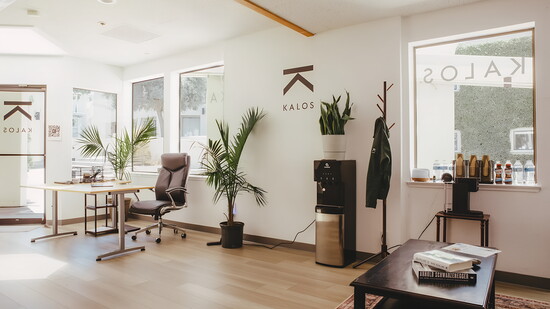
That was 2024. Kalos was where the parts of his career started to add up. Kalos is Greek for physical beauty, the root of the word calisthenics. Callum signed on for the idea: data, read by a real coach, changes what training does. Today the company runs four Bay Area locations, including the storefront at 195 Forest Avenue, between Nobu and Whole Foods. Thousands of clients have come through, with a staff of roughly twenty.
The way Kalos works is the same in every room. A client walks in. A DEXA scan reads their bone density, where their fat is sitting, and how much lean tissue they are carrying. A coach writes a four-week training and nutrition program against those numbers. At the end of the four weeks, the client scans again. Between scans the client logs every workout in the Kalos app. The next program is written against the pair: scan output and training input.
Kalos calls it a closed-loop system. Coaches A/B test training inputs and nutrition adjustments against the DEXA numbers between scans to see what is actually moving the body composition. The company is training an AI model on its scan library so the program a new client gets is informed by what worked for the thousand bodies before them. Callum is firm that the model is meant to make the coach better, not to replace the coach. The research on AI-only programs, he says, does not look good.
What drives him, he says, is competition. He wants to be the best at whatever he is doing. He grew up in Karori, one of the three shortest kids in his class. He says that might still be driving him. He has a 1:55.49 800-meter time for New Zealand, a HYROX Vancouver title, a Cambridge degree, and four rooms running closed-loop body composition in the Bay Area and he's only twenty-eight.
"It's human coaching that is enabled by AI to allow our coaches to reach people in a more effective way."
— Callum Parker