Nearly 250 years ago, long before Worthington became the charming community we know today, a remarkable group of Revolutionary War veterans made an extraordinary decision. After helping build a new nation, they chose to invest in another bold experiment: carving a settlement out of the, then wild, Ohio frontier. Through the Scioto Company, these men risked their savings, left established lives in New England, and journeyed west to create what would become Worthington.
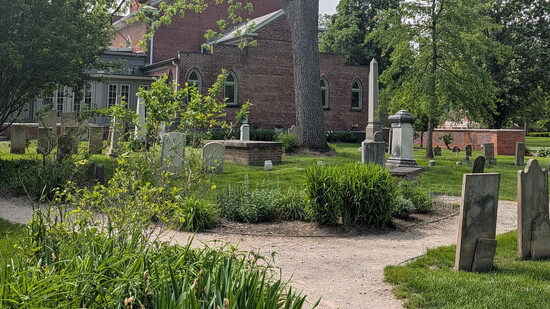
Their stories are being brought back to life thanks to local historian Ted Dziemianowicz, who serves on the board of the St. John's Worthington Historic Preservation Fund. His work restoring the historic St. John’s churchyard for America 250 led him deep into Revolutionary War records and early Worthington history. What began as a gravestone preservation project evolved into uncovering the stories of the veterans buried there.
Among those founders was Alexander Morrison, a Massachusetts farmer and Scioto Company member whose story reaches back to the opening days of the Revolution. Dziemianowicz uncovered records showing Morrison served as a Minute Man—part of the rapid-response militia system created in response to the tensions escalating with Britain.
When the Battles of Lexington and Concord erupted in April 1775, couriers rode through the night carrying handwritten warnings from town to town. Within just 24 hours of the first shots being fired, Morrison had joined fellow Minute Men marching toward Boston. His regiment was later “adopted in” to the Continental Army during the Siege of Boston.
Another future Worthington resident, John Goodrich of Wethersfield, Connecticut, also answered the call. Ted’s research shows Goodrich served in Connecticut militia units through the Revolutionary War period, mobilizing through the same local defense networks that supported the patriot cause.
The organization of those early patriots remains remarkable even by today's standards. Each town maintained a militia, but the Minute Men were specially trained to respond immediately. “They were expected to basically drop things and go,” Dziemianowicz explained. That same spirit of commitment and sacrifice would later help shape the earliest foundations of Worthington itself, as veterans traded battlefields for frontier life and the difficult work of building a new community from scratch.
Another Worthington settler carried equally legendary credentials. Samuel Beach, also a member of the Scioto Company, served with the famed Green Mountain Boys under Seth Warner, successor to Ethan Allen. Originally formed to protect settlers in what is now Vermont, the Green Mountain Boys became one of the Revolution’s most recognized fighting forces and famously helped capture Fort Ticonderoga early in the war.
These were not armchair investors chasing speculative profits. The Scioto Company required investors to relocate and help physically build the settlement themselves. In 1803, roughly 100 settlers arrived together with wagons, livestock, tools, and determination. They found no established town waiting for them—only forests, fertile land, and possibility.
Today, many of those Revolutionary veterans rest quietly in St. John’s churchyard—a reminder that Worthington itself was built by the generation that helped build America.
Worthington’s America 250 lectures and historical tours will continue throughout the year, with a full schedule available on the City of Worthington calendar @worthington.org/calendar.