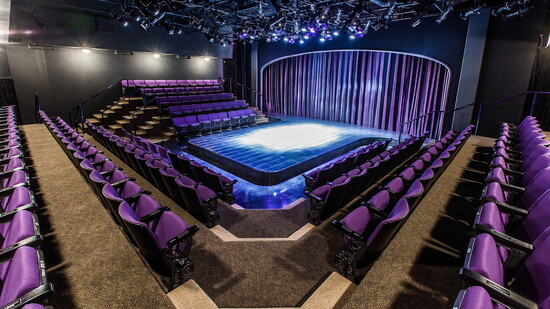
A theater is so much more than a building. It’s a home for artistic exploration, a place where old friends and strangers come together for a communal experience that’s new every time the house lights dim and the curtain rises. It’s a place that transports audiences to a different world through the story unfolding onstage. A place to laugh, cry—and learn something new about the human condition that connects us all.
The Purple Rose Theatre Company, located in historic downtown Chelsea, has been that place since opening its doors in 1991. The theater’s founder—acclaimed actor, playwright, musician, and Chelsea native Jeff Daniels—could have started a theater anywhere. He’s won two Primetime Emmy Awards and three Tony Awards, has been nominated for multiple Golden Globe and Screen Actors Guild awards, and has appeared in a diverse collection of films and television series, including Terms of Endearment, The Purple Rose of Cairo, The Newsroom, The Squid and the Whale, Godless,and, most recently, Apple TV’s Shrinking with Harrison Ford and Jason Segel.
But he chose to start a theater here, investing in the arts in Michigan.
From the beginning, Daniels has been committed to presenting original work and supporting emerging talent—and the Purple Rose has earned the respect of the national theater community while centering the Midwestern voice. Here, we talk with Daniels about creating a space for the arts in the most important place of all—home.
The Purple Rose Theatre Company was born in a building your grandfather once owned as a car and bus garage. What did it mean to return that space to the community as a home for the arts?
In the ’40s, my grandfather used the wooden warehouse to store cars during the winter. Nice connection, but when it was for sale, I started imagining creating a theater company much like the one Alan Ayckbourn, a British playwright, had started in the small town of Scarborough, England. Personally, while sitting in Michigan waiting for my next acting job, I wanted to live a creative life with other like-minded, Michigan-based creatives that I gambled were out there. Turns out, they were.
At a time when you could have built a theater almost anywhere, why did Chelsea feel like the right place—and why does that choice still matter today?
Building it anywhere other than 10 minutes from my house wasn’t even considered. I may have sensed that if it worked, it might help make Chelsea a destination but there was no plan other than buying the building and holding auditions to see who was out there. Six months after we opened, Craig Common opened the Common Grill, and between the two of us, suddenly 40,000 people a year were coming to our small town to see a play and eat in his restaurant. Rocco Landesman, then the Chairman of the National Endowment For The Arts, came to Chelsea to visit the Purple Rose and said, “You’re the poster child for what the arts can do for a local economy.” Thirty five years later, we have entire runs that sell out by opening night. They’re not only still coming, they’re coming more than ever.
The theater takes its name from The Purple Rose of Cairo, a film that marked an early turning point in your career. What did that story symbolize about the kind of theater you wanted to build here?
I didn’t want to put my name on it, so I picked the one movie that I considered to be a turning point in my career. When we shot the film in 1985, Woody Allen was one of the top American film makers. When I finished that film, I remember thinking I was now going to be able to make a living in this business because if I was good enough for Woody, I was good enough for anybody, which is exactly what Mike Nichols said when I asked him if he wanted me to read a scene at my audition for the film, Heartburn.
You made a very deliberate decision to live and work full-time in Chelsea rather than Hollywood. How did that choice shape not only your life, but the values and culture of the Purple Rose?
There’s something about living in the Midwest that helps me retain the wonder I had when I embarked on this crazy career. Because I live here, when I go out to LA and walk onto the lot at Warner Brothers to shoot an episode of Shrinking, it’s not lost on me that I’m standing on the same sound stage where Henry Fonda and Jack Lemmon shot scenes for Mister Roberts.
Acting has never been a job—it’s who I am, what I do, what I have to do. Same thing applies to those who work at the Purple Rose. We provide a place for professional theater people to make professional theater. They just happen to be doing it in a small town in the Midwest. Everything I’ve ever learned I’ve tried to give to those who work at the Purple Rose. Thirty five years later, what’s most gratifying to me is knowing that what we do and how we do it can play on any stage in the country.
You’ve written and premiered more than 20 full-length plays at the Purple Rose. How has wearing both the playwright and founder hats influenced the kinds of stories this theater tells?
In Michigan, we need to build, attract and sustain an audience. To do that, I believe regional theaters should produce stories that reflect where they live. It’s why I wrote Escanaba in da Moonlight. The Purple Rose is proof that if you write about who you are and where you live, they’ll come. And our audience isn't just people who are regular theater-goers. During a recent weekend of previews, we asked how many people in our audience were here for the first time. At each performance, more than half the audience raised their hands.
The Purple Rose has long been committed to original work. Why was it important to you that new plays and new voices—particularly Midwestern voices—remain at the center of the mission?
When I joined New York's Circle Repertory Company in 1976, they only produced new plays. Nearly every film I’ve done is from an original screenplay. I’ll always be more interested in creating something no one’s seen. What I discovered is that people like being able to relate to the stories we tell. As artistic director, finding writers who can write about this part of the country with a sense of humor is what I’m interested in. And so is our audience.
The theater’s intimate scale means every audience member is close to the stage. How does that closeness change the relationship between the story, the actors, and the audience?
For the audience, it’s like being inside the play. For the actors, it’s film acting on stage. We designed the Purple Rose to feel like a medium closeup. On our stage the audience can see what you’re thinking. In a bigger theater, you have to send it out. At the Purple Rose, we pull them in.
Looking ahead, are there one or two upcoming productions that you feel especially capture the heart and spirit of this theater?
Any play we’ve done, are doing, or will do in the future that is set in the Midwest, written by one of our Midwestern playwrights, designed by our Midwestern designers and performed by Midwestern actors qualifies. The more of those kinds of plays we can develop, find, and produce, the better.
For someone walking through the doors for the first time, what do you hope they feel—or come to understand—about the Purple Rose?
I want first timers to discover live theater. I want them to marvel at the creativity and imagination, be impressed by the high quality of the set, lights, sound and execution of a story that’s being performed just for them. And when they’re walking out, I want them thinking about coming back.
Lastly, what's your favorite part about living in Michigan?
It’s home.
Learn more and see what’s onstage next at purplerosetheatre.org.
"The Purple Rose is proof that if you write about who you are and where you live, they’ll come...people like being able to relate to the stories we tell."