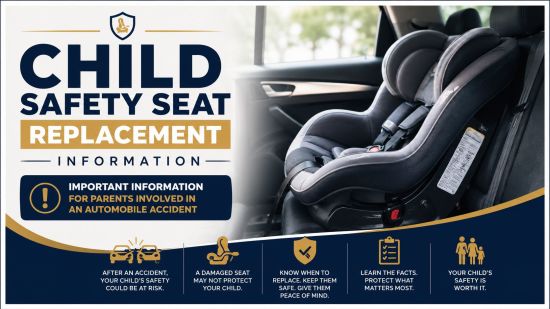
One of the most important safety devices in your vehicle is your child's safety seat. Whether your child uses an infant carrier, convertible car seat, forward-facing seat, booster seat, or other child restraint system, the seat is designed to protect your child during a collision.
What many parents do not realize is that a child safety seat may need to be replaced after an accident—even when it appears completely undamaged.
This guide explains why replacement may be necessary, what steps you should take after an accident, and how replacement costs may be reimbursed.
Why Child Safety Seats Matter
Child safety seats are designed to absorb and manage crash forces.
During a collision, the seat may experience significant stress that is not visible to the naked eye.
Although the seat may look perfectly normal afterward, internal components may have been weakened or damaged.
Because of this, manufacturers and safety organizations often recommend inspection or replacement following a collision.
Inspect the Child Immediately
Following any collision:
Check your child for injuries.
Seek medical evaluation when appropriate.
Follow emergency personnel instructions.
Monitor your child for delayed symptoms.
Even when a child appears unharmed, it is important to watch for signs of injury that may develop later.
Do Not Assume the Seat Is Safe
A common mistake is assuming:
"The seat looks fine, so it must still be safe."
Unfortunately, damage may not be visible.
Possible hidden damage may include:
Internal stress fractures
Damaged harness systems
Compromised attachment points
Structural weakening
Damaged energy-absorbing components
Because these conditions may not be visible, appearance alone is not a reliable indicator of safety.
Check the Manufacturer's Instructions
Different child safety seat manufacturers have different recommendations.
Locate:
The owner's manual.
Manufacturer instructions.
Manufacturer website.
Some manufacturers recommend replacing the seat after any collision.
Others provide more specific guidelines.
Always review the recommendations applicable to your particular model.
Understanding "Minor" vs. "Moderate or Severe" Crashes
Certain safety organizations have published guidelines concerning when replacement may be necessary.
Some collisions may be considered minor if factors such as the following are present:
The vehicle was able to be driven away.
The door nearest the child seat was undamaged.
No vehicle occupants were injured.
Airbags did not deploy.
There is no visible damage to the child seat.
If all criteria are met, replacement may not always be required. However, if any criterion is not met, replacement may be recommended. When in doubt, consult the manufacturer and prioritize your child's safety.
Photograph the Child Safety Seat
As soon as practical after the collision, photograph:
The seat in the vehicle.
The installation location.
The harness system.
Any labels or serial numbers.
Any visible damage.
The overall condition of the seat.
Photographs can be helpful if reimbursement issues arise later.
Save Important Information
Record:
Manufacturer name.
Model number.
Serial number.
Date of manufacture.
Purchase price if known.
Purchase receipt if available.
This information may be needed by the insurance company.
Do Not Dispose of the Seat Immediately
Many parents replace the seat and throw the old one away.
Before disposing of the seat:
Photograph it.
Document identifying information.
Ask whether the insurance company wants to inspect it.
Verify that reimbursement has been addressed.
The old seat may become important evidence regarding the claim.
Can Insurance Cover Replacement?
In many cases, the cost of replacing a child safety seat may be recoverable as part of a property damage claim arising from the collision.
Insurance companies often request:
Photographs
Proof of ownership
Purchase receipts
Replacement receipts
Manufacturer information
Keep all documentation.
Save the Replacement Receipt
If you purchase a replacement seat:
Keep the receipt.
Photograph the receipt.
Keep the product information.
Save installation instructions.
The receipt may be required for reimbursement.
Choosing a Replacement Seat
When replacing a child safety seat:
Verify it is appropriate for your child's age.
Verify it is appropriate for your child's height.
Verify it is appropriate for your child's weight.
Follow manufacturer installation instructions.
Register the product with the manufacturer if available.
Proper installation is just as important as selecting the correct seat.
Have the New Seat Inspected
Many communities offer child safety seat inspection programs.
A certified technician may be able to:
Verify proper installation
Check harness adjustment
Confirm appropriate seat selection
Answer safety questions
A properly installed seat provides the best protection.
Common Mistakes Parents Make
Mistake #1: Continuing to use a seat without reviewing manufacturer recommendations.
Mistake #2: Throwing away the seat before documenting it.
Mistake #3: Failing to request reimbursement.
Mistake #4: Purchasing the wrong replacement seat.
Mistake #5: Improper installation of the replacement seat.
Child Safety Seat Checklist
After an accident:
Check your child for injuries.
Seek medical care if needed.
Photograph the child safety seat.
Record model and serial numbers.
Review manufacturer recommendations.
Determine whether replacement is recommended.
Keep all receipts.
Save the old seat until documentation is complete.
Request reimbursement if applicable.
Properly install the replacement seat.
Questions to Ask
If your child safety seat was in the vehicle during the collision, ask:
Does the manufacturer recommend replacement?
Is there visible damage?
Could hidden damage exist?
Will the insurance company reimburse replacement costs?
Have I documented the seat properly?
Have I retained purchase and replacement receipts?
Final Thoughts
A child safety seat is designed to protect one of the most important passengers in your vehicle. Because collision damage is not always visible, parents should take every reasonable precaution following an accident.
When in doubt, prioritize safety. Review the manufacturer's recommendations, preserve documentation, and determine whether replacement is appropriate.
The cost of replacing a child safety seat is small compared to the value of knowing that your child is protected by equipment that is safe, properly functioning, and ready to perform if it is ever needed again.