Your staircase is the first thing people see when they walk into your home. Everything that follows — every room, every collected object, every design decision you've made — gets introduced by that moment. Which means the details matter more than most people realize.
One of the most overlooked details is the stair runner.
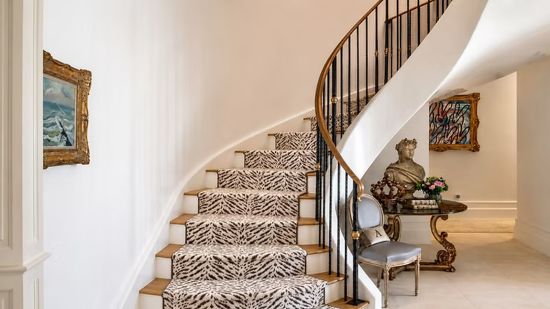
We recently completed a project in Santa Rosa Beach, Florida in collaboration with Rugmart Houston where the entire brief came down to one thing: our client wanted to weave her antiques together with bold, collected art. That constraint shaped every decision we made — including what went on her curved staircase.
The Real Challenge Isn’t Finding Something You Love
Most homeowners approach a stair runner the same way they approach a rug — they find something beautiful and they go with it. The problem is that a stair runner doesn’t live in isolation. It lives alongside your art, your furniture, your architectural details, and every other pattern already present in your entry.
In a home full of antiques and statement pieces, a runner with too much personality will compete. The result is visual noise where there should be composition. We see it often — the entry is almost always the most underestimated space in a luxury home.
How We Solved It in Santa Rosa Beach
This staircase was already a focal point — curved, with natural drama built into the architecture itself. Beneath it sat a gilded console table, a classical bust, books, and florals. On the walls, bold collected artwork in ornate gold frames. Everything intentional. Everything with presence.
The runner needed to hold its own without trying to win.
We chose a graphic animal print in a tight, low-contrast palette. It has texture and personality — but it doesn’t fight the art or the antiques for attention. It anchors the entry and gives the staircase the moment of arrival it deserves. That balance between presence and restraint is something we come back to in nearly every collected space we design, including our Albans Residence and our award-winning Aspen Residence.
Three Things to Keep in Mind
If your home has antiques, bold art, or a layered mix of old and new, here is how we think about the runner decision:
Let the art lead. If there is statement artwork in your entry or along your staircase wall, the runner’s job is to support it — not compete with it. Pull from a neutral or secondary tone already present in the artwork and build from there. For more on how we approach art selection, see our interior design portfolio.
Pattern is fine. Contrast is the variable. An animal print, a geometric, a small-scale motif — any of these can work beautifully in a collected home. What matters is keeping the contrast level in check so the runner reads as grounding rather than grabbing. Our blog on incorporating antique and vintage pieces goes deeper on balancing old and new in a single space.
Start with the architecture. A curved staircase already has drama. A straight, traditional stair can handle more pattern. The runner should match the energy of the stair itself. This is the same principle that guides every room we design — architecture always leads.
Why the Entry Deserves This Level of Intention
The entry is where the whole story of your home begins. It is the space that tells your guests — and reminds you every single day — what kind of home you have created. At L. Pearson Design, we treat it with the same care we bring to every other room: it should feel composed, personal, and completely intentional.
A well-chosen stair runner is one of the most effective ways to make that happen. It adds warmth, texture, and character to a space that too often gets treated as a pass-through. When it is done right, it becomes a moment — for everyone who walks through your door.
For more on how we layer pattern and texture across a home, explore our Museum District Residence and our Nottingham Residence.
Ready to think through your own entry or staircase? Reach out to the L. Pearson Design team and let’s talk about what’s possible.