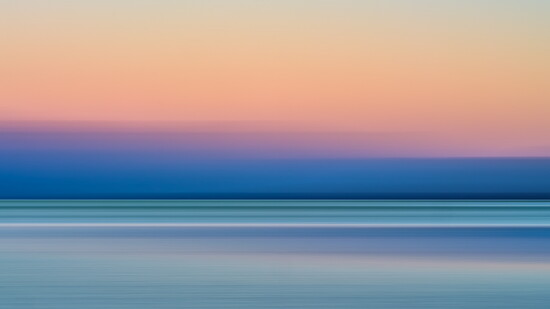
“Photography is about the capture of light,” reflects Marc McClish, standing in his home studio in the mountains outside Nederland, Colorado.
McClish’s photography captures what Henri Cartier-Bresson called “the decisive moment”—the instant when a photograph tells a deeper emotional truth. Yet McClish expands this idea by combining precise, linear movement with a long exposure that reveals a color-drenched image that invokes the emotional presence of the scene itself.
No Photoshop or spinning Dutch angles; what sets McClish’s chromoscapes apart is his technical precision that unfolds emotion slowly, giving his photography a sense of harmony and tension. His clients seek him out to create art that captures the emotional tone of a place, evoking the landscape without literal depiction.
"I made this large Chromascape for a client at his son’s wedding in the mountains overlooking San Francisco Bay. He has it hanging in his kitchen, a place the family gathers, and he told me, ‘I love this piece and the wonderful memories it holds of the day my oldest son was married. It’s a great image that everyone enjoys, and I get to live with beautiful art that reminds me of that special day,” says McClish.
His images have longevity—art people live and grow with, contemporary yet timeless, responding to the viewer over time.
From Precision to Emotion: Lessons from Avedon
McClish honed his meticulous approach at Santa Barbara’s Brooks Institute of Photography, known for its technical rigor and hands-on training—a proving ground for visual storytellers who wanted to master the technical side of photography.
After Brooks, McClish worked for celebrated photographer Richard Avedon in his New York studio.
“When I interviewed with Avedon, he asked questions about how I’d solve different photographic problems, and I gave him all these technical answers. It wasn't until I started working for him, months later, that I realized he didn’t really know what I was talking about. He had a group of assistants at the time that were all from art schools, and didn't have the technical skillset he needed, so he hired me to strengthen his team—it was pretty funny in hindsight," shares McClish.
Avedon taught McClish to see photographic prints in emotional terms—how the viewer would respond to them.
"Avedon was very demanding of what he wanted to see and feel in a final print—which he should be—and it was really frustrating when I first started printing for him because I wanted him to just tell me, ‘No, I want it darker, lighter, more contrasty—bring this down or up,’ but he talked about how the print needs to be angrier or more beautiful, it needs to have more elegance to it—that's a very different way of trying to create something—and it's super valuable. As an artist, that's what you want to do—you want to give the viewer the emotional experience that you want them to have," reflects McClish.
That blend of emotional awareness and technical mastery would become the foundation for his later work. After a year, Avedon promoted him to first assistant—a role McClish held for four years before opening his own black and white photography lab, SilverWorks. Over the following six years, McClish’s work attracted clients such as James Nachtwey and Annie Leibovitz, before packing up his NYC studio and relocating to the Rocky Mountains of Colorado
Now a fixture in the local art community, McClish is a member of the Boulder Contemporary Group, a collection of distinguished local artists whose work is internationally celebrated and locally viewable. Standing in his Nederland art studio, you sense the decades of refinement that make his prints possible.
"All my photographs in this series are single long exposures. I'm moving the camera for the duration of the exposure to abstract color, light, and structure in the scene, and create these new blended colors and structures," McClish explains. "Everything you see here happened in-camera during the exposure. There's no post-Photoshop manipulation or composites. I control how fast the camera moves, how slow it moves, where I start, and where I stop. And, of course, how long the exposure is. And I control everything from an iPad without touching the camera—it connects wirelessly. That’s how I capture such precise lines."
Despite McClish’s meticulous process, surprises always find their way in. While making a long exposure during sunset in Santa Barbara, a fishing boat drove directly through the reflected sunlight on the water, rippling the light McClish was capturing.
“I literally yelled at the boat,” McClish laughs, “But it produced this beautiful gift—because... As the boat went through, it produced a wake that caused that sun reflection to rise and fall and splinter up—you get these shreds of movement and light—it was beautiful. That's part of why I go out there, you never know what you're going to get. That moment was the difference between something that is just pretty or something truly magical,” shares McClish.
A 40” x 60” edition print of Chromascape 098 sold at his solo gallery show in Denver earlier this year. When McClish asked the collector what attracted him to the piece, he replied, “I love the story. I love the picture, but I love the story. I have a son who's on a fishing boat that goes in and out of that inlet every day—and I just imagine him going through, ruining your picture as you yell at him, and it turns out it’s this beautiful gift. That’s the definition of my son. That’s my son in one image—a beautiful gift,” remembers McClish.
Out of every image McClish has created for his ongoing series, only one has a distinguishable human form.
"This is Chad's Cafe, a well-known cafe in Santa Barbara. What attracted me was the outdoor seating area with these bright yellow umbrellas, the red tile roof, the Adobe walls, and the red painted fire curb in front of the restaurant—it offered great color and structure. It was a blue sky day, lunchtime rush—there's 60 people sitting outside eating lunch. I'm across the street, four lanes of traffic with cars whizzing by at 35 miles an hour, and the sun's beating down. And as I made my long exposure, the sun reflected off several car windshields into the cafe. It was like flash photography—it froze these images of her. This is all one person, all one waitress, putting down something, serving somebody in the cafe. And it was magical. I couldn't have created or planned it—the other pictures I made here didn't show anybody in them,” McClish shares.
McClish takes personal reference photos of the scenes he’s capturing, but doesn’t include them in his series. The triptych Chromascape 133 is a rare example of seeing the original landscape paired with the image he created in-camera.
“This Chromascape was one of several I made during sunrise at Lake Manly on Badwater salt flat in Death Valley. I love the way the water reflects the light off of it. As the camera moves left to right, the brighter areas will override the darker areas, and where there's no light, it stays dark. The final Chromascape captures the saturation of color, the hues of sunrise—and the reference image gives context of what I used to create that image, which is kind of fun,” says McClish.
Patience, Process, and the Final Print
Not every image McClish creates makes it into the series.
"Some of the images, I know instantly that I love it—there’s no question for me. Others, I'm not sure at first—does this deserve a number in the series or not? Do I love it because I loved the experience, or is it a strong image?" McClish reflects.
The walls of McClish’s studio are paneled with coated steel and dotted with soft, silver magnets that hold up large test prints. His process is both meditative and methodical, where living with the work becomes part of creating it.
“I'll work on a series up here—work it out by spending time with them. Then once I've got that dialed in, I go to my printers and—you would think, it’s a printer, you just hit print, but it never works that way… Between software updates and different print drivers, there’s always something. But I want the final print to achieve the desired artistic effect, so that’s why I print everything myself,” McClish explains.
Inside his studio, McClish built a large custom wooden table that rolls out and locks in place, where he spreads out smaller test prints and organizes notes for every print in his series. He carefully tests each print, perfecting the color balance before making a final print.
"I write down my formula for each print, little adjustments, what it was for. And I've got stacks of them for every big print I do,” says McClish.
The Relationship Between Artist and Collector
McClish’s career has taken many forms, but he now spends time traveling to create his chromoscapes. Often, his trips are self-scheduled, but several friends who collect his work have invited him into their homes, allowing him to capture the scenery of their everyday lives from a new perspective. For him, art is a collaboration between place, chance, and the people who invite him into their worlds.
"This is the view from the home of good friends I was staying with in Maine. I made this Chromascape of the ocean at sunrise to remember the beauty and light of the place—the time shared with friends. A large print of Chromascape 142 hangs in their home now. I also love that they took this photo of me while I was making my images that morning,” shares McClish. “I think of art as a shared experience rather than transactional. It’s an incredible honor to be invited into someone’s home to create a piece of art they will hopefully live with forever.”
The fact that collectors invite McClish into their homes is no surprise—his openness and curiosity are professional with an adorable charm that’s inviting and calm. His presence has the twinkle of someone who has fallen in love with the beauty of the world and appreciates the opportunity to share in that wonder with others.
Designing a Life Around Art
In his mountain home, McClish displays his work in minimalist steel frames crafted by his close friend and gifted metal sculptor Joshua Pass. (JoshuaPass.com)
“Joshua fabricates the frames for me, then I do the black patina and seal them. The print gets mounted to Dibond, which is an aluminum composite. Structurally, it’s super strong and stable,” McClish explains. “I wanted something super simple—something that would protect the piece, not overstate it, but let it be unique. It doesn’t take away from the art at all—the printed paper goes right up to the edge, and then it just floats in the frame.”
McClish designed his house with sweeping views of the Indian Peaks Wilderness range and a studio on the ground floor.
“I love having a studio at the house. I don’t like working in the house, but I love leaving home and walking all the way around to the studio,” McClish laughs. “People come here for studio visits, we look through the art, I share stories, they buy pieces—when people see the art in person, it’s a whole different experience, they feel the connection,” shares McClish.
McClish’s work is a study in exposure—of light, time, and attention. Each chromoscape becomes its own pulse, transforming the space around it like music filling a quiet room.
Where you can see McClish's work on display (some viewings are by appointment only):
Rembrandt Yard
1301 Spruce Street
Boulder, CO 80302
(720) 260-4194
director@rembrandtyard.com
Space Gallery
art@spacegallery.org
Space Annex
art@spacegallery.com
Marc McClish’s home studio in Nederland, CO
Contact McClish for commission inquiries or studio visits
MarcMcClish.com/Contact