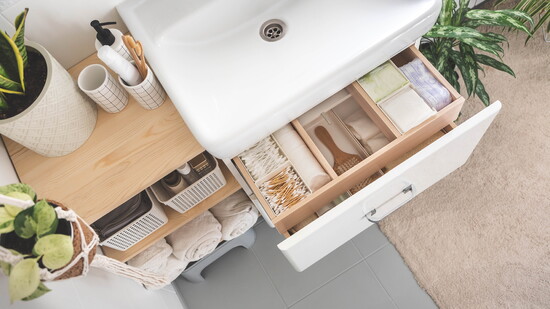
How would you describe the connection between an organized space and a peaceful mind?
Being in an organized space minimizes visual distractions and reminders of tasks to do. Reducing visual clutter reduces mental clutter, which reduces stress and enhances focus, allowing us to relax.
When you walk into a cluttered room, what’s the first thing you notice–and how do you decide where to begin?
Volume is the first thing I notice, then categories. What are the categories of things I’m seeing to be able to put “like with like,” and where do I have space to do so? Sometimes, to declutter, we just need to start in one corner and work our way around a room, making a decision about the one thing in hand – keep, get rid of, put elsewhere in the home. Alternatively, if a large category is obvious, it can be helpful to start gathering that category, such as picking up all of the trash, or all clothing, etc., to start getting “like with like.”
Why do you think organizing can feel so freeing for people once they start?
Being organized frees people from the burden of the unknown. Not knowing if they still have an item, not knowing where it is, does it still work, etc. It allows us to be free from the worry, anxiety, and wasted time of having to find things, and allows us to be in control.
Knowing where something is when someone wants it gives people real control over their home and possessions, when so much of people’s lives and the world is out of their control. When organizing, we get an immediate sense of fulfillment in a task completed, in addition to the sense of satisfaction and control, knowing what we have and where to find it.
What are some subtle ways disorganization can drain our energy or affect our mood without us even realizing it?
Visual clutter increases the stress hormone cortisol, increases blood pressure, and leads to poor sleep. When people aren’t sleeping well, energy and mood are directly affected.
If organization is a form of wellness, what “wellness habits” do you recommend people build into their routines to stay organized?
“Routine” is the keyword. One rule of organizing is “Everything has a home and the floor is never a home”. If systems can be set up for how someone lives so that everything has a home that makes sense to the owner, routines should be able to be formed for putting things away. Labels do a great job at screaming to “put something here”. If someone can push through in the beginning to learn a new routine (to put keys in the bowl, coat on the hook, etc., instead of on the bench), to follow the labels, it’ll be worth it in the end.
What’s one organizing myth you wish people would stop believing, and what’s the truth behind it?
That an organizer is going to come in and tell people to just throw it all away. We don’t! It’s more personal than that. Just getting rid of everything will likely lead to distrust and regret. Many of us prefer to re-home as much as possible and send as little as possible to the landfill. “Use it or lose it” (with the exception of a small number of sentimental items). Going through clutter and making conscious decisions about items can help remind people of things they own or help them find things they’ve been looking for.
When someone feels completely overwhelmed by their space, how do you help them shift from stuck to motivated?
Starting anywhere is better than not starting at all. Pick up one item and make a decision about that one item. We always say to break big projects down into small ones. Instead of looking at the whole room of clutter, shift to one area, maybe it’s a bookshelf, and within that, one shelf. Then focus only on the item in hand and make a decision about that one item. Once people start to see a measurable difference, it’s motivating to continue, so start anywhere, with one item, and then another…
What role does mindset play in maintaining organization–does it start with the bins, or the beliefs?
The beliefs. We often see people who continue to purchase “organizing supplies” because they aspire to organize, and it makes them feel like they’re getting somewhere. However, the execution stops them. This is where getting help to get over the hump of getting started helps. Someone can own all the organizing bins and tools in the world, but until they can use them effectively and efficiently, they’re just more clutter.
In your experience, how does simplifying a home help people make space for what really matters?
Studies continue to show that when people live in a cluttered environment, it increases the stress hormone cortisol. Once that clutter–and therefore stress–is removed, people can relax, and that allows them to focus on what matters. I’ve seen this firsthand with many of our long-time clients, and they’ve told me how much impact the difference has made on all aspects of their lives.
Anything else you’d like readers to know:
Decluttering and organizing are very personal projects. There’s not a one-solution system that can work for everyone. The general rules of organizing can be applied to all people and places, but how it’s done is very much dependent on each individual and how they function in their space.
When organizing, we get an immediate sense of fulfillment in a task completed, in addition to the sense of satisfaction and control, knowing what we have and where to find it.